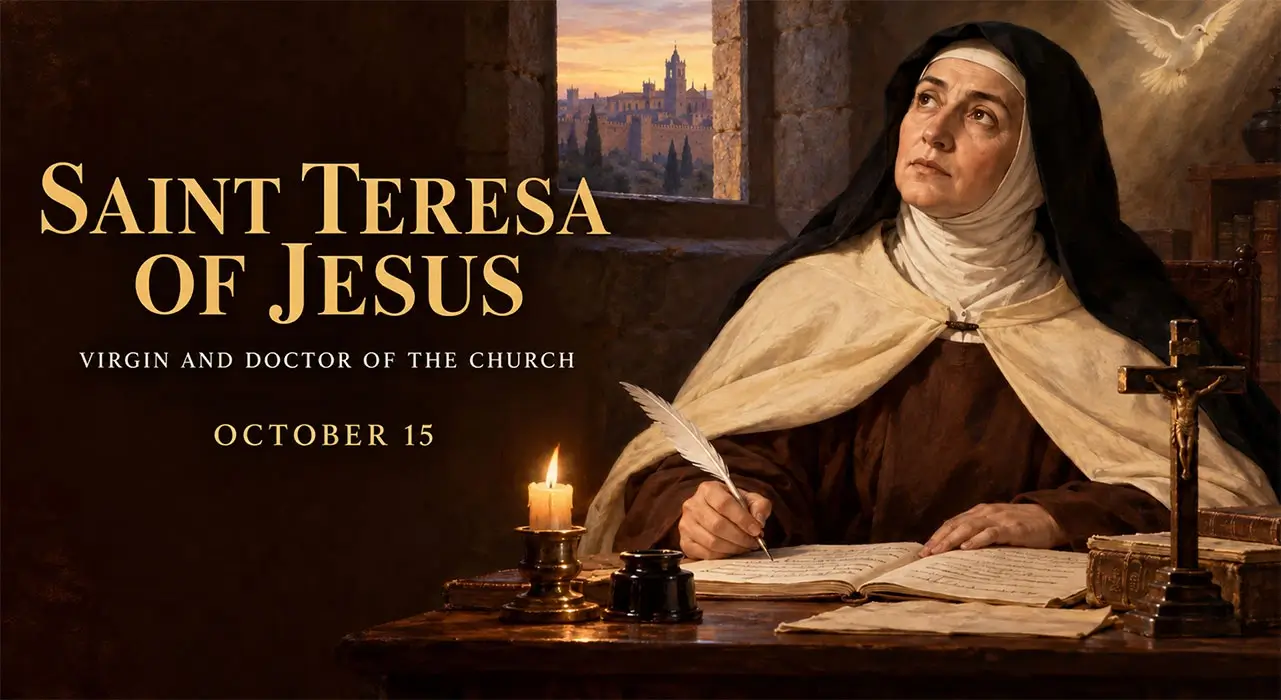
Saint Teresa of Jesus, better known as Saint Teresa of Ávila, was a Carmelite nun, reformer, mystic, writer, and one of the great teachers of Christian prayer.
She did not present prayer as an escape from ordinary responsibilities. For Teresa, prayer was a living friendship with Jesus that gradually transformed how a person loved, served, suffered, and acted within the Church.
Her memorial on October 15 invites us to ask a practical question: Do we make time to remain with the God who loves us?
Saint Teresa of Jesus or Saint Thérèse of Lisieux?
These two Doctors of the Church are sometimes confused because their names appear similar in English.
Saint Teresa of Jesus was born in Ávila, Spain, in 1515. She was a Carmelite reformer and author of works including The Book of Her Life, The Way of Perfection, and The Interior Castle. Her memorial is October 15.
Saint Thérèse of Lisieux was a French Carmelite who lived in the nineteenth century and taught the “little way” of trust and love. Her memorial is October 1.
Both were Carmelites and Doctors of the Church, but they lived in different countries and centuries and emphasized different aspects of the spiritual life.
From Ávila to Carmel
Teresa was born into a large Catholic family in Ávila. As a young woman, she entered the Carmelite Monastery of the Incarnation despite opposition from her father.
Her early religious life included long periods of illness, internal struggle, inconsistent prayer, and competing attachments. She understood from experience how easily a person can desire God while remaining distracted, divided, or discouraged.
Teresa did not become a great teacher of prayer because prayer was always easy for her. She became a teacher because she learned to persevere through difficulty and allow Christ to expose and heal what prevented deeper friendship with him.
That makes her especially valuable to people who struggle to pray consistently. Her writings do not come from theory alone. They come from years of beginning again.
Prayer as Friendship
Pope Benedict XVI highlighted Teresa’s well-known description of prayer as friendship with God, a frequent conversation in secret with the One we know loves us.
This definition is simple, but it changes how we approach prayer.
Prayer is not merely delivering requests, completing a religious obligation, or searching for a special feeling. It is spending time with a Person. It includes speaking honestly, listening, remaining silent, reading Scripture, asking forgiveness, and allowing God to change us.
Friendship also requires consistency. A relationship cannot deepen if we only approach God during emergencies. Teresa encourages a regular time and place for prayer, even when nothing dramatic seems to happen.
If quiet prayer feels difficult, the Rosary for Anxiety can provide a steady structure while an unsettled mind learns to rest in God’s presence.
The Humanity of Christ
Teresa’s mysticism was firmly centered on Jesus Christ.
She warned against forms of spirituality that try to move beyond the humanity of Jesus as though his earthly life were only a temporary stage. Christ’s Incarnation, teaching, suffering, death, and Resurrection remain essential to Christian prayer.
We do not reach God by leaving Jesus behind. We meet God through the Son who became man for our salvation.
This is one reason the Rosary works so well with Teresian spirituality. Its mysteries keep our attention on the concrete life of Christ. We contemplate him in Bethlehem, at Cana, preaching the Kingdom, carrying the Cross, and rising from the dead.
The Mysteries of the Rosary can help readers connect daily prayer with the events Teresa kept at the center of her spiritual life.
The Interior Castle
Teresa’s most famous spiritual work, The Interior Castle, describes the soul as a castle containing many dwelling places. At the center dwells God.
The image helps explain the spiritual journey. We often remain near the outer rooms, occupied by noise, distraction, self-protection, and attachment. Prayer leads us inward, not toward isolation, but toward the God already calling us into deeper communion.
The journey through the castle involves self-knowledge, humility, purification, grace, and increasing union with God. Teresa never treats this growth as a technique we control. God takes the initiative. Our task is to respond, persevere, and remain open.
The castle is not a map for comparing spiritual status. If we become preoccupied with deciding which “mansion” we occupy, we miss the point. Teresa wants us to seek God, not collect labels about ourselves.
Self-Knowledge and Humility
For Teresa, genuine prayer produces self-knowledge. The closer we come to God’s light, the more clearly we see both his mercy and our need for conversion.
This does not lead to unhealthy self-hatred. Humility means living in truth. We acknowledge our gifts without pretending they came from us alone. We admit our sins without believing they are greater than God’s mercy.
Teresa’s humor also protected her from false solemnity. She could recognize human weakness, including her own, without abandoning hope.
Prayer that makes us proud, harsh, or convinced of our spiritual superiority is not bearing healthy fruit. Authentic prayer makes us more patient, truthful, teachable, and charitable.
Reform Rooted in Prayer
Teresa lived during a difficult period for the Church. She became convinced that Carmelite life needed renewal through deeper prayer, poverty, simplicity, and community.
Her reform faced misunderstanding, criticism, practical obstacles, and opposition. She traveled across Spain founding monasteries while dealing with finances, unreliable transportation, difficult personalities, illness, and Church authorities.
This side of Teresa matters. She was not a detached visionary who ignored practical work. Her contemplation produced decisive action.
Prayer should help us face reality more honestly and serve more faithfully. It should improve the way we handle responsibilities, make decisions, treat people, and remain steady under pressure.
Readers who want to pray through her teaching can use the Saint Teresa of Ávila Novena.
Doctor of the Church
In 1970, Pope Saint Paul VI proclaimed Saint Teresa of Jesus a Doctor of the Universal Church. She was the first woman to receive the title, together with Saint Catherine of Siena shortly afterward.
The title recognizes the enduring value of Teresa’s teaching for the whole Church. Her doctrine joins deep spiritual experience with loyalty to Scripture, the sacraments, and ecclesial authority.
The official proclamation emphasized that Christ stands at the center of her teaching and that Christian prayer is a life of love.
Teresa’s authority does not come from unusual experiences alone. It comes from the holiness, wisdom, and tested Christian teaching found in her life and writings.
What Saint Teresa Teaches Us About Distraction
People often assume contemplative saints prayed without distraction. Teresa knew the mind could be noisy and difficult to control.
She did not recommend forcing the mind into emptiness. Instead, she returned to Christ, used spiritual reading, looked at a sacred image, prayed familiar prayers, and persevered.
When distraction dominates:
- Begin with a short Gospel passage.
- Tell Jesus honestly what is occupying your mind.
- Use one decade of the Rosary to become recollected.
- Sit quietly for a few minutes without demanding a particular feeling.
- End with one concrete resolution.
The guided Rosary for today can help create a repeatable prayer habit when beginning alone feels difficult.
Prayer Must Lead to Love
Teresa judged spiritual growth by its fruits. Extraordinary experiences were secondary. What mattered was growth in love of God and neighbor.
If prayer is real, it should make us more available to others. We should become more willing to forgive, complete our duties, tell the truth, accept correction, and serve without constant recognition.
This is not immediate perfection. Teresa’s life shows gradual transformation. The important thing is to keep returning to Christ and allow grace to reshape our conduct.
A Practice for October 15
Set aside fifteen quiet minutes today.
Place yourself consciously in God’s presence. Read John 15:9-17, where Jesus calls his disciples friends. Speak to him about what is actually happening in your life, including what you fear, avoid, or desire.
Then remain silent for a few minutes. Do not measure the prayer by emotion. End by choosing one act of love or responsibility to complete faithfully.
If you prefer structured prayer, offer one set of Rosary mysteries and ask Saint Teresa to help you grow in friendship with Christ. The Joyful Mysteries are especially helpful for contemplating the Incarnation and hidden life of Jesus.
Prayer to Saint Teresa of Jesus
Saint Teresa of Jesus, faithful daughter of the Church and teacher of prayer, help us grow in friendship with Christ.
Pray that we may persevere when prayer feels dry, remain humble when God grants consolation, and return quickly when distraction or sin leads us away.
Teach us to seek Jesus in Scripture, the Eucharist, and the ordinary duties of life. May our prayer produce courage, patience, truthfulness, and practical love for others.
Intercede for those who feel spiritually tired, those struggling with anxiety or illness, and those beginning again after a long absence from prayer.
Saint Teresa of Jesus, Virgin and Doctor of the Church, pray for us. Amen.
Sources
- Vatican: General Audience on Saint Teresa of Ávila
- Vatican: Proclamation of Saint Teresa of Jesus as Doctor of the Church
- Vatican: Message on Prayer and the Carmelite Reform
Related Articles