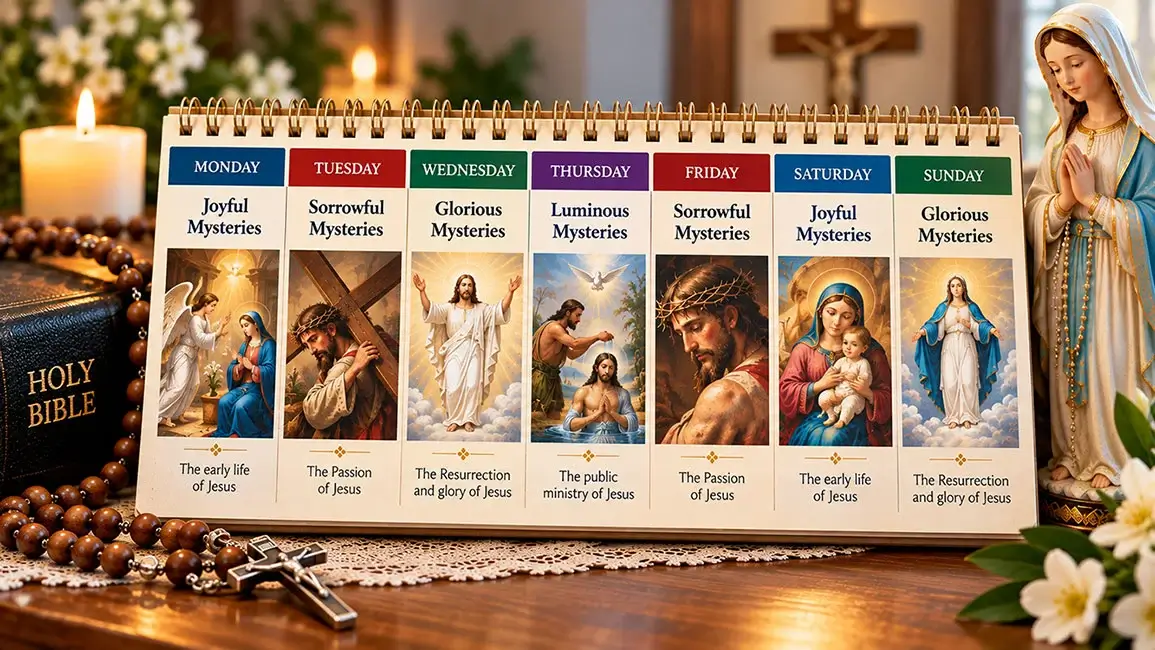
The Holy Rosary invites us to reflect on the life of Jesus Christ through the loving eyes of His Blessed Mother, Mary. Each day, Catholics around the world take up their Rosary beads to meditate on the mysteries of our salvation, remembering the joy of Christ’s birth, His public ministry, His suffering and death, and the glory of His Resurrection.
But if you are new to praying the Rosary, or simply need a reminder, you may wonder: Which Rosary mysteries should I pray today?
The Catholic Church has a widely followed weekly schedule that helps us meditate on all four sets of mysteries throughout the week.
This guide explains which mysteries are traditionally prayed each day, what each mystery represents, and how you can make the Rosary part of your daily prayer life.
Rosary Mysteries by Day: Weekly Schedule
The following schedule reflects the customary arrangement recommended by Saint John Paul II in his apostolic letter Rosarium Virginis Mariae.
| Day | Rosary Mysteries |
|---|---|
| Monday | Joyful Mysteries |
| Tuesday | Sorrowful Mysteries |
| Wednesday | Glorious Mysteries |
| Thursday | Luminous Mysteries |
| Friday | Sorrowful Mysteries |
| Saturday | Joyful Mysteries |
| Sunday | Glorious Mysteries |
This weekly arrangement allows us to contemplate different moments in the life of Jesus and Mary.
Important: The schedule is a devotional custom, not a strict obligation. Catholics may pray any set of mysteries on any day, especially when reflecting on a particular liturgical celebration or personal intention.
For example, some families choose to meditate on the Joyful Mysteries during Christmas or the Sorrowful Mysteries during Lent.
The most important thing is not following a schedule perfectly, but allowing the mysteries to draw our hearts closer to Jesus Christ.
Monday and Saturday: The Joyful Mysteries
The Joyful Mysteries invite us to contemplate the beginning of our salvation, from Mary’s acceptance of God’s will to the childhood of Jesus.
They remind us of the beauty of trust, humility, family love, and obedience to God.
The Five Joyful Mysteries
- The Annunciation (Luke 1:26-38): The Angel Gabriel announces to Mary that she will become the Mother of Jesus. We reflect on her humility and willingness to accept God’s plan.
- The Visitation (Luke 1:39-56): Mary visits her cousin Elizabeth, offering us an example of charity, generosity, and loving service.
- The Nativity of Jesus (Luke 2:1-20): Jesus is born in Bethlehem. We contemplate God’s great love and the humility of our Savior.
- The Presentation of Jesus in the Temple (Luke 2:22-38): Mary and Joseph present Jesus to the Lord, teaching us faithfulness and obedience to God.
- The Finding of Jesus in the Temple (Luke 2:41-52): Mary and Joseph find the young Jesus among the teachers in the Temple. We reflect on seeking Christ and placing Him at the center of our lives.
Prayer intention: We can offer the Joyful Mysteries for families, expectant mothers, children, those discerning God’s will, and everyone seeking renewed joy and hope.
Tuesday and Friday: The Sorrowful Mysteries
The Sorrowful Mysteries lead us through the Passion and death of Jesus Christ.
They invite us to remember the depth of His love and the sacrifice He willingly endured for our salvation.
When we pray these mysteries, we bring our own suffering, fears, and burdens before the Lord.
The Five Sorrowful Mysteries
- The Agony in the Garden (Matthew 26:36-46): Jesus prays in Gethsemane and submits Himself to the Father’s will. We ask for strength to trust God during difficult moments.
- The Scourging at the Pillar (John 19:1): Jesus suffers cruel punishment. We reflect on His sacrifice and pray for purity of heart.
- The Crowning with Thorns (Matthew 27:27-31): Jesus is mocked and crowned with thorns. We ask for humility, courage, and faithfulness.
- The Carrying of the Cross (John 19:16-17): Jesus carries His Cross toward Calvary. We pray for patience and perseverance in our daily struggles.
- The Crucifixion and Death of Jesus (Luke 23:33-46): Jesus gives His life for our salvation. We contemplate His mercy, forgiveness, and unconditional love.
Prayer intention: We can offer the Sorrowful Mysteries for the sick, those experiencing grief, people facing hardship, families in conflict, and everyone carrying a heavy cross.
These mysteries remind us that Christ understands human suffering and remains close to us in our trials.
Wednesday and Sunday: The Glorious Mysteries
The Glorious Mysteries proclaim the victory of Jesus Christ over sin and death.
They fill our hearts with hope as we meditate on the Resurrection, the coming of the Holy Spirit, and the glory of the Blessed Virgin Mary.
The Five Glorious Mysteries
- The Resurrection of Jesus (Matthew 28:1-10): Jesus rises from the dead, conquering sin and death. We ask for renewed faith and hope.
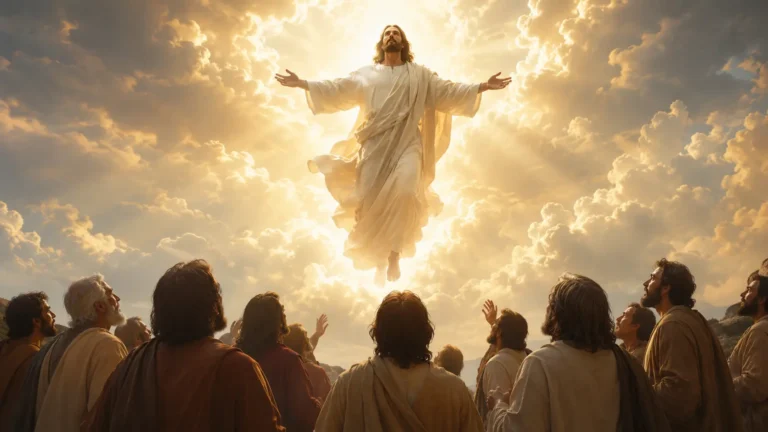
- The Ascension of Jesus into Heaven (Acts 1:6-11): Jesus ascends to the Father, promising that His disciples will receive the Holy Spirit. We reflect on our hope of eternal life.
- The Descent of the Holy Spirit (Acts 2:1-13): The Holy Spirit descends upon the Apostles at Pentecost. We ask for wisdom, courage, and openness to God’s grace.
- The Assumption of the Blessed Virgin Mary: Mary is taken body and soul into heavenly glory. We contemplate the hope of eternal life promised through Christ.
- The Coronation of Mary as Queen of Heaven and Earth: We honor Mary as Queen and Mother, asking for her loving intercession as we journey toward heaven.
The Assumption and Coronation are contemplated in the light of Catholic teaching and tradition. The Assumption is a defined dogma of the Catholic faith, while the Coronation expresses Mary’s heavenly queenship. The scriptural imagery associated with these mysteries includes Revelation 12:1.
Prayer intention: We can offer the Glorious Mysteries for the Church, the faithful departed, those who have lost hope, and families seeking renewed faith and spiritual strength.
Thursday: The Luminous Mysteries
The Luminous Mysteries, also known as the Mysteries of Light, were proposed by Saint John Paul II in 2002.
They focus on important moments in the public ministry of Jesus Christ, revealing His identity and His mission to bring salvation to the world.
The Five Luminous Mysteries
- The Baptism of Jesus in the Jordan (Matthew 3:13-17): Jesus is baptized by John the Baptist. We reflect on our own Baptism and our identity as children of God.
- The Wedding at Cana (John 2:1-11): Jesus performs His first sign, turning water into wine at Mary’s request. We reflect on trusting Christ and following Mary’s instruction to do whatever He tells us.
- The Proclamation of the Kingdom of God (Mark 1:14-15): Jesus announces the Kingdom and calls people to repentance and faith. We pray for conversion of heart.
- The Transfiguration (Matthew 17:1-8): Jesus reveals His glory before Peter, James, and John. We ask for the grace to listen to Him and follow His teachings.
- The Institution of the Holy Eucharist (Luke 22:14-20): At the Last Supper, Jesus gives us the gift of His Body and Blood. We pray for a deeper love of the Holy Eucharist.
Prayer intention: We can offer the Luminous Mysteries for priests, families, those preparing for the sacraments, and everyone seeking a closer relationship with Jesus.
Do the Rosary Mysteries Change During Advent, Lent, or Easter?
The ordinary weekly Rosary schedule remains a helpful guide throughout the liturgical year. However, Catholics may choose mysteries that reflect the particular season or celebration.
During Advent and Christmas, the Joyful Mysteries are especially fitting as we prepare for and celebrate the birth of Jesus.
During Lent, the Sorrowful Mysteries help us reflect more deeply on Christ’s Passion and the sacrifice of the Cross.
During Easter, the Glorious Mysteries invite us to celebrate the Resurrection and the hope of eternal life.
On Marian feasts and solemnities, families and prayer communities may choose mysteries that connect naturally with the celebration.
These are devotional choices rather than mandatory changes to the weekly schedule.
The Rosary is meant to deepen our meditation on Christ, not become a rigid calendar of rules.
How to Pray the Rosary Each Day
If you are beginning this devotion, the following steps provide a simple guide.
- Make the Sign of the Cross. Begin by placing yourself in God’s presence.
- Pray the Apostles’ Creed. Profess your faith in the Holy Trinity and the teachings of the Church.
- Pray one Our Father. Offer this prayer for the intentions of the Holy Father.
- Pray three Hail Marys. Traditionally offered for an increase in faith, hope, and charity.
- Pray one Glory Be. Give praise to the Father, Son, and Holy Spirit.
- Announce the first mystery. Briefly reflect on the event in the life of Jesus or Mary.
- Pray the decade. One Our Father, ten Hail Marys, one Glory Be, and the Fatima Prayer where customary.
- Continue through the remaining four mysteries. Take a moment before each decade to reflect on its meaning.
- Conclude the Rosary. Pray the Hail, Holy Queen and the concluding Rosary prayer, according to your customary practice.
- Make the Sign of the Cross. End by thanking God for the opportunity to pray.
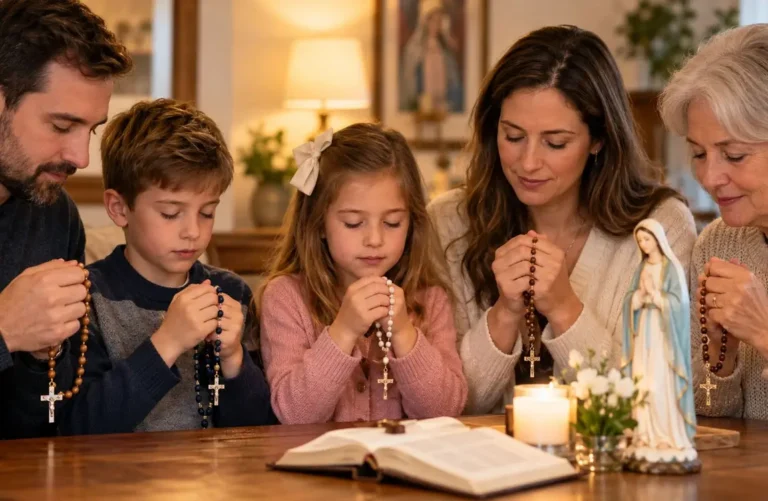
You can pray the Rosary privately, with your family, at church, or together with an online prayer community.
Making the Daily Rosary Part of Your Life
Finding time for prayer can be difficult, especially when work, family responsibilities, illness, or other concerns fill our days.
Begin with a time that works naturally with your routine.
Some people pray the Rosary early in the morning, offering the day to God before beginning their responsibilities. Others pray in the evening, entrusting their worries and loved ones to the Lord.
If you are unable to complete five decades at once, consider praying one decade at a time throughout the day.
You can also dedicate each decade to a particular intention.
For example, the first decade might be offered for your family, the second for the sick, the third for those who are struggling financially, the fourth for the Church, and the fifth for peace in the world.
Over time, the Rosary can become a familiar source of spiritual comfort and a daily reminder of God’s presence.
Pray Today’s Holy Rosary with Us
At Holy Rosary Today, we invite you to join our prayer community as we meditate on the mysteries of the Rosary each day.
You do not need to know every prayer by heart to begin. You can listen, follow along, and gradually become familiar with the words and mysteries.
Whether you are praying at home, with your family, or during a quiet moment of the day, we welcome you to pray with us.
Join our daily Holy Rosary prayers on YouTube and entrust your intentions to God through the loving intercession of the Blessed Virgin Mary.
Frequently Asked Questions About the Rosary Mysteries
What Rosary mysteries are prayed on Monday?
The Joyful Mysteries are traditionally prayed on Mondays and Saturdays. They focus on the Annunciation, Visitation, Nativity, Presentation, and Finding of Jesus in the Temple.
What Rosary mysteries are prayed on Tuesday?
The Sorrowful Mysteries are traditionally prayed on Tuesdays and Fridays. They help us meditate on the Passion and death of Jesus Christ.
What Rosary mysteries are prayed on Wednesday?
The Glorious Mysteries are traditionally prayed on Wednesdays and Sundays. They focus on Christ’s Resurrection, Ascension, Pentecost, and the heavenly glory of Mary.
What Rosary mysteries are prayed on Thursday?
The Luminous Mysteries are traditionally prayed on Thursdays. They focus on five important events during the public ministry of Jesus.
What Rosary mysteries are prayed on Friday?
The Sorrowful Mysteries are traditionally prayed on Fridays, recalling the Passion and Crucifixion of Jesus.
What Rosary mysteries are prayed on Saturday?
The Joyful Mysteries are traditionally prayed on Saturdays, a day especially associated with devotion to the Blessed Virgin Mary.
What Rosary mysteries are prayed on Sunday?
The Glorious Mysteries are ordinarily prayed on Sundays. Some devotional traditions choose the Joyful Mysteries during Advent and Christmas or the Sorrowful Mysteries during Lent.
Can I pray different Rosary mysteries on any day?
Yes. The weekly schedule is a devotional recommendation, not a requirement. You may choose any set of mysteries based on your intentions, the liturgical season, or the spiritual needs of your family.
A Closing Prayer Before Our Daily Rosary
Heavenly Father,
Thank You for the gift of the Holy Rosary, through which we remember the life, death, and Resurrection of Your beloved Son, Jesus Christ.
As we meditate on these sacred mysteries, help us grow in faith, hope, and charity. Teach us to trust You in times of uncertainty, remain faithful during suffering, and recognize Your blessings in the ordinary moments of our lives.
Through the loving intercession of the Blessed Virgin Mary, guide our families, strengthen the Church, comfort the sick, and bring peace to those whose hearts are troubled.
May each Rosary we pray draw us closer to Jesus and help us follow Him more faithfully every day.
Amen.
Our Lady of the Rosary, pray for us.
Related Articles