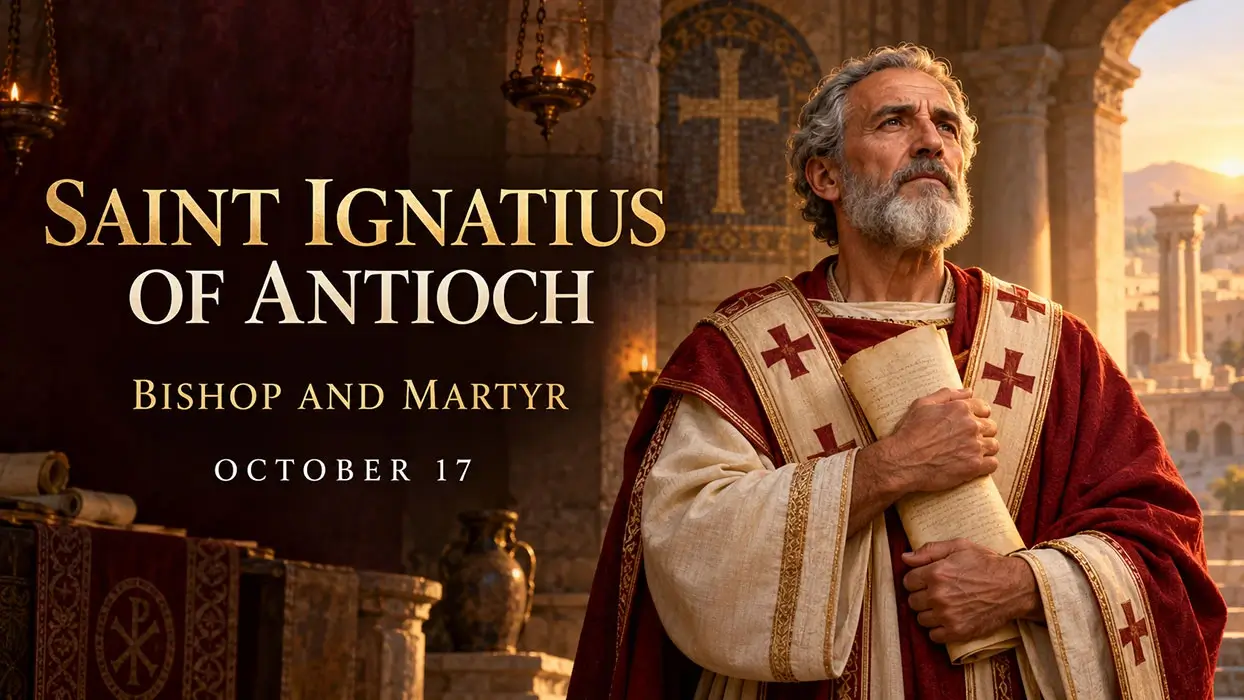
On October 17, the Church honors Saint Ignatius of Antioch, one of the earliest bishops and martyrs of Christianity. His life brings us close to the generation that followed the Apostles, when Christian communities were still small, persecution was a real danger, and believers had to decide what faithfulness to Jesus might cost them.
Ignatius did not leave behind a comfortable story. He was arrested, taken away from the people he served, and transported under guard toward Rome. Yet during that painful journey, he wrote letters filled with courage, pastoral concern, and love for Christ.
He knew death was approaching. Still, his attention was not fixed only on himself. He encouraged Christians to remain united, reject false teaching, care for one another, and stay close to Jesus in the Eucharist.
His witness asks us a direct question: Is our faith strong enough to shape how we live when following Christ becomes difficult?
Who Was Saint Ignatius of Antioch?
Saint Ignatius served as bishop of Antioch, one of the most important Christian communities of the ancient world. Antioch was the city where the followers of Jesus were first called Christians, as recorded in Acts 11:26.
Ignatius lived during the late first and early second centuries. He belonged to the age of the Apostolic Fathers, leaders who helped preserve and explain the faith received from the Apostles.
During the reign of the Roman emperor Trajan, Ignatius was arrested and condemned. He was taken from Antioch toward Rome, where he would be martyred. Along the way, Christian communities welcomed him, sent representatives to meet him, and received the letters he wrote.
Seven of those letters survive. They were addressed to the churches in Ephesus, Magnesia, Tralles, Rome, Philadelphia, and Smyrna, along with a personal letter to Saint Polycarp, the bishop of Smyrna.
These writings give us a remarkable glimpse into the faith and worship of the early Church.
A Bishop Concerned for His People
Ignatius was facing death, but he continued acting as a pastor.
His letters encouraged Christians to remain faithful to the teaching they had received. He warned them about divisions and ideas that denied the true humanity of Jesus. He reminded them that Christ truly entered human history, truly suffered, and truly rose from the dead.
This mattered because the Christian faith is not built on a distant spiritual idea. It is rooted in Jesus Christ, the Son of God who became man, accepted suffering, died on the Cross, and rose bodily from the tomb.
Pope Benedict XVI described Ignatius as a powerful witness to the true and concrete humanity of Christ. Ignatius insisted that Jesus was truly born, truly suffered, and was truly crucified for us.
That same truth remains central today. Jesus does not save us from a distance. He entered our wounded human condition and carried it through death into resurrection.
Unity Was Not Optional
One of the strongest themes in the letters of Saint Ignatius is unity.
He saw division as a serious danger to Christian communities. For Ignatius, unity was not simply everyone being polite or avoiding difficult conversations. It meant remaining united in the truth of Christ, in charity, in the Eucharist, and in communion with the bishop, priests, and deacons.
His teaching helps us see the Church as more than a collection of individuals who happen to believe similar things. The Church is a people gathered by Christ and joined together in him.
Vatican News notes that Ignatius was the first known Christian writer to use the word catholic in reference to the Church. His well-known teaching connects the presence of Christ with the gathering of the Catholic Church.
For us, this call to unity begins in ordinary places. It means refusing gossip, resisting the desire to win every disagreement, forgiving injuries, and choosing to build up the parish or community instead of quietly weakening it.
Unity does not require pretending that problems do not exist. It requires facing them with truth, humility, and love.
Saint Ignatius and the Eucharist
Ignatius spoke about the Eucharist with clarity and devotion. He opposed teachings that treated Christ’s body and suffering as appearances rather than realities. His defense of the Incarnation was closely connected to his understanding of the Eucharist.
The Jesus who truly took flesh and truly gave himself on the Cross is the same Lord who gives himself to his people.
For Ignatius, the Eucharist was central to the unity and life of the Church. Christians did not gather merely to remember an absent teacher. They gathered around the living Christ.
This gives us a practical reason to examine how we approach Mass. Do we arrive with a heart prepared to worship? Do we recognize the gift being offered? Do we allow our reception of Christ to change how we speak, forgive, serve, and make decisions?
Devotion to the Eucharist cannot remain separate from daily life. If we receive Christ, we must also learn to recognize him in the person who needs patience, mercy, protection, or practical help.
Courage During the Journey
Ignatius did not write from a place of safety. He wrote while being transported as a prisoner.
He had lost control over his destination and circumstances. He could not return to his community or continue his ministry in the way he had planned. Yet his letters show that his faith had not become passive.
He continued teaching. He continued encouraging others. He continued preparing his heart to meet Christ.
Many people know what it is like to enter a season they did not choose. Illness changes a family’s routine. Work disappears. A relationship breaks down. A responsibility becomes heavier than expected. Prayer feels dry, and the future becomes uncertain.
Saint Ignatius does not offer a shallow promise that everything will quickly become easy. His witness shows something more demanding and more durable: Christ can remain our center even when the road is not ours to choose.
A Martyr’s Desire to Belong Completely to Christ
The word martyr means witness. Christian martyrdom is not a love of pain or death. It is the final act of refusing to abandon Christ.
Ignatius desired to remain faithful to Jesus without compromise. His language can sound intense because he understood what was at stake. He was not trying to prove personal strength. He wanted his entire life, including his suffering, to belong to Christ.
Most Christians will not be asked to face literal martyrdom. Still, discipleship asks for smaller deaths each day.
We die to pride when we admit we were wrong. We die to resentment when we choose forgiveness. We die to selfishness when another person’s need interrupts our plans. We die to fear when we speak the truth with charity. We die to comfort when faith requires us to serve.
These quiet sacrifices prepare the heart for deeper faithfulness.
What Saint Ignatius Teaches Us Today
Saint Ignatius speaks clearly to a Church living in a divided and distracted age.
First, he teaches us to keep Jesus Christ at the center. Faith weakens when it becomes only a cultural label, an online identity, or a set of arguments. Christianity begins with a living relationship with the crucified and risen Lord.
Second, he teaches us to value unity. We should be careful about words and actions that create suspicion, contempt, or needless division among believers.
Third, he teaches us to treasure the Eucharist. The Mass is not one devotional option among many. It is the heart of Catholic worship, where Christ gathers and feeds his people.
Fourth, he teaches perseverance. We may not control every circumstance, but we can decide whether we will remain faithful within it.
If you are carrying a difficult intention, you can share your prayer request or learn how to offer intentions through the Rosary. When you need help returning to prayer, use this simple guide to praying the Rosary or pray today’s mysteries.
A Simple Practice for October 17
Choose one concrete act of faithfulness today:
- Attend Mass or spend time in prayer before the Blessed Sacrament.
- Pray for your bishop, priests, deacons, and parish community.
- Refuse to repeat a story that could damage another person.
- Reconcile with someone when it is safe and appropriate.
- Offer one difficult responsibility to Christ without complaining.
- Pray one decade of the Rosary for persecuted Christians.
The goal is not to perform something dramatic. It is to let love for Christ shape one real decision.
Prayer to Saint Ignatius of Antioch
Saint Ignatius of Antioch, faithful bishop and courageous martyr, pray that we may love Jesus Christ with an undivided heart.
Help us remain firm when faith becomes difficult. Teach us to protect the unity of the Church, receive the Eucharist with reverence, and serve others with humility.
Pray for bishops, priests, deacons, and all who guide the Christian community. Pray also for believers who face persecution, imprisonment, violence, or rejection because they follow Christ.
May our words and choices bear witness to the Gospel. When fear, suffering, or uncertainty enters our lives, help us remain close to Jesus and faithful until the end.
Saint Ignatius of Antioch, Bishop and Martyr, pray for us. Amen.
Sources
- Pope Benedict XVI, General Audience on Saint Ignatius of Antioch
- Vatican News, Saint Ignatius of Antioch, Bishop and Martyr in Rome
- USCCB, Readings for the Memorial of Saint Ignatius of Antioch
Related Articles