Saint Cecilia is one of the most beloved virgin martyrs of the early Church and is honored as the patron saint of music, musicians, and singers. Her story has inspired generations of Christians to remain faithful to God, even when doing so requires great courage and sacrifice.
Although many details of her life come from ancient Christian traditions rather than verified historical records, her witness continues to remind us that the deepest form of praise begins in a heart devoted to Christ.
Who Was Saint Cecilia?
Saint Cecilia was an early Christian martyr traditionally associated with Rome during the second or third century. She is remembered for her commitment to Christ, her consecrated virginity, and her courage in the face of persecution.
Her name has been honored in the Church for many centuries. She is also among the saints mentioned in the Roman Canon, one of the Eucharistic Prayers of the Catholic Mass.
Quick Facts About Saint Cecilia
| Detail | Information |
|---|---|
| Name | Saint Cecilia of Rome |
| Feast Day | November 22 |
| Title | Virgin and Martyr |
| Birthplace | Traditionally Rome, Roman Empire |
| Lived | Traditionally second or third century |
| Death | Exact date uncertain |
| Patronage | Music, musicians, singers, and church music |
| Canonization | Pre-Congregation, honored through ancient Christian veneration |
| Associated Church | Basilica of Santa Cecilia in Trastevere, Rome |
The Life of Saint Cecilia
Her Devotion to Christ
According to the traditional account of her life, Cecilia was born into a noble Roman family. Although surrounded by wealth and privilege, she developed a deep love for Christ and desired to dedicate her life entirely to Him.
Christian tradition describes Cecilia as a woman of prayer, charity, and purity. Her devotion was not simply an outward practice but a personal commitment that shaped her decisions and relationships.
Her Marriage to Valerian
The traditional story recounts that Cecilia was promised in marriage to a Roman nobleman named Valerian.
Although she had made a private vow of virginity, she entered the marriage and shared her Christian faith with her husband. According to the account, Valerian eventually received baptism, and his brother Tiburtius also became a Christian.
These events are preserved in the Passio Sanctae Caeciliae, an early devotional account that contains legendary elements and cannot be treated as a fully verified biography.
Nevertheless, the story has long been cherished for its message about the quiet influence of faith, the importance of conversion, and the courage to follow Christ.
The Martyrdom of Saint Cecilia
Christian tradition tells us that Cecilia remained steadfast during a period of persecution against Christians in Rome.
After Valerian and Tiburtius suffered martyrdom, Cecilia was reportedly arrested for refusing to abandon her faith.
The traditional narrative describes an unsuccessful attempt to kill her in a heated chamber, followed by an executioner’s attempt to behead her. She is said to have survived for three days before dying from her wounds.
The exact circumstances and date of her martyrdom remain historically uncertain. What endures is the Church’s ancient remembrance of Cecilia as a virgin and martyr who remained faithful to Christ.
Why Is Saint Cecilia the Patron Saint of Music?
Saint Cecilia’s association with music comes from the traditional account of her wedding.
As musical instruments played during the celebration, Cecilia was said to have sung silently in her heart to God.
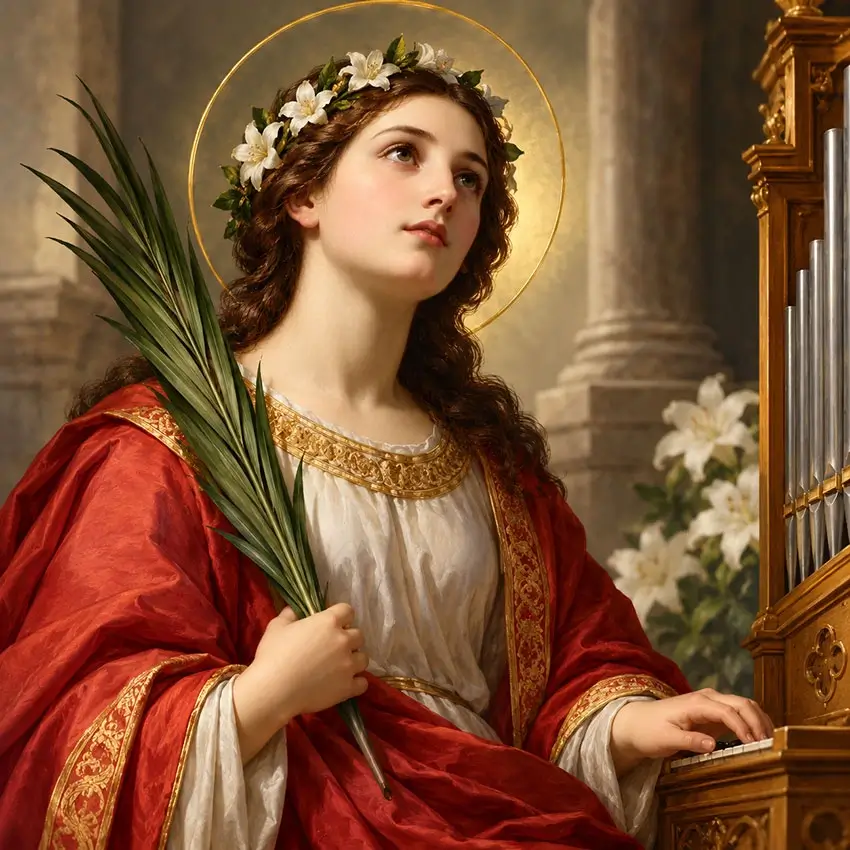
Over time, this image of interior prayer became closely associated with sacred music. From the late Middle Ages onward, artists frequently portrayed her with an organ or other musical instruments.
Her patronage reminds us that music can become more than an expression of artistic beauty. When offered with love and reverence, it can help lift our hearts toward God.
For choir members, cantors, organists, composers, and all who serve through sacred music, Saint Cecilia remains a special heavenly intercessor.
The Basilica of Saint Cecilia in Rome
The Basilica of Santa Cecilia in Trastevere is one of Rome’s historic churches dedicated to the saint.
Her veneration is closely connected with this sacred place. In the ninth century, Pope Paschal I transferred relics associated with Saint Cecilia to the basilica.
Beneath its main altar is a famous marble sculpture by Stefano Maderno depicting the saint in the traditional posture associated with her martyrdom.
The basilica remains an important place of prayer and pilgrimage for those devoted to Saint Cecilia.
What Can We Learn From Saint Cecilia?
1. Remain Faithful During Difficult Times
Saint Cecilia’s witness reminds us that faith is not limited to moments when life is peaceful or comfortable.
We are called to trust Christ even when our beliefs are challenged, our prayers seem unanswered, or following Him requires sacrifice.
2. Let Prayer Begin in the Heart
The tradition of Cecilia singing inwardly to God reminds us that prayer does not always need beautiful words or a perfect voice.
Even in silence, our hearts can offer praise to the Lord.
3. Use Our Gifts to Glorify God
Not everyone is called to sing in a choir or play a musical instrument. Yet each of us has received gifts that can be used in service to others.
Saint Cecilia encourages us to offer our talents with humility, remembering that their greatest purpose is to bring glory to God.
4. Help Others Encounter Christ
The traditional conversion of Valerian and Tiburtius reminds us that our example can influence those around us.
Through patience, charity, and a faithful Christian life, we can help others discover the love of Jesus.
Prayer to Saint Cecilia
O glorious Saint Cecilia, faithful virgin and martyr of Christ, you gave your heart entirely to the Lord and remained steadfast in your love for Him.
Pray for us, that our faith may remain strong during times of difficulty and that our hearts may always be open to God’s grace.
Intercede especially for musicians, singers, choir members, and all who serve the Church through sacred music. May their voices and talents lead others closer to Jesus and bring honor to His holy name.
Help us to recognize the gifts God has entrusted to us and to use them with humility, gratitude, and love.
Saint Cecilia, teach us to praise the Lord not only with our voices but also through the way we live each day.
Through your intercession, may our lives become a song of faith, hope, and love, offered to God our heavenly Father.
Amen.
Saint Cecilia, pray for us.
Pray the Saint Cecilia Novena
The Saint Cecilia Novena traditionally begins on November 13 and concludes on November 21, the day before her feast.
During these nine days, we can ask for her intercession for our personal intentions, for those serving in music ministries, and for a deeper love of Christ.
Frequently Asked Questions About Saint Cecilia
When is Saint Cecilia’s feast day?
Saint Cecilia’s feast day is celebrated annually on November 22 in the Catholic Church.
What is Saint Cecilia the patron saint of?
Saint Cecilia is especially known as the patron saint of music, musicians, singers, and church music.
How did Saint Cecilia die?
According to Christian tradition, Saint Cecilia was martyred in Rome after refusing to abandon her faith. The exact historical circumstances of her death are uncertain.
Why is Saint Cecilia shown with an organ?
The organ symbolizes her association with sacred music, which developed from the traditional account of her singing to God in her heart during her wedding celebration.
Was Saint Cecilia a real person?
Saint Cecilia has been venerated as an early Christian martyr since antiquity. However, much of the familiar narrative of her life comes from later accounts whose historical accuracy cannot be fully established.
Saint Cecilia’s life reminds us that true devotion is expressed not only in the prayers we speak or the hymns we sing, but also in the faithfulness with which we follow Jesus Christ.
Sources and References
- Saint Cecilia, Virgin and MartyrVatican News
- Saint CeciliaCatholic Encyclopedia