
- Feast Day
- December 3
- Saint Types
- Missionary, Priest, Religious
- Patronage Details
- Catholic missions and missionaries
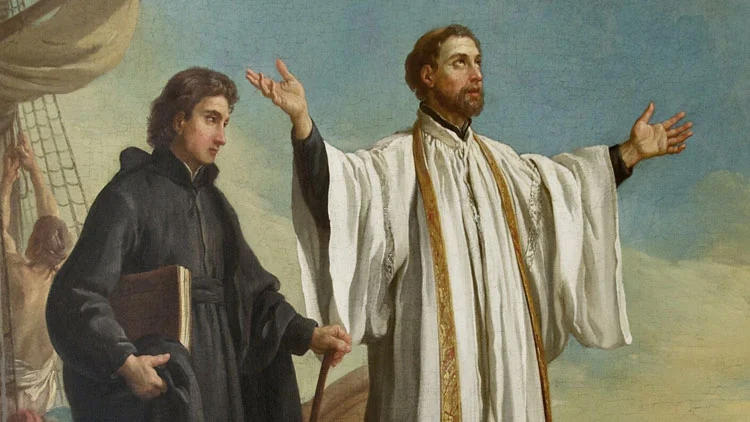
Saint Francis Xavier was a sixteenth-century Catholic priest, Jesuit missionary, and one of the most influential figures in the history of Christian evangelization.
He traveled thousands of miles to share the Gospel, serving communities in India, Southeast Asia, and Japan. His missionary journeys were marked by physical hardship, dangerous sea voyages, unfamiliar languages, and a deep desire to help others come to know Jesus Christ.
A close companion of Saint Ignatius of Loyola, Francis Xavier became one of the founding members of the Society of Jesus, commonly known as the Jesuits.
He devoted much of his priestly life to missionary service in Asia and hoped to bring the Gospel to China before his death in 1552.
The Catholic Church celebrates his feast day on December 3.
His life reminds us that Christian faith is not meant to remain hidden. We are called to share the love of Christ through prayer, service, compassion, and faithful witness.
Table of Contents
Early Life in the Kingdom of Navarre
Saint Francis Xavier was born on April 7, 1506, at the Castle of Xavier in the Kingdom of Navarre.
He belonged to a noble family and received an education that prepared him for a promising future.
His early years were shaped by the political and social changes affecting Navarre during the sixteenth century.
As a young man, Francis traveled to Paris to continue his studies.
He attended the University of Paris, where he developed a strong interest in academic achievement and personal success.
At that time, he did not yet imagine the missionary vocation that would eventually take him across the world.
His life began to change through his friendship with Ignatius of Loyola.
This relationship would become one of the most important influences on his spiritual journey.
Meeting Saint Ignatius of Loyola
While studying in Paris, Francis Xavier met Ignatius of Loyola.
Ignatius had experienced a profound religious conversion and was encouraging others to dedicate their lives to Jesus Christ.
At first, Francis was more interested in his studies and future career than in embracing a life of religious poverty and missionary service.
Over time, however, Ignatius helped him reflect more deeply on the purpose of his life.
Through their friendship, Francis began to understand that worldly success could never fully satisfy the human heart.
He gradually embraced a new desire to serve God.
Their relationship reminds us that a faithful friend can have a lasting influence on our spiritual journey.
Sometimes God works through the encouragement and example of others to help us recognize our true vocation.
Becoming One of the First Jesuits
On August 15, 1534, Francis Xavier joined Ignatius of Loyola and several companions in making religious commitments at Montmartre in Paris.
This group would become the foundation of the Society of Jesus.
The companions dedicated themselves to poverty, chastity, and service to the Church.
They hoped to place their lives at the disposal of God and respond generously wherever they were needed.
Francis was ordained a priest in Venice on June 24, 1537.
In 1540, Pope Paul III formally approved the Society of Jesus.
The Jesuits would become especially known for missionary work, education, spiritual formation, and service to the Church.
Francis Xavier became one of the earliest and most influential missionaries of the new religious order.
His Calling to the Missions
Francis Xavier’s missionary vocation developed when the Portuguese crown requested priests to serve in its overseas territories.
Ignatius of Loyola selected Francis for the mission after another companion became unable to travel.
Francis accepted the assignment and prepared to leave Europe.
In 1541, he departed from Lisbon on a long sea voyage toward India.
The journey was difficult and dangerous.
Travelers faced storms, illness, limited supplies, and months at sea.
Nevertheless, Francis continued forward with a strong desire to serve Christ.
He arrived in Goa in May 1542.
This marked the beginning of approximately ten years of missionary activity across Asia.
His willingness to leave behind familiar surroundings reminds us that following God’s call sometimes requires sacrifice and trust.
Missionary Work in Goa, India
Goa became an important center of Saint Francis Xavier’s missionary activity.
He began working among Christian communities and people who were interested in learning about the faith.
He preached, taught prayers, visited the sick, and provided religious instruction.
Francis became especially concerned about the spiritual formation of children.
He gathered young people to teach them basic Christian prayers and the foundations of the Catholic faith.
His ministry also included visiting hospitals and helping people who were poor or neglected.
Francis understood that missionary work required personal involvement.
It was not enough to preach from a distance.
He sought to meet people, understand their needs, and accompany them in their spiritual journey.
His example encourages Catholics to recognize that evangelization begins with love and genuine concern for others.
Bringing the Gospel to the Pearl Fishery Coast
Saint Francis Xavier later traveled to the Pearl Fishery Coast of southern India, where he worked among communities that included the Parava people.
Many members of these communities had already received Baptism but needed further religious instruction.
Francis devoted himself to teaching prayers, explaining Christian beliefs, and strengthening local communities.
He recognized the importance of communicating the faith in ways that people could understand.
Because he did not initially know the local languages, he relied on interpreters and worked to learn essential prayers and religious expressions.
His missionary efforts were demanding.
He traveled between villages, often under difficult conditions, and continued his ministry despite exhaustion and illness.
His work reminds us that sharing the Gospel requires patience, perseverance, and respect for the people we encounter.
Missionary Journeys in Southeast Asia
Saint Francis Xavier’s missionary journeys extended beyond India.
He traveled to Malacca and several islands in the region that is now part of Indonesia.
He visited communities in the Moluccas, where he preached, taught the faith, and encouraged local Christians.
These journeys required long voyages through unfamiliar waters.
Communication was often difficult, and living conditions could be challenging.
Francis nevertheless continued traveling because he believed the Gospel should be shared with people beyond the communities he already served.
His letters reveal both the enthusiasm and the difficulties of missionary life.
He often expressed concern about the shortage of priests and the need for better religious instruction.
His experiences demonstrate that missionary service requires more than enthusiasm.
It also demands perseverance, preparation, and a willingness to learn from others.
Saint Francis Xavier in Japan
One of the most important chapters in Saint Francis Xavier’s missionary life began when he traveled to Japan.
He arrived in 1549, accompanied by companions who helped him communicate with the Japanese people.
Japan presented new cultural and religious challenges.
Francis encountered a society with established philosophical, religious, and social traditions.
He recognized that effective missionary work required careful communication and a greater understanding of the people he hoped to reach.
He traveled to different communities, explained Christian beliefs, and engaged in discussions about faith.
His work helped establish an early Catholic missionary presence in Japan.
Although his time there was relatively brief, his efforts contributed to the development of Christian communities that would later face severe persecution.
Saint Francis Xavier’s experience in Japan reminds us that evangelization must be accompanied by patience, humility, and sincere efforts to understand others.
His Desire to Bring the Gospel to China
After his missionary work in Japan, Francis Xavier became convinced that China held great importance for the future of Christianity in East Asia.
He hoped to enter the country and begin missionary work there.
However, travel restrictions and political difficulties made the journey extremely challenging.
In 1552, Francis reached Shangchuan Island, near the Chinese mainland.
He waited for an opportunity to continue toward China.
During this period, he became seriously ill.
Despite his determination, he was unable to complete the journey.
His final days were spent far from his homeland and the communities he had previously served.
His unfinished mission reminds us that faithfulness is not measured only by visible success.
Sometimes our greatest act of trust is to continue serving God even when our plans remain incomplete.
The Death of Saint Francis Xavier
Saint Francis Xavier died on December 3, 1552, on Shangchuan Island, near the coast of China.
He was forty-six years old.
After years of difficult travel and missionary service, his life ended before he could enter mainland China.
His body was initially buried on the island.
His remains were later brought to Malacca and eventually to Goa.
Today, his relics are venerated at the Basilica of Bom Jesus in Goa, India.
Devotion to Francis Xavier spread widely after his death.
His missionary example inspired generations of priests, religious, and lay Catholics to share the Gospel throughout the world.
He was canonized on March 12, 1622, by Pope Gregory XV, alongside Saint Ignatius of Loyola and other notable saints.
Miracles Associated with Saint Francis Xavier
Saint Francis Xavier became widely associated with extraordinary events during and after his lifetime.
Traditional accounts describe healings, remarkable conversions, and other miracles attributed to his prayers.
Some stories also claim that he possessed extraordinary abilities to communicate across language barriers.
However, historical research shows that Francis frequently depended on interpreters and faced significant language difficulties during his missionary journeys.
For this reason, claims about miraculous fluency in unfamiliar languages should not be presented as established historical fact.
Devotion to Saint Francis Xavier also grew around reports concerning the preservation of his body after death.
Catholics may recognize these accounts as part of the devotional history surrounding the saint while distinguishing them from independently verifiable evidence.
His lasting example is found above all in his missionary zeal, sacrificial service, and commitment to Jesus Christ.
Saint Francis Xavier and the Blessed Virgin Mary
Saint Francis Xavier lived during a period when Marian devotion was deeply rooted in Catholic life.
As a Jesuit missionary, he belonged to a spiritual tradition that encouraged devotion to Jesus Christ and reverence for the Blessed Virgin Mary.
His missionary work included teaching essential Catholic prayers and encouraging Christian communities to grow in faith.
The Blessed Virgin Mary offers a beautiful example of obedience, humility, and trust in God’s will.
Like Mary, Francis responded to a calling that led him into an uncertain future.
He accepted hardship and placed his confidence in God’s providence.
Through Mary’s intercession, we can ask for the grace to respond generously when God calls us to serve others.
Saint Francis Xavier and the Holy Rosary
Saint Francis Xavier lived in the sixteenth century, when the Rosary was already an established Catholic devotion.
His missionary life unfolded during a period of growing Marian prayer and popular devotion.
However, we should avoid claiming that every aspect of his missionary work centered on the Rosary unless supported by specific historical sources.
His example nevertheless offers meaningful inspiration for Catholics who pray the Holy Rosary.
The Joyful Mysteries remind us of Mary’s willingness to accept God’s call and bring Jesus into the world.
The Luminous Mysteries invite us to contemplate Christ’s public ministry and the proclamation of the Kingdom of God.
These mysteries connect naturally with Francis Xavier’s missionary vocation.
He dedicated his life to proclaiming Jesus Christ and helping others grow in faith.
As we pray the Holy Rosary, we can ask God to bless missionaries, strengthen Christian communities, and help us share the Gospel through our words and actions.
We may never travel to distant countries as Saint Francis Xavier did, but every Christian is called to witness to Christ wherever God has placed us.
Patron Saint of Catholic Missions
Saint Francis Xavier is especially honored as a patron saint of Catholic missions.
His extensive travels and missionary dedication made him an enduring symbol of the Church’s evangelizing mission.
In 1927, Pope Pius XI named Saint Francis Xavier and Saint Thérèse of the Child Jesus principal patrons of the missions.
Their lives offer two complementary examples of missionary spirituality.
Francis Xavier traveled across continents to proclaim the Gospel.
Saint Thérèse lived a hidden life of prayer within a Carmelite monastery.
Both remind us that missionary work depends on the grace of God.
Some are called to serve in distant lands, while others support the mission of the Church through prayer, generosity, and faithful daily living.
Together, they show that every Catholic can participate in the Church’s mission.
Lessons We Can Learn from Saint Francis Xavier
1. Respond generously to God’s call
Francis Xavier left behind a promising academic future to dedicate his life to missionary service.
His example encourages us to place God’s will above personal ambition.
2. Share the Gospel with love
His missionary journeys remind us that evangelization should be motivated by love for Jesus Christ and sincere concern for others.
3. Remain faithful during hardship
Francis endured illness, dangerous travel, and difficult living conditions.
His perseverance encourages us to trust God when our responsibilities become challenging.
4. Respect the people we serve
His experiences in Asia show the importance of learning, listening, and communicating with patience.
Christian witness should be accompanied by humility and respect for human dignity.
5. Trust God with unfinished plans
Francis died before reaching his goal of entering mainland China.
His example reminds us that our faithfulness matters even when we cannot accomplish everything we hoped to achieve.
Prayer to Saint Francis Xavier
Saint Francis Xavier, faithful priest and courageous missionary of Jesus Christ, we ask for your intercession as we seek to grow in faith and share the love of God with others.
You traveled far from your homeland to proclaim the Gospel and serve those who had not yet heard the name of Jesus.
Pray for missionaries throughout the world, especially those serving in difficult, dangerous, or isolated places.
Intercede for priests, religious, catechists, and lay missionaries, that they may be strengthened by the Holy Spirit and guided by wisdom, humility, and compassion.
Help us to become faithful witnesses to Christ within our families, workplaces, and communities.
Pray for those who are searching for God, that they may encounter His love and discover the hope of the Gospel.
Through the loving intercession of the Blessed Virgin Mary, may we remain steadfast in prayer, generous in service, and courageous in following the Lord.
Saint Francis Xavier, pray for us, that we may bring the light of Jesus Christ to those around us.
Amen.
Frequently Asked Questions About Saint Francis Xavier
When is the feast day of Saint Francis Xavier?
The Catholic Church celebrates the feast day of Saint Francis Xavier on December 3, the anniversary of his death in 1552.
Who was Saint Francis Xavier?
Saint Francis Xavier was a sixteenth-century Catholic priest, one of the founding members of the Society of Jesus, and a missionary who preached the Gospel in parts of Asia.
Why is Saint Francis Xavier famous?
He is especially remembered for his extensive missionary journeys in India, Southeast Asia, and Japan, as well as his efforts to bring the Gospel to China.
What is Saint Francis Xavier the patron saint of?
Saint Francis Xavier is a principal patron saint of Catholic missions, together with Saint Thérèse of the Child Jesus.
Was Saint Francis Xavier a Jesuit?
Yes. He was one of the founding companions of Saint Ignatius of Loyola and became one of the earliest Jesuit missionaries.
Did Saint Francis Xavier travel to Japan?
Yes. He arrived in Japan in 1549 and helped establish an early Catholic missionary presence there.
Did Saint Francis Xavier reach China?
He reached Shangchuan Island near the Chinese mainland but died in 1552 before he could begin his intended mission within China.
Where are Saint Francis Xavier’s relics?
His remains are venerated at the Basilica of Bom Jesus in Goa, India.
When was Saint Francis Xavier canonized?
Saint Francis Xavier was canonized by Pope Gregory XV on March 12, 1622.
How is Saint Francis Xavier connected to the Holy Rosary?
Saint Francis Xavier lived during a period when the Rosary was an established Catholic devotion. His missionary example can inspire Catholics to pray for evangelization and reflect on the proclamation of the Kingdom of God in the Luminous Mysteries.
Conclusion
Saint Francis Xavier dedicated his life to bringing the Gospel of Jesus Christ to people across Asia.
His missionary journeys required courage, perseverance, humility, and a willingness to leave behind familiar comforts.
Although he died before fulfilling his desire to enter China, his faithful service left a lasting influence on the Church.
As we celebrate his feast day on December 3, may his example encourage us to share our faith with love, support the mission of the Church, and remain faithful even when our plans are uncertain.
Through the intercession of the Blessed Virgin Mary, may our prayers strengthen our commitment to Jesus Christ and inspire us to serve others with generous hearts.