Why do Catholics pray the Rosary? Why do they repeat the Hail Mary so many times? And why do they ask the Blessed Virgin Mary to pray for them when they can speak directly to Jesus?
These are sincere questions, especially for people discovering the Catholic faith or learning to pray the Rosary for the first time.
The answer begins with something important: the Holy Rosary is a prayer centered on Jesus Christ.
Through the Rosary, Catholics meditate on the life, teachings, suffering, death, and Resurrection of Jesus. We pray familiar words while reflecting on the events of the Gospel, asking the Blessed Virgin Mary to accompany us through her intercession.
Although the Rosary developed as a devotion over centuries, its central prayers and mysteries have deep connections to Sacred Scripture.
Let us explore why Catholics pray the Rosary, what the Bible teaches about its prayers, and how this devotion helps us grow closer to Christ.
What Is the Purpose of Praying the Rosary?
The purpose of the Rosary is to help us contemplate Jesus Christ and grow in faith, hope, and love.
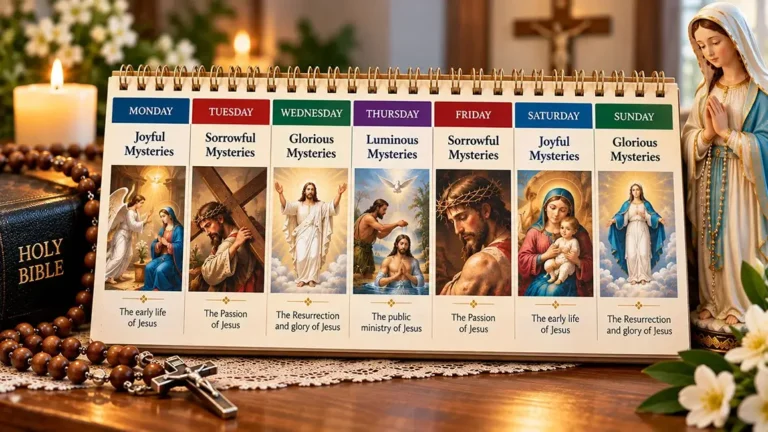
A traditional five-decade Rosary includes the Our Father, Hail Mary, Glory Be, and meditation on five mysteries from the life of Jesus and Mary.
As we pray, we remember the Annunciation, the birth of Christ, His public ministry, His Passion, and His glorious Resurrection.
The Rosary gives us a way to spend time with these events instead of simply reading about them and moving on.
Saint John Paul II explained in his apostolic letter Rosarium Virginis Mariae that the Rosary is a deeply Christ-centered prayer. He encouraged Catholics to contemplate the face of Christ in the company of His Blessed Mother.
This is why the mysteries are so important. The repeated prayers create a rhythm that helps us remain attentive to Jesus and the saving work He accomplished.
Is the Rosary Biblical?
The Rosary as a complete devotional practice is not presented as a step-by-step prayer in the Bible.
However, several of its central prayers come directly from Scripture, and most of its mysteries recall events recorded in the New Testament.
The Catholic Church understands the Rosary as a devotional way of meditating on biblical truths, not as a replacement for Scripture, the Holy Mass, or the sacraments.
1. The Our Father Comes from Jesus Himself
Scripture: Matthew 6:9-13; Luke 11:2-4
When the disciples asked Jesus to teach them to pray, He gave them the prayer we now call the Our Father or the Lord’s Prayer.
Catholics pray the Our Father at the beginning of the Rosary and before each decade.
It reminds us that all prayer is ultimately directed toward God and that we depend on Him for our daily needs, forgiveness, and spiritual protection.
2. The Hail Mary Contains Words from the Gospel of Luke
Scripture: Luke 1:28, 42
The opening portion of the Hail Mary draws from two important moments in the Gospel.
At the Annunciation, the Angel Gabriel greets Mary, whom God has chosen to become the Mother of Jesus.
Later, during the Visitation, Elizabeth blesses Mary and the child she carries.
These biblical greetings form the foundation of the first part of the Hail Mary.
The prayer continues:
“Holy Mary, Mother of God, pray for us sinners, now and at the hour of our death.”
This second portion developed within the prayer tradition of the Church. It asks Mary to intercede for us, just as Christians ask one another for prayers.
When Catholics pray the Hail Mary, the name of Jesus remains at its center.
3. The Glory Be Expresses Biblical Trinitarian Faith
Scripture: Matthew 28:19
The Glory Be praises the Father, the Son, and the Holy Spirit.
Although its exact wording is not a direct biblical quotation, the prayer expresses the Christian belief in the Holy Trinity.
In Matthew’s Gospel, Jesus commands His disciples to baptize in the name of the Father, and of the Son, and of the Holy Spirit.
The Glory Be helps us conclude each decade by directing our praise to God.
4. The Rosary Mysteries Help Us Meditate on the Gospel
The mysteries are the heart of the Rosary.
They include the Annunciation, the Nativity, the Baptism of Jesus, the Agony in the Garden, the Crucifixion, the Resurrection, and many other events in Christ’s life.
For example:
- The Annunciation: Luke 1:26-38
- The Nativity: Luke 2:1-20
- The Baptism of Jesus: Matthew 3:13-17
- The Crucifixion: Luke 23:33-46
- The Resurrection: Matthew 28:1-10
- The Descent of the Holy Spirit: Acts 2:1-13
Two Glorious Mysteries, the Assumption and Coronation of Mary, are not directly narrated as events in Scripture. They are understood through Catholic teaching and Sacred Tradition, with related biblical passages used for meditation.
Through these mysteries, the Rosary invites us to reflect on the Gospel and allow its message to shape our daily lives.
Why Do Catholics Pray to Mary?
This question often comes from a misunderstanding of what Catholics mean by asking Mary for prayers.
Catholics worship God alone.
The Church distinguishes between the worship owed to God and the honor given to Mary and the saints.
When Catholics say, “Holy Mary, Mother of God, pray for us sinners,” they are asking Mary to intercede for them.
This is different from treating Mary as a goddess or believing she possesses divine power independently of God.
Asking Mary to Pray for Us
Scripture: James 5:16; 1 Timothy 2:1
The Bible encourages Christians to pray for one another.
When a friend asks us to pray for their family, health, or personal struggles, we understand that request as an expression of shared faith.
Catholics believe that those who are united with Christ in heaven remain alive in Him and belong to the communion of saints.
For this reason, the Church teaches that the saints can intercede for those still making their earthly pilgrimage.
Mary holds a special place in this communion because she is the Mother of Jesus Christ.
Catholics do not believe Mary’s intercession replaces Christ’s unique role as our Savior and Mediator. Rather, all authentic Christian intercession depends entirely on Him.
Mary’s Example at the Wedding at Cana
Scripture: John 2:1-11
At the wedding feast in Cana, Mary notices that the hosts have run out of wine.
She brings the need to Jesus, who performs His first sign.
Mary then tells the servants to follow whatever Jesus commands.
This event offers a beautiful picture of Mary’s role in Catholic devotion.
She notices a need, brings it to her Son, and directs others to obey Him.
When Catholics ask for Mary’s intercession, they seek the same thing: to bring their needs before Jesus and follow His will.
Does Praying the Rosary Mean Catholics Worship Mary?
No. The Catholic Church teaches that worship belongs to God alone.
Mary is honored because of her unique role in salvation history and her faithful response to God’s invitation.
She is called the Mother of God because Jesus Christ, whom she bore, is truly God and truly man. This title protects the Church’s teaching about who Jesus is.
Catholics recognize Mary as a model of faith, humility, obedience, and discipleship.
The Rosary honors Mary by inviting us to contemplate the life of her Son.
A genuine Marian devotion should always lead us toward a deeper relationship with Jesus Christ.
Why Do Catholics Repeat the Hail Mary?
One of the most common questions about the Rosary concerns repetition.
In a traditional five-decade Rosary, Catholics pray 53 Hail Marys.
To someone unfamiliar with this devotion, repeating the same words may seem unnecessary.
But the purpose is not to repeat words without thought.
The Hail Mary provides a steady rhythm while we meditate on the mysteries of Christ.
Similar to the repeated responses in the Psalms and other forms of Christian prayer, familiar words can help us remain focused on God.
Didn’t Jesus Warn Against Repetitive Prayer?
Scripture: Matthew 6:7-8
Jesus warns against empty or meaningless prayer, particularly the idea that multiplying words will somehow force God to listen.
Catholics understand this warning as a rejection of vain repetition, not a prohibition against every repeated prayer.
Jesus Himself prayed repeatedly in Gethsemane, as Matthew 26:44 recounts.
The important distinction is the attitude of the heart.
We can repeat a prayer thoughtfully, allowing its words to deepen our meditation. We can also say many different words without truly directing our hearts toward God.
The Rosary invites us to pray attentively, not mechanically.
What Does the Bible Say About Meditating on God’s Word?
Meditation is an important part of biblical spirituality.
Scripture: Psalm 1:2; Luke 2:19; Philippians 4:8
Psalm 1 describes the blessed person who meditates on God’s law day and night.
Luke tells us that Mary treasured the events surrounding Jesus and pondered them in her heart.
Saint Paul encourages believers to direct their minds toward what is true, honorable, just, pure, and worthy of praise.
The Rosary brings this spirit of meditation into a structured prayer.
We reflect on what Jesus did, consider what His example teaches us, and ask for the grace to live more faithfully.
The mysteries are not simply historical scenes to remember. They invite us to respond to Christ in the present.
What Are the Spiritual Benefits of Praying the Rosary?
The Rosary is not a guarantee that every problem will disappear or that every request will be answered exactly as we wish.
Instead, it is a devotion through which we seek God’s grace and grow in Christian virtue.
A Deeper Relationship with Jesus
Meditating on the mysteries helps us become more familiar with the Gospel and the life of Christ.
Greater Trust in God
Mary’s example encourages us to trust God’s will, even when the future is uncertain.
Strength During Difficult Times
The Sorrowful Mysteries remind us that Jesus understands human suffering and remains close to those who carry heavy burdens.
Hope in the Resurrection
The Glorious Mysteries direct our hearts toward Christ’s victory over death and the promise of eternal life.
A Habit of Daily Prayer
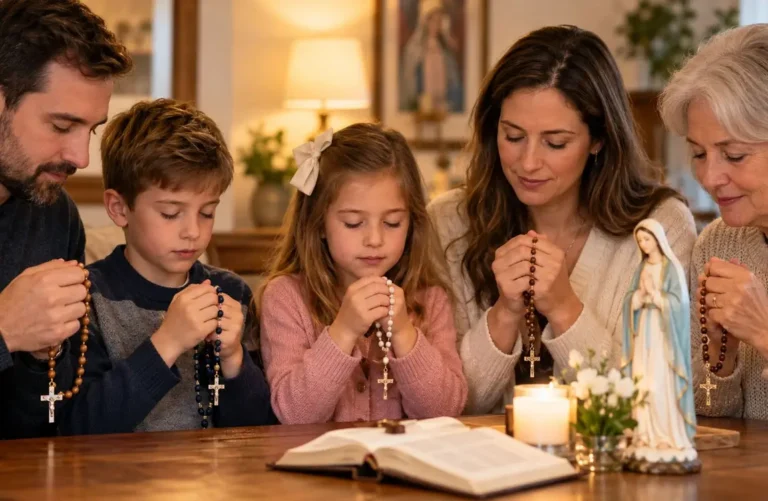
The familiar structure of the Rosary can help us establish a consistent time for prayer, whether alone or with family.
These spiritual fruits grow through God’s grace and our willingness to respond to Him.
Is Praying the Rosary Required for Catholics?
The Rosary is a highly recommended Catholic devotion, but it is not a universal obligation for every Catholic.
Catholics are called to participate in the sacramental life of the Church, especially the Holy Eucharist, and to maintain a life of prayer.
The Rosary supports that Christian life, but it does not replace the Mass, Confession, Scripture, or other essential aspects of the faith.
You can begin with one decade, pray five decades each day, or incorporate the Rosary into your family prayer routine.
The purpose is not to measure your devotion against someone else’s, but to grow closer to Christ.
How to Begin Praying the Rosary
If you are new to this devotion, start with a simple approach.
- Find a quiet moment and make the Sign of the Cross.
- Offer your Rosary for a personal intention.
- Begin with the Apostles’ Creed, Our Father, and three Hail Marys.
- Announce the first mystery and briefly reflect on its meaning.
- Pray one Our Father, ten Hail Marys, and one Glory Be.
- Continue through the remaining mysteries as you are able.
- Conclude with the traditional Rosary prayers.
You do not need to memorize everything immediately.
Our complete How to Pray the Rosary: Step-by-Step Guide for Beginners includes the full prayers, the order of the beads, and practical instructions.
Frequently Asked Questions About the Rosary
Is the Rosary mentioned in the Bible?
The Rosary as a complete devotion is not explicitly described in the Bible. However, its central prayers draw from Scripture, and most of its mysteries focus on events recorded in the New Testament.
Why do Catholics say the Hail Mary instead of only praying directly to Jesus?
Catholics do pray directly to Jesus. The Hail Mary is a request for the Blessed Virgin Mary’s intercession, not a replacement for prayer to Christ.
Is the Hail Mary a biblical prayer?
The first part of the Hail Mary is drawn from Luke 1:28 and Luke 1:42. The second part is a traditional prayer asking Mary to intercede for sinners.
Does the Bible forbid praying the Rosary?
The Bible warns against empty and meaningless prayer. It does not explicitly discuss the Rosary as a devotion. Catholics understand thoughtful repetition and meditation on Christ’s life to be consistent with biblical prayer.
Is Mary more important than Jesus in the Rosary?
No. Jesus Christ is the center of the Rosary. Mary’s role is to help lead believers toward her Son through her example and intercession.
Can someone who is not Catholic pray the Rosary?
Yes. Anyone interested in meditating on the life of Jesus and learning about Catholic prayer may pray the Rosary.
Can I pray the Rosary without understanding every mystery?
Yes. Understanding grows through prayer, Scripture reading, and reflection. Beginners can start with short descriptions of the mysteries and learn more over time.
Pray the Holy Rosary with Holy Rosary Today
The Rosary is an invitation to spend time with Jesus, to remember His love, and to allow the Gospel to shape our hearts.
Whether we are praying in gratitude, asking for healing, seeking guidance, or carrying concerns for our families, we can bring our intentions before the Lord.
At Holy Rosary Today, we welcome you to join our daily prayer community as we meditate on the mysteries of the Rosary.
Through the loving intercession of the Blessed Virgin Mary, may we grow in faith, hope, and charity and follow Jesus Christ more faithfully each day.
Our Lady of the Rosary, pray for us. Amen.
Related Articles