Annunciation Rosary Meditation — Luke 1:26-38
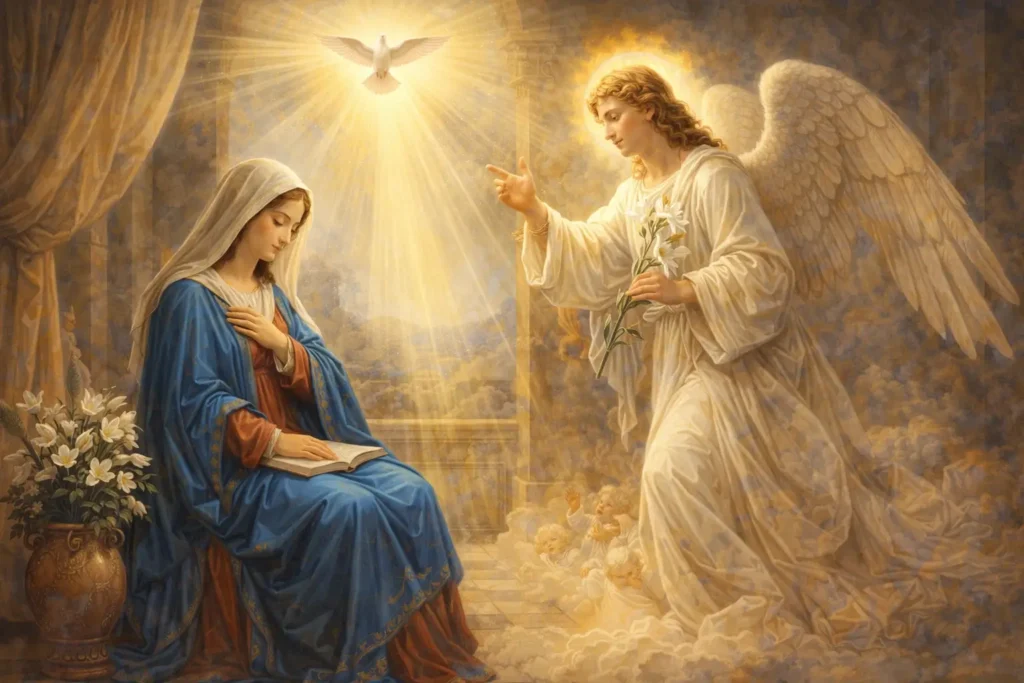
Nazareth was not a place anyone expected God to go looking. It was small and easy to overlook. People from bigger towns even joked about it. Nothing about it looked like a place heaven was watching. Yet inside that small town, in an ordinary house, an angel appeared to a young girl who had done nothing yet to earn the world’s attention. He called her full of grace.
She was troubled by this. Not by the angel showing up, but by the words themselves. Scripture is clear about this. Mary was not shaken by fear first. She was shaken by a greeting. She turned it over in her mind, wondering what kind of greeting this could be.
That small detail is worth pausing on before we go any further. It is worth carrying together into this mystery, as a group of people who gather to pray it as one.
The Scripture of the Mystery
In the sixth month, the angel Gabriel was sent from God to a town of Galilee called Nazareth, to a virgin betrothed to a man named Joseph… And coming to her, he said, “Hail, favored one! The Lord is with you.”
But she was greatly troubled at what was said and pondered what sort of greeting this might be.
Then the angel said to her, “Do not be afraid, Mary, for you have found favor with God.”
“How can this be, since I have no relations with a man?”
“The holy Spirit will come upon you… for nothing will be impossible for God.”
Mary said, “Behold, I am the handmaid of the Lord. May it be done to me according to your word.”
(Luke 1:26-38)
Meditation on the Annunciation
Gabriel’s first job is not to explain. It is to comfort. “Do not be afraid, Mary.” He says this before she has asked a single question, before she has pushed back at all. He says it because he can see what his greeting has already stirred up in her. Not terror exactly, but a kind of quiet unease. The feeling of standing somewhere she did not choose to stand.
Then comes the real news. She will have a son, and he will be called Son of the Most High, and his kingdom will never end. It is a huge thing to hear. It is also still hard to picture. It is a future she cannot yet see clearly.
What Mary does next is easy to skip past. She asks a question. “How can this be, since I have no relations with a man?” This is not the same kind of doubt that Zechariah showed just a few verses earlier, and the angel does not treat it that way either. Zechariah asked for proof. Mary asks for understanding. That is a real difference, and the Gospel seems to want us to see it. She is not stalling. She is not trying to find a way out. She simply does not yet see how this could happen to someone like her. She is young. She is not yet married. She does not have the normal way a child comes into the world. Her question comes from a mind that is wide awake, not from a will that is resisting.
Gabriel’s answer does not solve the mystery. It goes deeper into it. The Holy Spirit will come upon her. The power of the Most High will overshadow her. He gives her no method she could have guessed on her own. He only gives her a promise. Nothing is impossible for God. And as proof, he tells her about her relative Elizabeth, who was thought to be unable to have children and is now six months along. God is already at work in ways Mary could not have known before this moment.
And then the angel waits.
This part is easy to miss because the story moves quickly from her question to her answer. But everything depends on the space in between. Gabriel has given the message. God has made the invitation. Now the outcome depends on what one young woman, in one small house, in one unimportant town, decides to say. Nothing forces her answer. The Word does not become flesh because Mary has no choice. It waits on her freedom.
“Behold, I am the handmaid of the Lord. May it be done to me according to your word.”
She says this without seeing the road ahead. She does not yet know about the escape to Egypt, the years of hardship, the sword that would one day pierce her heart, or the hill outside Jerusalem. She says yes to what has been asked of her right now, not to everything that will come from it later. That is worth sitting with, because so much would happen after this moment that Mary herself could not yet see. Her yes does not end her not knowing. It is the start of walking forward without knowing everything, and trusting the one who asked.
In that one sentence, a girl from a town that nobody respected becomes, in a moment nobody else saw, the one through whom God enters the world. Nothing about this scene is loud. There is no crowd, no proof, no public sign. Just an honest question, answered honestly, and a yes given freely, in a room where only she and God knew what had happened.
The Church has never prayed this mystery alone. Every family, every parish, every small group of people holding beads returns to that room in Nazareth together, as one body remembering the moment its own story began.
Spiritual Fruit: Humility
The fruit given to this mystery is humility. Mary’s Annunciation shows what that word really means when it is not watered down into just being quiet or shy.
Humility here is not Mary making herself small. It is Mary telling the truth about who she is in front of God. She is a servant, receiving a mission she did not choose or earn, but she still asks a real question. She still brings her whole mind and her whole will into the moment. She does not disappear in front of the angel. She answers as herself.
This is closer to what humility actually is. It is not erasing yourself. It is seeing clearly. Mary knows she did not start what is happening to her. She knows the plan belongs entirely to God. And because she knows this, she does not shrink back from her part. She gives it fully. Her humility does not fight against her freedom. It is what lets her give her freedom without holding anything back. She has nothing to protect and no image of herself to guard. That is what makes her yes complete instead of half given.
Pride would have needed proof, or control, or at least a clear picture of what was coming. Mary asks how, gets an answer she still cannot fully understand, and says yes anyway. Not because she stopped thinking, but because she had already placed herself honestly in the hands of the one asking.
As a community that prays this mystery together, we carry that same posture. None of us created the faith that was handed to us. We received it, the way Mary received the angel’s word. And what is asked of us now is to answer the same way she did, together, with the same honesty and the same freedom.
How the Annunciation Meets Us Together
Most of the moments that shape a community do not come with all the details laid out ahead of time. A family faces a hard diagnosis with no map for what comes next. A parish is handed a responsibility before anyone feels ready to carry it. A door opens and asks us to walk through it together before we can see what is on the other side. In each case, the honest response as a people is closer to Mary’s than we might think. Not certainty, but a willingness to ask what needs asking, and then to answer together anyway.
There is also the weight, felt by so many of us in a room like this one, of feeling unqualified. Mary had every reasonable objection available to her. Her age. Her situation. Her lack of standing. And the angel did not argue against any of it. He simply told her what God intended to do, and let her decide whether to receive it. So often, what is asked of us as a community does not wait until we feel ready. It asks for an answer now, and the readiness, if it comes at all, comes after the yes, not before it.
There is also the waiting that follows a yes. Mary said yes to something whose full shape she could not see. Much of what that yes would cost her was still hidden from her that day in Nazareth. Faithfulness, then, is not just saying yes once, alone. It is a group of people continuing to say it together as the hidden parts of that yes become clear, one at a time, over years. It means holding one another up when the path is unclear, and remembering that none of us walks it apart from the rest.
A Prayer for the Annunciation
Lord, you did not force your Word upon Mary. You asked, and you waited for her answer.
Give us, gathered here, hearts that listen as closely as hers did. Hearts that are not too hurried, too anxious, or too sure of our own plans to hear you when you speak.
When we are troubled by what you ask of us, let us bring you our honest questions instead of a false and empty readiness. Teach us the difference between doubting you and simply not understanding yet.
Where we feel unqualified, remind us that you do not wait for us to feel ready before you call us. Give us the courage to answer before we can see the whole path, and the humility to know that the outcome was never ours alone to arrange.
Mary, you said yes without knowing all it would ask of you. Pray for us now, that our yes to God, spoken together as one body, may be as free and as whole as yours.
Amen.