Presentation Rosary Meditation — Luke 2:22-38
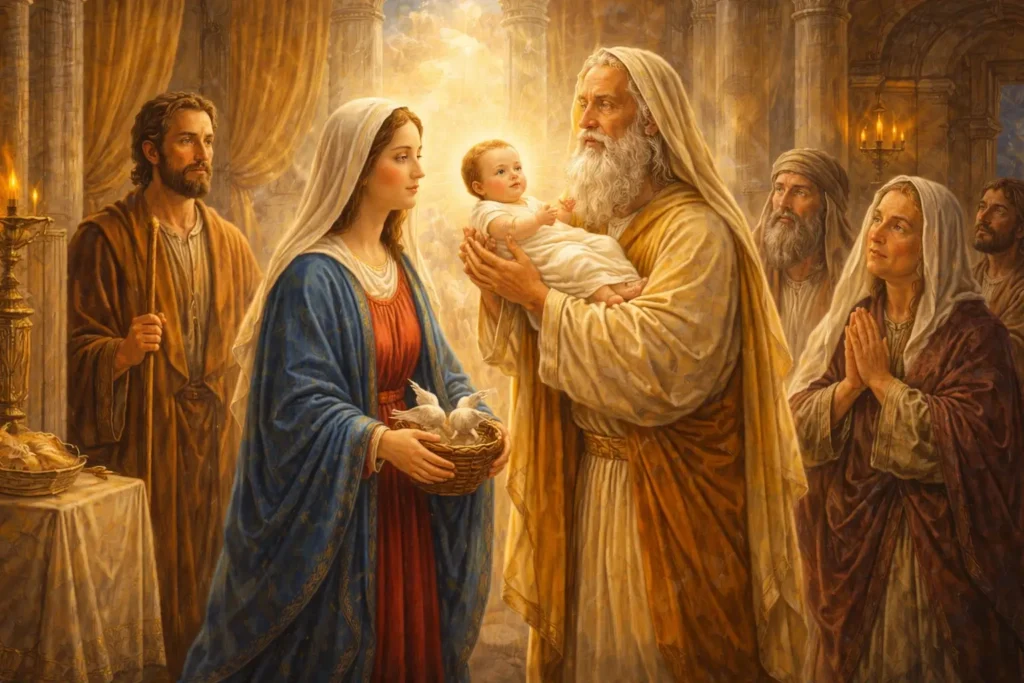
An old man had been waiting for a very long time. Scripture does not tell us how many years, only that Simeon was righteous and devout, and that he had been promised he would not die before seeing the Christ. Every day that passed without that promise being kept must have asked something of him. And then, on one ordinary morning in a crowded Temple full of people who noticed nothing unusual, he saw a young couple carrying a baby forward for the offering required by the Law, and he knew.
That is where this mystery lives. Not in a dramatic scene, but in the quiet collision between years of waiting and a moment almost no one else in the building would have looked at twice.
The Scripture of the Mystery
When the days were completed for their purification according to the law of Moses, they took him up to Jerusalem to present him to the Lord.
Simeon took him into his arms and blessed God, saying, “Now, Master, you may let your servant go in peace, according to your word, for my eyes have seen your salvation… a light for revelation to the Gentiles, and glory for your people Israel.”
Then Simeon blessed them and said to Mary his mother, “Behold, this child is destined for the fall and rise of many in Israel… and you yourself a sword will pierce.”
There was also a prophetess, Anna… She never left the temple, but worshiped night and day with fasting and prayer. And coming forward at that very time, she gave thanks to God and spoke about the child to all who were awaiting the redemption of Jerusalem.
(Luke 2:22-38)
Meditation on the Presentation
Mary and Joseph go to the Temple because the Law requires it. Nothing about their reason for being there is extraordinary. Every faithful Jewish family did the same after the birth of a firstborn son. They bring the offering allowed for those who cannot afford more: a pair of turtledoves or two young pigeons. This detail matters. The parents of the Messiah come forward not with something impressive, but with the offering of the poor, following the same requirements as everyone else that day.
They already know who their son is. The angel spoke to Mary. The angel spoke to Joseph. And still they do exactly what the Law asks of any family in their position, without asking for an exception, without expecting special treatment because of who this child truly is. Their obedience is not the obedience of people who do not yet understand. It is the obedience of people who understand completely, and choose to walk the ordinary path anyway.
Into this very ordinary scene comes Simeon. Luke tells us the Spirit had revealed to him that he would see the Christ before his death, and that same Spirit now moves him to come into the Temple at the exact moment Mary and Joseph arrive. Nothing marks this child out to the crowd around them. No sign separates this family from any other family completing the same ritual that morning. Yet Simeon comes forward, takes the child into his own arms, and recognizes what years of waiting had prepared him to see.
His words carry the weight of everything he has been holding onto. Now, Master, you may let your servant go in peace. This is not disappointment finally ending. It is fulfillment finally arriving, after enough years that letting go had become possible only because the waiting was over. He calls this child a light for revelation to the Gentiles, and glory for Israel, naming in that single moment what this small life will mean for the whole world.
Then his words turn toward Mary directly, and the mood shifts without losing its reverence. This child is destined for the fall and rise of many, he tells her, and then, and you yourself a sword will pierce. This is the first time anyone has spoken plainly to Mary about what her son’s life will cost her. It arrives not as a private warning delivered later, but inside the very moment of joy and recognition, spoken over the child still resting in Simeon’s arms. Joy and sorrow are not given to her separately. They are given together, in the same breath, from the same old man who has just called her son salvation itself.
Mary does not answer. Luke does not tell us she asks a question or protests what she has heard. She listens, as she listened at the Annunciation, taking in something she cannot yet fully understand and will carry forward regardless.
And then Anna appears. She is described carefully, a widow of great age, who never left the Temple, worshiping there night and day through fasting and prayer. She is not a minor figure who happens to be present. She is someone whose entire life has been built around this kind of waiting. When she comes forward at that very moment and recognizes the child, she does not stay silent the way Simeon’s prophecy might suggest reverent stillness would call for. She gives thanks to God, and she begins speaking about the child to everyone around her who has also been waiting for the redemption of Jerusalem. Her years of faithful presence in that Temple find their answer in this one encounter, and she responds not with private reflection alone but with open testimony.
Spiritual Fruit: Obedience
The fruit given to this mystery is obedience, and the Presentation shows what that word means when it is lived by people who already know more than obedience alone would require of them.
Mary and Joseph’s obedience is not the obedience of people following rules they do not understand. They know their son’s identity, and they still bring him to the Temple, still offer what the Law requires, still stand among ordinary families completing an ordinary ritual. Their obedience is a choice to remain within the shape of faithful life even while carrying something the rest of that life could never fully contain.
Simeon’s obedience looks different. His has been sustained across years of waiting, with no way to know when, or whether, the promise made to him would be kept within his own lifetime. His obedience is perseverance, a fidelity that continues showing up, day after day, without visible results, until the day it is finally answered.
Anna’s obedience takes the form of unbroken presence. She does not wait passively for something to happen to her. Her worship, her fasting, her prayer, all of it continues whether or not fulfillment ever arrives, because her faithfulness was never contingent on seeing the outcome first.
Together these three show obedience as something far larger than compliance. It is the willingness to keep showing up faithfully to what has been asked of you, to keep trusting even without a full view of where that trust will lead, and to keep offering what you have, however small, without knowing exactly what will be required of you next.
How the Presentation Meets Us Today
Many responsibilities carried faithfully go unnoticed by nearly everyone, the way Mary and Joseph’s obedience that day went unnoticed by most of the Temple crowd. Raising a family, caring for someone who needs constant attention, doing quiet and repeated work without recognition- these things rarely draw the eyes of the people around us. The Presentation suggests that faithfulness offered without an audience is not wasted. It may be exactly the kind of obedience that carries the most weight.
There is also Simeon’s long patience, which speaks to anyone who has been waiting years for something they were promised, without any clear sign of when it will come. His waiting did not make him bitter or careless. It kept him present, attentive, ready to recognize fulfillment the moment it finally arrived, even in a form as unremarkable as a poor family completing a ritual offering.
And there is the way joy and sorrow met in Simeon’s words to Mary, offered together rather than one after the other. Many people carry both at once, receiving good news that also asks something costly of them, welcoming a joy that arrives already touched by future difficulty. The Presentation does not separate these two experiences or promise that one will replace the other. It shows them held together, received honestly, without either one erasing the truth of the other.
A Prayer for the Presentation
Lord, Simeon waited faithfully for years without knowing when his waiting would end, and Anna never left her place of prayer.
Give me that same perseverance when what I am waiting for has not yet come, and help me stay present and attentive rather than growing careless or discouraged.
Teach me the obedience of Mary and Joseph, who followed the ordinary path even while carrying something extraordinary, without demanding a shortcut or an exception for themselves.
When joy and sorrow arrive together in my own life, help me receive both honestly, the way Mary received Simeon’s words, without turning away from either one.
Give me the courage to keep offering what I have, however small it seems, trusting that you receive it fully even when I cannot see where it leads.
Amen.