

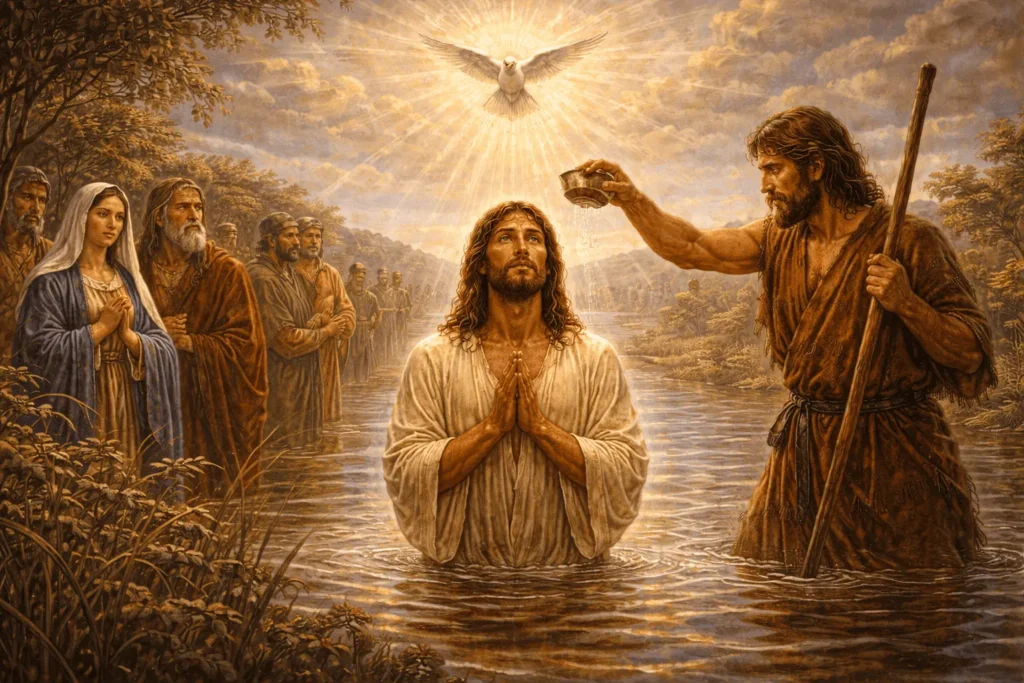
Baptism of Jesus Rosary Meditation — Matthew 3:13–17
Jesus comes to the Jordan and approaches John for baptism. John knows that something about this request is beyond the order he expected. The one before him has come to receive something from him, and he hesitates.
The first Luminous Mystery asks us to pause at the river. We watch Jesus enter the waters, and we listen as his identity is revealed. Before we follow the works of his public ministry, we are invited to attend to the love of the Father and the presence of the Holy Spirit.
The Scripture of the Mystery
Scripture summary: Jesus comes from Galilee to be baptized by John in the Jordan. John initially objects, but Jesus asks him to allow it in fulfillment of righteousness. After Jesus is baptized, the heavens open. The Spirit of God descends like a dove, and a voice from heaven identifies Jesus as the Father’s beloved Son.
Read the full passage: Matthew 3:13–17.
Meditation on the Baptism of Jesus
We often introduce ourselves through what we do. A job, a responsibility, a family role, or an achievement becomes the quickest way to explain why we matter. These things can be good, yet they become a heavy foundation when we depend on them to make us worthy of love.
This mystery turns our attention first toward relationship. Jesus is the eternal Son of the Father. The Father’s love is not a reward he earns by becoming impressive enough. As we contemplate him, we can begin to question the restless bargain by which we try to earn our own place in every room.
Jesus’ baptism is different from our own. He is sinless and has no need to be cleansed of sin. He enters the waters in solidarity with those he has come to save and in obedience to the Father’s will. His humility invites us to receive the mercy we do need, without excuses or shame that keeps us away.
For us, Baptism is a real beginning in the life of grace. We are joined to Christ and brought into the life of his Church. Whether we remember the day or received the sacrament as infants, it belongs to our story. We can return to it with gratitude and ask how its gift is shaping the life we now lead.
Much of that answer takes place outside moments that feel religious. It appears in the way we treat a difficult colleague, speak about someone who is absent, or respond to a responsibility we would rather avoid. Baptismal life reaches into the whole day because belonging to Christ reaches into the whole person.
The scene at the Jordan also draws us into wonder before the Trinity. We hear the Father, behold the Son, and contemplate the descent of the Spirit. Prayer is our response to the God who makes himself known and draws us into communion with him. We need not reduce that mystery to something small enough to manage.
We can ask for a greater willingness to receive. Some of us know how to work, organize, and provide, but feel uneasy when love is offered without a task attached. We look for something to do immediately, as though receiving itself were irresponsible. The life of grace begins by letting God give what we cannot create for ourselves.
Receiving does not leave us passive. A person secure in being loved can become freer to serve. We no longer need every kindness to prove that we are good or every success to prove that we belong. We can attend more honestly to what another person needs.
As we pray this decade, we bring our names and the names of those baptized with us into the presence of God. We remember a family larger than the circle we know personally. We ask for the grace to live as people whose deepest belonging is to Christ, and whose love is meant to make that belonging visible.
Spiritual Fruit: Openness to the Holy Spirit
Openness begins with a willingness to be addressed. We can become so full of plans, explanations, and familiar reactions that there is little room left to listen. We ask the Spirit to make us attentive to the Gospel and honest about the parts of life we have kept beyond its reach.
This openness may require a practical change in pace. We can leave a few minutes of quiet before filling the day with noise. We can read a passage of Scripture slowly enough to notice where it challenges us. We can seek wise counsel rather than treating our first impulse as a complete answer.
We also ask for the courage to act on what becomes clear. A generous thought becomes fruitful when it reaches a decision. We might reconcile with someone, return to a neglected duty, or abandon a habit we know is harmful. Openness grows through the faithful response we make today.
How the Baptism of Jesus Meets Us Today
When a role changes or an achievement disappoints us, this mystery helps us remember a deeper belonging. We can take our responsibilities seriously without asking them to carry the whole meaning of our lives. We remain people called into communion with God.
Parents and godparents can remember the promises made at Baptism. Prayer for a child can be joined to practical care: making faith visible at home, answering questions patiently, and helping the child experience the Church as a place of truth and welcome.
We can also renew our own gratitude through a simple act. When we make the Sign of the Cross or use holy water, we can pause instead of hurrying through the gesture. We remember whose life we have received and ask for grace to live the next part of the day faithfully.
A Prayer for the Baptism of Jesus
Father, thank you for sending your beloved Son and calling us into life with him. Help us receive your love with gratitude.
Jesus, you entered the waters in humility. Lead us away from pride and toward the mercy we need. Teach us to live the gift of our Baptism in ordinary choices.
Holy Spirit, make our hearts attentive. Give us wisdom to recognize the good before us and courage to respond.
Remember those preparing for Baptism, those newly baptized, and those who have grown distant from the life they received. Draw your people into deeper faithfulness and communion.
Mary, mother of Jesus, pray for us, that we may listen to your Son and follow him with willing hearts.
Amen.