Institution of the Eucharist Rosary Meditation — Luke 22:14–20
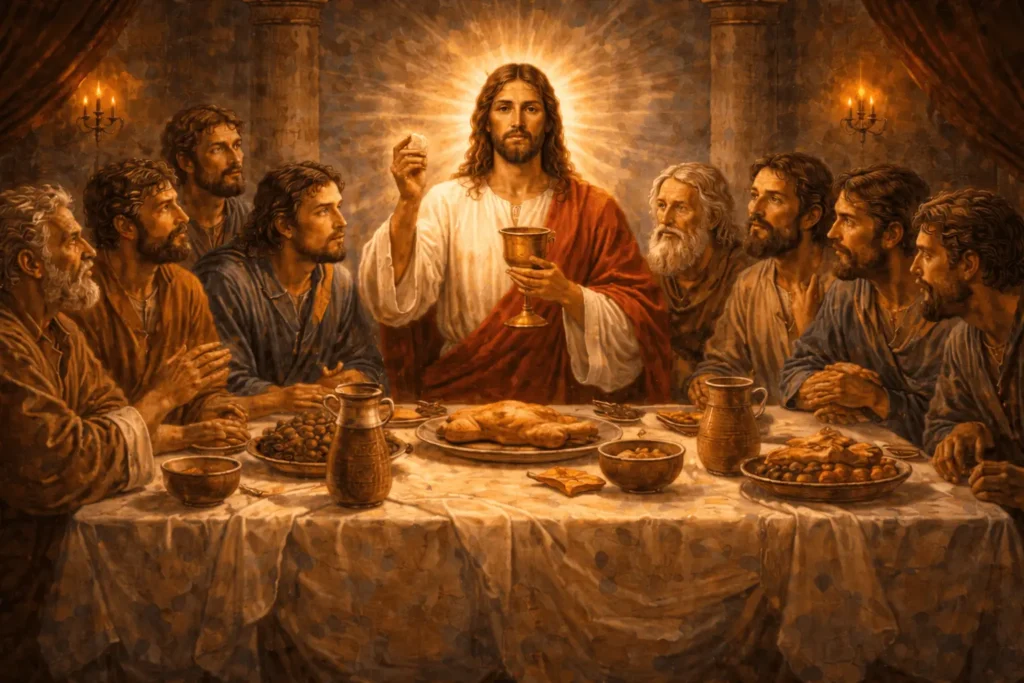
Jesus sits at table with his apostles. The hour of his Passion is near, and he gives them a meal they will not yet understand in its fullness. He takes what is before him, gives thanks, and places the gift of himself into their hands.
We come to the final Luminous Mystery with the attention such a gift asks of us. We may have received Holy Communion many times or be learning to approach the Eucharist for the first time. We ask for hearts awake to Christ, who gives himself to his Church and calls us into communion with him.
The Scripture of the Mystery
Scripture summary: At the Passover meal, Jesus speaks of his desire to share it with his apostles before his suffering. He takes bread, gives thanks, breaks it, and gives it to them as his body, offered for them, commanding them to do this in remembrance of him. He also gives the cup as the new covenant in his blood, poured out for them.
Read the full passage: Luke 22:14–20.
Meditation on the Institution of the Eucharist
An ordinary table can hold much of a family’s life. People bring their tiredness, news, disagreements, and hopes to it. Sometimes the meal is hurried. Sometimes it becomes a place of reconciliation. We learn there how much receiving and sharing can reveal about the way we belong to one another.
At the Last Supper, Jesus gives a gift beyond what any ordinary meal can contain. The Church receives his words with faith: in the Eucharist, he gives us his Body and Blood. His presence is real and sacramental, and our response begins in adoration before a mystery we cannot reduce to our own understanding.
We can approach this gift too quickly because the gestures are familiar. We know when to stand, kneel, answer, and move. Familiarity can help us pray with the Church, but it can also conceal how little attention we are bringing. This decade gives us room to ask that familiar words become a living prayer again.
Christ’s self-giving also directs us toward the cross. At Mass, the one sacrifice of Calvary is made sacramentally present; Christ is not crucified again. We are drawn into the offering through which he saves us. Our praise, repentance, work, and suffering can be united to his perfect gift to the Father. See the Catechism of the Catholic Church, 1366–1367.
This helps us bring a real life to the altar. We need not arrive with only the parts of ourselves that look orderly. We can bring a strained relationship, a difficult responsibility, a fear for someone we love, and gratitude we have not yet found words to express. We ask that our whole life be taken into a more faithful response to God.
Receiving also requires humility. We do not create the gift or possess a claim upon it through our achievements. We prepare to receive according to the Church’s teaching, examine our conscience, and seek reconciliation where it is needed. Reverence is an expression of love for the Lord who comes to us.
Some who pray this mystery cannot receive Communion at the moment. They may be homebound, far from Mass, preparing to enter the Church, or addressing something that requires pastoral guidance. They can still turn toward Christ with desire, pray for his help, and seek the support appropriate to their situation.
The Eucharist joins us to a people. We receive the Lord whose love gathers the Church, including people whose habits or opinions we find difficult. We cannot take communion with him seriously while becoming indifferent to the dignity and needs of his members.
As the decade continues, we can ask how the gift will reach the rest of our day. Will we speak more patiently? Will we make room for the hungry, lonely, or overlooked? The love we receive is meant to form the love we give. Adoration can continue through a life offered more generously to God and neighbor.
Spiritual Fruit: Love of the Eucharist
Love of the Eucharist grows through faith, attention, and time. We ask to recognize the greatness of the gift and respond with gratitude. We can prepare for Mass, listen to the readings, and allow the prayers of the liturgy to shape the intentions we bring.
This love can also lead us into quiet presence before the Blessed Sacrament. We do not need to fill every moment with a polished prayer. We can adore, give thanks, ask forgiveness, and place another person’s need before the Lord. A simple, faithful presence can become a school of trust.
Love also makes us willing to be changed. We can ask which part of our life remains resistant to Christ’s generosity. A grudge, a careless habit, or a refusal to share may become clearer when we pray before him. We receive that discovery as an invitation to cooperate with grace.
How the Institution of the Eucharist Meets Us Today
Before the next Mass, we can choose one intention to bring consciously to the altar. It may be a person, a responsibility, or an area of life in need of conversion. Taking a few quiet minutes beforehand can help us arrive with attention.
After Communion, we can make room for thanksgiving before returning to the demands of the day. We thank Jesus for his presence and ask for grace to live what we have received. Where Communion is not possible, we can make an act of spiritual communion and bring our desire to him.
We can also connect prayer with a particular act of charity. We might visit someone unable to join the community, help provide a meal, or seek peace with a person we have avoided. We ask that the Eucharist deepen a love recognizable in our treatment of others.
A Prayer for the Institution of the Eucharist
Jesus, present in the Blessed Sacrament, we adore you. Thank you for giving yourself to your Church and drawing us into the love you offer to the Father.
Awaken our attention at Mass. Teach us to prepare with humility, listen with faith, and give thanks for the gift we receive.
Remember those who cannot receive you sacramentally today. Sustain their desire, guide their next steps, and bring them faithful support.
Unite our ordinary lives to your offering. Let the love you give us become patience, reconciliation, and practical care for those in need.
Mary, mother of Jesus, pray for us, that we may receive your Son with reverence and carry his love into the world.
Amen.