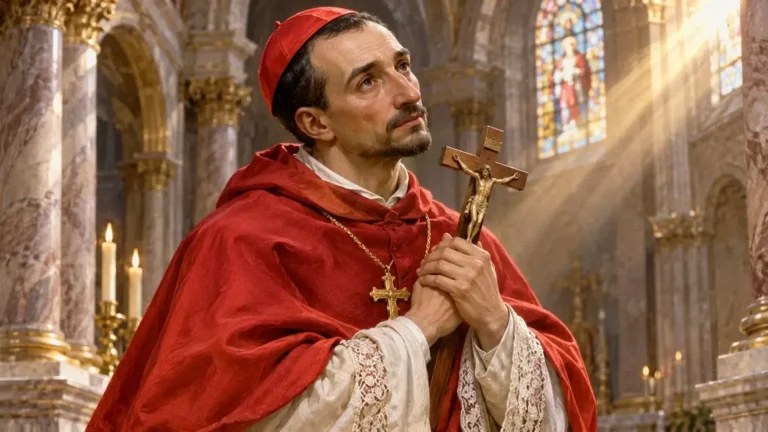
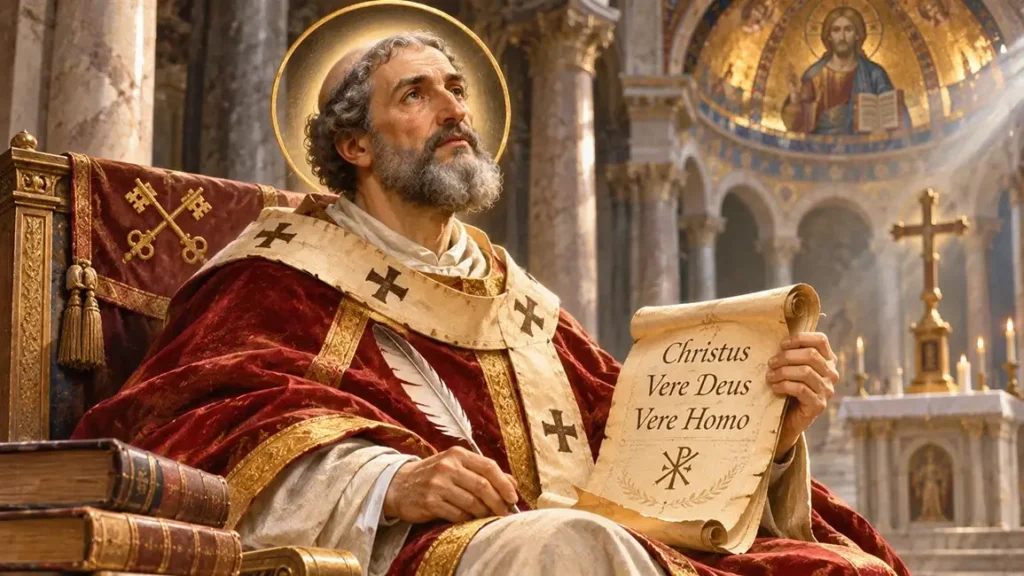
On November 10, the Catholic Church honors Saint Leo the Great, a remarkable pope, teacher, and shepherd whose courage helped guide the Church through one of the most challenging periods of its early history.
Saint Leo served as pope during the fifth century, when political instability, invasions, and theological disputes threatened both the Church and the wider Roman world.
Yet amid these difficulties, he remained steadfast in his mission.
He defended the truth about Jesus Christ, worked to preserve unity within the Church, and cared for those entrusted to his pastoral leadership.
His life reminds us that faithfulness to God requires both courage and humility.
As we commemorate Saint Leo the Great, we are invited to strengthen our faith, seek the truth with sincere hearts, and place our trust in Jesus Christ, who remains the foundation of His Church.
In this article
Quick Facts About Saint Leo the Great
- Name: Saint Leo I, commonly known as Saint Leo the Great
- Born: Probably in the late fourth century
- Birthplace: Uncertain; traditionally associated with Tuscany, Italy
- Died: November 10, 461
- Feast Day: November 10
- Papacy: September 29, 440, to November 10, 461
- Saint Type: Pope, Doctor of the Church
- Known For: Defense of the faith, the Tome of Leo, the Council of Chalcedon, and pastoral leadership during the decline of the Western Roman Empire
- Declared Doctor of the Church: 1754, by Pope Benedict XIV
- Major Work: The Tome of Leo, also known as the Letter to Flavian
- Common Symbols: Papal vestments, book, scroll, and pastoral staff
Who Was Saint Leo the Great?
Saint Leo the Great, also known as Pope Leo I, served as Bishop of Rome from 440 until his death in 461.
Although relatively little is known about his early life, he became one of the most influential leaders of the early Church.
Before his election as pope, Leo was already recognized for his administrative abilities, theological understanding, and commitment to the Church.
His pontificate began during a period of serious political and religious uncertainty.
The Western Roman Empire was weakening, and disagreements about the nature of Jesus Christ were creating divisions among Christians.
Leo understood that the Church needed strong leadership rooted in sound teaching, pastoral charity, and fidelity to the Gospel.
He dedicated himself to protecting the faith handed down by the apostles while encouraging Christians to live according to the teachings of Jesus.
The Vatican News biography of Saint Leo the Great describes his remarkable contributions as a theologian, pastor, and defender of the Church.
His leadership left a lasting influence on Catholic doctrine and the understanding of the papacy.
Why Is Saint Leo Called “the Great”?
Only a small number of popes have received the title “the Great.”
Saint Leo earned this distinction because of his extraordinary contributions to the Church during a difficult period of history.
His greatness was not based simply on political influence or administrative achievements.
It was rooted in his dedication to Christ and his responsibility as a shepherd of God’s people.
Leo worked to preserve unity within the Church, defend authentic Christian teaching, and respond to the suffering of ordinary people.
His sermons and letters reveal a leader who understood the importance of both theological truth and practical charity.
He believed that Christian teaching should transform the way believers live.
For Saint Leo, defending the faith and caring for others were inseparable responsibilities.
His example reminds us that true greatness in the Christian life is found in faithful service.
Saint Leo the Great and the Council of Chalcedon
One of Saint Leo’s most important contributions to Catholic history was his defense of the truth that Jesus Christ is both fully God and fully human.
During the fifth century, theological disagreements arose concerning the relationship between Christ’s divine and human natures.
These disputes were not merely academic.
They concerned the very identity of Jesus Christ and the mystery of our salvation.
Saint Leo addressed these questions in a famous letter to Flavian, the Patriarch of Constantinople.
This document became known as the Tome of Leo.
In it, Leo explained that Jesus Christ is one divine Person possessing both a complete divine nature and a complete human nature.
The teaching affirmed that Christ’s divinity and humanity are united without confusion or separation.
At the Council of Chalcedon in 451, the bishops affirmed the Church’s teaching concerning the two natures of Christ.
Leo’s letter played an important role in the council’s deliberations.
The historical significance of his contribution is explained in the Catholic Encyclopedia’s account of Pope Saint Leo I.
Why Does This Teaching Matter Today?
The truth that Jesus is fully God and fully human remains central to our Catholic faith.
Because Jesus is truly God, He has the power to save us.
Because He is truly human, He entered fully into our human experience, except for sin.
He experienced hunger, sorrow, suffering, and death.
He understands the struggles we face.
When we pray during difficult moments, we are not speaking to a distant Savior who is unfamiliar with human suffering.
We turn to Jesus Christ, who knows our weakness and offers us His mercy.
Saint Leo’s defense of this teaching reminds us that Catholic doctrine is not separated from our daily lives.
The truth about Christ gives meaning to our hope, our prayers, and our relationship with God.
Saint Leo the Great and Attila the Hun
One of the most famous events in Saint Leo’s life occurred in 452, when Attila the Hun threatened Italy.
Attila’s forces had already devastated several cities in northern Italy, creating widespread fear and uncertainty.
As the danger increased, Pope Leo traveled as part of a delegation to meet Attila near Mantua.
Following their meeting, Attila withdrew his forces from Italy.
The exact reasons for his withdrawal remain a matter of historical discussion, and the outcome should not be attributed solely to Leo’s intervention.
Nevertheless, the encounter became one of the most memorable examples of Leo’s courage and diplomatic leadership.
According to Vatican News, a later tradition tells of a vision involving Saints Peter and Paul during the meeting.
This account belongs to the devotional tradition surrounding Saint Leo and should be distinguished from the established historical details.
The event reminds us that courage does not always require force.
Sometimes, courage means seeking peace when others are overwhelmed by fear.
Saint Leo demonstrated a willingness to accept personal risk in his efforts to protect the people entrusted to his care.
His example encourages us to become instruments of peace within our own families, communities, and relationships.
A Shepherd Who Cared for the Poor and Vulnerable
Saint Leo’s ministry extended beyond theological disputes and political challenges.
He was deeply concerned about the spiritual and material needs of ordinary people.
During his pontificate, many families experienced poverty, insecurity, and the consequences of political instability.
Leo encouraged acts of charity and reminded Christians that love for God must be expressed through love for others.
His sermons frequently emphasized the importance of generosity, repentance, and Christian responsibility.
He understood that the Church’s mission included caring for those who suffered.
This pastoral concern is an important part of his legacy.
The Vatican’s account of Saint Leo highlights his efforts to uphold justice and practice mercy during a time of considerable hardship.
His life challenges us to recognize those who need compassion today.
We may encounter someone struggling with illness, financial difficulties, loneliness, or family problems.
Although we cannot solve every problem, we can respond with kindness, prayer, and practical assistance.
These simple acts become expressions of our faith in Christ.
Why Is Saint Leo the Great a Doctor of the Church?
The Catholic Church recognizes certain saints as Doctors of the Church because their teachings have made an important and lasting contribution to the understanding of the faith.
Saint Leo received this distinction because of his theological writings, sermons, and defense of Christian doctrine.
His teachings helped clarify the Church’s understanding of Jesus Christ and strengthened the faith of generations of believers.
He also emphasized the dignity of the Christian vocation.
For Leo, following Christ was not simply a matter of knowing religious teachings.
It required living according to the grace received through Baptism.
His sermons encouraged Christians to recognize their identity as members of Christ’s Body and to live in a manner worthy of that calling.
This message remains meaningful today.
We are called not only to understand our Catholic faith but also to allow it to shape our actions.
Through prayer, the sacraments, forgiveness, and charity, we respond to God’s invitation to holiness.
The Scripture Readings for November 10, 2026
The readings for Tuesday, November 10, 2026, invite us to reflect on faithful Christian living, humility, and service.
The readings include:
- First Reading: Titus 2:1–8, 11–14
- Responsorial Psalm: Psalm 37:3–4, 18 and 23, 27 and 29
- Gospel: Luke 17:7–10
These readings are also presented in the Vatican News Word of the Day for November 10, 2026.
First Reading: Titus 2:1–8, 11–14
In his Letter to Titus, Saint Paul emphasizes the importance of sound teaching and a life shaped by God’s grace.
He encourages believers to practice self-control, integrity, patience, and goodness.
The reading reminds us that our faith should be visible through our conduct.
Saint Leo understood this responsibility.
He defended Christian doctrine while encouraging believers to live according to the Gospel.
His example invites us to examine whether our daily actions reflect the faith we profess.
Responsorial Psalm: Psalm 37
Psalm 37 encourages us to trust in the Lord and continue doing good.
It reminds us that God remains faithful to those who place their hope in Him.
Saint Leo faced uncertainty throughout his pontificate, yet he continued fulfilling his responsibilities.
His perseverance encourages us to trust God’s guidance, especially when circumstances are beyond our control.
Gospel: Luke 17:7–10
In the Gospel, Jesus teaches His disciples about humble service.
He reminds them that faithfully fulfilling their responsibilities should not become a reason for pride.
This teaching is especially meaningful as we remember Saint Leo the Great.
Although he held one of the highest positions in the Church, his mission was fundamentally one of service.
He was called to care for God’s people, defend the faith, and remain faithful to Christ.
The Gospel invites us to serve without constantly seeking recognition.
Whether we care for our families, fulfill responsibilities at work, or help others in our communities, we can offer these acts to God with humility.
True discipleship is not measured by applause.
It is revealed through faithful love.
For more daily Bible readings, inspiring Scripture verses, and reflections to strengthen our faith, visit Verse Buddy and continue exploring God’s Word.
What Can We Learn from Saint Leo the Great?
Saint Leo’s life offers several lessons that remain relevant to our Christian journey.
Remain Faithful to the Truth
Saint Leo defended the teachings of the Church during a time of theological confusion.
His example reminds us to deepen our understanding of the Catholic faith through Scripture, prayer, and the teachings of the Church.
We are called to seek truth with humility rather than pride.
Practice Courage with Wisdom
Saint Leo demonstrated courage through both his teaching and his efforts to protect the people of Rome.
His life reminds us that courage should be guided by prudence, compassion, and a sincere desire for peace.
Serve Without Seeking Recognition
Christian service is not meant to bring personal glory.
We are called to help others because we recognize Christ’s presence in them.
Small acts of kindness, performed with love, can become meaningful expressions of holiness.
Protect Unity Within the Church
Saint Leo understood the importance of communion among Christians.
His example encourages us to pray for unity, avoid unnecessary division, and approach disagreements with charity.
Trust Christ During Difficult Times
Leo lived through political instability, conflict, and uncertainty.
Yet his hope remained rooted in Jesus Christ.
When we face challenges in our own lives, we can remember that Christ remains faithful even when circumstances change.
Praying the Holy Rosary on the Memorial of Saint Leo the Great
On Tuesday, November 10, 2026, we traditionally meditate on the Sorrowful Mysteries of the Holy Rosary.
These mysteries invite us to contemplate the suffering, sacrifice, and redeeming love of Jesus Christ.
They also remind us of the truth Saint Leo defended: Jesus is truly God and truly human.
Through His Passion, Christ entered into the depths of human suffering and offered Himself for our salvation.
As we pray the Sorrowful Mysteries, we can offer our intentions for the Holy Father, bishops, priests, and all who serve the Church.
We can also pray for unity among Christians, courage during difficult times, and peace in communities affected by conflict.
Through the intercession of the Blessed Virgin Mary and Saint Leo the Great, may we remain faithful to Christ and grow in humility and love.
Join our prayer community at Holy Rosary Today as we meditate on the Sorrowful Mysteries and entrust our intentions to Jesus through the intercession of His Blessed Mother.
A Prayer for the Memorial of Saint Leo the Great
Heavenly Father,
On this Memorial of Saint Leo the Great, we give You thanks for the life of a faithful shepherd who defended the truth of Your Son and guided the Church through times of uncertainty.
Through his courage, wisdom, and dedication, we are reminded that our faith must remain firmly rooted in Jesus Christ.
Lord, we acknowledge the moments when fear, confusion, or discouragement weaken our trust in You.
Sometimes we struggle to understand Your will.
At other times, we find it difficult to remain patient, humble, and faithful when life becomes challenging.
Renew our hearts and strengthen our desire to follow You.
Through the intercession of Saint Leo the Great, we pray for the Holy Father, our bishops, priests, and all who carry responsibilities within the Church.
Grant them wisdom to teach the truth, courage to defend the faith, and humility to serve Your people with compassion.
Protect the unity of Your Church.
Heal divisions, soften hardened hearts, and guide us toward greater understanding and charity.
We also remember those who suffer because of conflict, injustice, poverty, and uncertainty.
May Your mercy bring comfort to the afflicted, peace to troubled communities, and hope to those who feel forgotten.
Blessed Virgin Mary, Mother of the Church, we ask for your loving intercession.
Help us remain close to your Son, especially when our faith is tested.
Teach us to contemplate His suffering with gratitude and to follow His example of humility and selfless love.
Lord Jesus, You are truly God and truly man, our Savior and Redeemer.
Strengthen our faith in Your saving love.
May the example of Saint Leo inspire us to seek the truth, serve others faithfully, and remain steadfast in our Christian vocation.
Lead us closer to Your Sacred Heart, so that our lives may reflect Your peace, mercy, and holiness.
Through Christ our Lord. Amen.
Saint Leo the Great, pray for us.
How Can We Honor Saint Leo the Great Today?
We can honor Saint Leo the Great by deepening our knowledge of the Catholic faith and responding to God’s call with humility.
Attending Holy Mass, reading Scripture, and spending time in prayer are meaningful ways to observe his memorial.
We can also offer special prayers for the Pope, bishops, priests, and all who serve the Church.
Another way to honor Saint Leo is by practicing charity toward those who are struggling.
We may encourage someone who feels discouraged, help a family in need, or seek reconciliation in a relationship affected by misunderstanding.
We can also pray the Holy Rosary, asking the Blessed Virgin Mary to strengthen our faith and guide us closer to Jesus.
These acts remind us that Christian faith is not simply something we profess.
It is something we are called to live.
A Closing Reflection: Courage Rooted in Christ
Saint Leo the Great lived during a period of uncertainty and conflict.
Yet he remained faithful to his mission.
He defended the truth about Jesus Christ, sought peace during dangerous times, and encouraged Christians to live with charity and humility.
His life reminds us that the strength of the Church does not come from human power alone.
It comes from Jesus Christ, who continues to guide His people.
We may face difficulties that challenge our faith, test our patience, or leave us uncertain about the future.
But we are never called to face these struggles without God’s grace.
Through prayer, the sacraments, and the intercession of the saints, we can continue growing in faith.
As we commemorate Saint Leo the Great, may we remember that courage is not the absence of fear.
It is the willingness to remain faithful to Christ even when the path becomes difficult.
Saint Leo the Great, Pope and Doctor of the Church, pray for us.
Our Lady, Mother of the Church, pray for us.
Related Articles