- Feast Day
- November 11
- Saint Types
- Bishop
- Patronage
- Soldiers
- Patronage Details
- Soldiers, conscientious objectors, beggars, and several communities and professions
- Invoked For
- Sharing his cloak with a poor man, monastic life, missionary preaching, and service to the poor
Saint Martin of Tours was a fourth-century Catholic bishop, former Roman soldier, and one of the most beloved saints of the early Church.
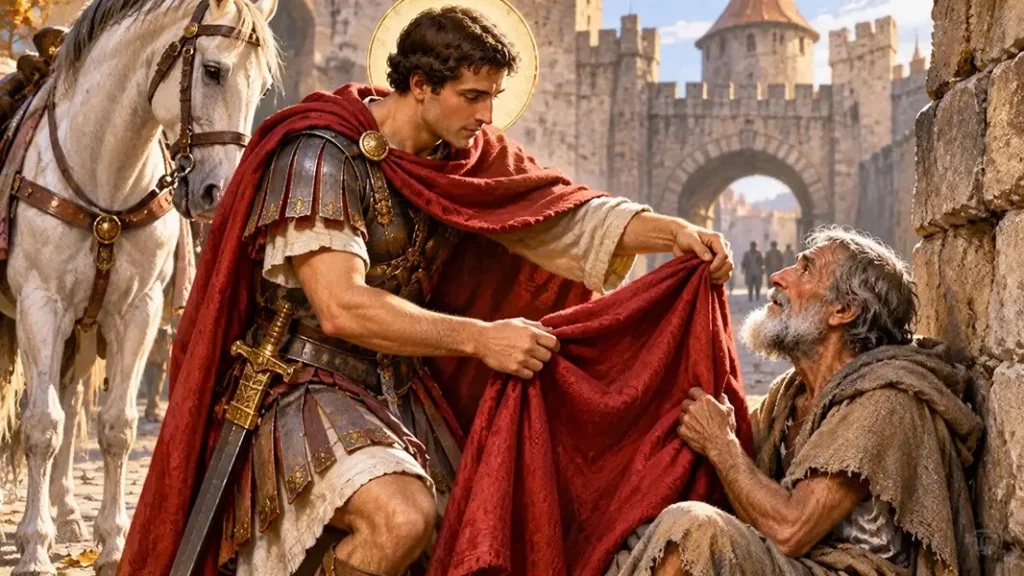
He is best remembered for a remarkable act of charity: sharing his military cloak with a poor man who was suffering in the cold. According to an early account of his life, Martin later saw Jesus Christ in a dream wearing the portion of the cloak he had given away.
This experience became a defining symbol of his Christian vocation.
After leaving military service, Martin embraced a life of prayer, simplicity, and service. He later became Bishop of Tours in present-day France, where he worked to spread the Gospel and strengthen the faith of Christian communities.
His life reminds us that following Jesus means recognizing His presence in the poor, the sick, and those who are often overlooked.
The Catholic Church celebrates his feast day on November 11.
Early Life and Childhood
Saint Martin of Tours was born around AD 316 or 317 in Sabaria, a city in the Roman province of Pannonia.
His father served as an officer in the Roman army, and Martin grew up in a military family.
During his childhood, his family moved to Ticinum, now known as Pavia, in northern Italy.
Although his parents were not Christians, Martin became interested in Christianity while still young.
According to his early biographer, Sulpicius Severus, Martin desired to become a catechumen, someone preparing to receive Baptism.
However, his father’s military background and the expectations placed upon him influenced the direction of his early life.
As the son of a Roman soldier, Martin entered military service while still young.
Yet even as a soldier, he showed an unusual concern for those who were poor and vulnerable.
His growing Christian faith would eventually transform his understanding of service, sacrifice, and the purpose of his life.
Saint Martin and the Beggar: The Story of the Divided Cloak
The most famous event in Saint Martin’s life took place while he was serving as a Roman soldier.
According to Sulpicius Severus, Martin was approaching the city of Amiens during a bitterly cold winter.
Near the city gate, he encountered a poor man who was inadequately clothed and suffering from the cold.
Others had passed by without helping him.
Martin had little left to give, so he took his sword and divided his military cloak into two pieces.
He gave one portion to the beggar and kept the other for himself.
That night, Martin experienced a dream in which he saw Jesus Christ wearing the portion of the cloak he had given away.
In the account, Jesus revealed to the angels that Martin, still a catechumen, had clothed Him.
This experience reflected the teaching of Jesus in Matthew 25:40, where Christ identifies Himself with those who are hungry, thirsty, sick, imprisoned, and in need.
For Martin, the poor man was not simply someone who needed assistance.
He was a person in whom Martin could encounter Christ.
The story of the divided cloak became a lasting symbol of Christian charity.
It reminds us that even a small act of kindness can have profound spiritual meaning when it is offered with love.
Baptism and Leaving Military Service
After the experience at Amiens, Martin continued his journey toward full Christian discipleship.
He was baptized while still serving in the Roman army.
Eventually, he sought to leave military service so that he could dedicate himself more completely to Jesus Christ.
His early biography describes his reluctance to participate in warfare and his desire to serve Christ rather than pursue a military career.
The precise chronology of his departure from the army is debated by historians, but his commitment to a religious vocation became increasingly clear.
Martin’s decision was not simply a rejection of one profession.
It represented his desire to place his whole life at the service of God.
His example encourages us to examine our own priorities and ask whether our choices reflect the teachings of Jesus Christ.
His Spiritual Formation Under Saint Hilary of Poitiers
After leaving military service, Martin became associated with Saint Hilary, Bishop of Poitiers.
Saint Hilary was a respected defender of Catholic teaching during the theological controversies of the fourth century.
Under his guidance, Martin grew in his understanding of the Christian faith and his desire for a life of prayer.
Martin also traveled to other regions, including his homeland, where early accounts describe his efforts to share the Christian faith.
During this period, he faced opposition and hardship.
Nevertheless, he remained committed to following Christ.
His relationship with Saint Hilary helped shape his spiritual life and prepared him for the responsibilities he would later assume as a bishop.
Founder of an Early Monastic Community
Saint Martin became one of the important figures in the development of Western monasticism.
Around AD 360, he established a religious community at Ligugé, near Poitiers.
There, Martin and his companions embraced a life centered on prayer, simplicity, spiritual discipline, and Christian fellowship.
The community is often regarded as one of the earliest monastic foundations in Western Europe.
Martin believed that a life of prayer should lead to deeper love for God and greater concern for others.
He sought to imitate the humility and simplicity of Jesus Christ.
His monastic life also influenced his later ministry as a bishop.
Even when entrusted with greater authority, he continued to value simplicity, prayer, and detachment from worldly honors.
Becoming Bishop of Tours
In approximately AD 371, Martin was chosen to become Bishop of Tours.
According to traditional accounts, he was reluctant to accept the position because he preferred the simplicity of monastic life.
Nevertheless, he eventually accepted the responsibility of serving the Church as a bishop.
Unlike some religious leaders of his time, Martin continued living simply.
He did not seek the comforts or privileges associated with his position.
Instead, he devoted himself to preaching, pastoral care, and missionary work.
He traveled through the countryside, encouraging people to abandon pagan practices and embrace the Christian faith.
He also established religious communities and strengthened the spiritual life of the people entrusted to his care.
His example reminds us that Christian leadership should be rooted in humility and service rather than personal recognition.
The Monastery of Marmoutier
After becoming Bishop of Tours, Saint Martin established a monastic community at Marmoutier, near the city.
The monastery became an important center of prayer, spiritual formation, and missionary activity.
Martin and his companions lived with simplicity and devoted themselves to prayer and religious discipline.
The community helped prepare men for service in the Church.
Many who were influenced by Martin’s example later became important Christian leaders.
Marmoutier reflected Martin’s conviction that pastoral ministry must be supported by a deep life of prayer.
His example remains relevant for priests, religious communities, and lay Catholics who seek to balance active service with spiritual growth.
Saint Martin of Tours and the Poor
Throughout his life, Saint Martin demonstrated a special concern for people experiencing poverty and suffering.
The story of the divided cloak was not an isolated expression of kindness.
It reflected a broader commitment to living the Gospel through charity.
As a bishop, Martin sought to remain close to ordinary people.
He valued simplicity and was known for his willingness to assist those who needed help.
His life reminds us that Christian charity does not depend entirely on material wealth.
We can share our time, attention, encouragement, food, clothing, or other resources according to our circumstances.
Sometimes the greatest gift we can offer is simply to recognize another person’s dignity and respond with compassion.
Saint Martin teaches us that love becomes meaningful when it is expressed through action.
Miracles Associated with Saint Martin of Tours
Saint Martin became known during his lifetime for extraordinary events attributed to his prayers.
His early biographer, Sulpicius Severus, described accounts of healing, deliverance from evil, and other remarkable occurrences.
Some stories recount the restoration of seriously ill people and even the raising of the dead.
These accounts contributed to Martin’s widespread reputation for holiness.
However, because these events are preserved in ancient hagiographical writings, they should be understood within their historical and devotional context.
Not every detail can be independently verified using modern historical methods.
For Catholics, the enduring significance of Saint Martin’s life is not limited to miraculous stories.
His faith, humility, charity, and commitment to Jesus Christ remain the strongest examples of his holiness.
Saint Martin and His Defense of Mercy
Saint Martin was also remembered for his opposition to the use of harsh civil punishment against people accused of religious error.
During the controversy surrounding Priscillian and his followers, Martin urged that the accused should not be executed.
He believed that matters of faith should not be addressed through bloodshed.
Although the controversy was complex and involved both religious and political authorities, Martin’s efforts reflected his concern for mercy and the proper exercise of pastoral authority.
His example reminds us that defending the truth must never become an excuse for cruelty.
Christian conviction should be accompanied by justice, compassion, and respect for human dignity.
Saint Martin of Tours and the Blessed Virgin Mary
Saint Martin lived in the fourth century, during the early development of Christian devotional traditions.
His surviving biography does not provide detailed evidence of a particular Marian devotion comparable to later Catholic practices.
Nevertheless, his life reflects virtues beautifully exemplified by the Blessed Virgin Mary.
Like Mary, Martin responded to God’s call with faith and humility.
He placed his trust in divine providence and sought to serve without seeking personal glory.
His willingness to share his cloak with a poor man reflects the same spirit of charity that Catholics are called to imitate through Mary’s example.
As we reflect on Saint Martin’s life, we can ask the Blessed Virgin Mary to help us recognize Jesus in those who suffer and respond with generous hearts.
Saint Martin of Tours and the Holy Rosary
Saint Martin of Tours lived many centuries before the Holy Rosary developed into its familiar form.
For this reason, it would not be historically accurate to describe him as a promoter of the modern Rosary.
However, his life offers meaningful reflections for Catholics who pray the mysteries of Jesus Christ.
The Joyful Mysteries invite us to contemplate the humility of the Son of God, who entered the world in poverty and simplicity.
The Sorrowful Mysteries remind us of Christ’s sacrificial love for humanity.
And the Glorious Mysteries encourage us to live with hope in the victory of Jesus over sin and death.
Saint Martin’s act of sharing his cloak reflects the charity to which Christ calls every disciple.
As we pray the Holy Rosary, we can ask for the grace to recognize Jesus in our neighbors and to respond to their needs with patience, generosity, and compassion.
Prayer should not end when we finish the final Hail Mary.
It should continue through the way we live and serve others.
His Final Years and Death
Saint Martin continued serving as Bishop of Tours into old age.
Despite the demands of his ministry, he remained committed to prayer, pastoral visits, and the spiritual needs of his people.
In 397, while visiting the community at Candes, Martin became seriously ill.
He died there on November 8, 397.
His body was brought to Tours, where he was buried on November 11.
This date became his liturgical feast day.
Devotion to Saint Martin spread widely throughout Europe, and his tomb became an important destination for Christian pilgrims.
He is remembered as one of the first widely venerated saints in the Western Church who was not honored primarily as a martyr.
His example helped shape the Church’s understanding of holiness through faithful pastoral service, monastic life, and Christian charity.
Lessons We Can Learn from Saint Martin of Tours
1. Recognize Jesus in those who suffer
Saint Martin’s encounter with the beggar reminds us that Christ identifies Himself with people in need.
When we help the poor, the sick, and the forgotten, we respond to Jesus’ call to love our neighbors.
2. Give generously, even when you have little
Martin did not have an abundance of possessions when he shared his cloak.
He gave what he could.
His example teaches us that sincere generosity is measured by love, not merely by the size of our gift.
3. Remain humble when entrusted with responsibility
Even as a bishop, Martin preferred a simple way of life.
He reminds us that leadership is an opportunity to serve, not a reason to seek privilege.
4. Make prayer the foundation of service
Martin’s monastic life shaped his ministry.
His example encourages us to remain close to God through prayer while actively caring for others.
5. Defend truth with mercy
Saint Martin’s concern for those facing harsh punishment reminds us that Christian faithfulness should be accompanied by compassion and justice.
Prayer to Saint Martin of Tours
Saint Martin of Tours, faithful bishop and compassionate servant of Jesus Christ, we ask for your intercession as we seek to grow in faith, humility, and love.
You recognized Christ in a poor man suffering from the cold and responded with generosity.
Pray that we may also recognize Jesus in the hungry, the sick, the lonely, and all who struggle to meet their daily needs.
Intercede for families experiencing financial difficulties, for those without shelter, and for people who feel forgotten or abandoned.
Help us to share what we have, to serve without seeking recognition, and to treat every person with dignity and compassion.
Pray for our bishops, priests, and all who lead the Church, that they may guide God’s people with humility, courage, and wisdom.
Through the loving intercession of the Blessed Virgin Mary, may we grow closer to Jesus Christ, remain faithful in prayer, and bring His love into our homes and communities.
Saint Martin of Tours, pray for us, that we may become generous and faithful servants of the Lord.
Amen.
Frequently Asked Questions About Saint Martin of Tours
When is the feast day of Saint Martin of Tours?
The Catholic Church celebrates the feast day of Saint Martin of Tours on November 11, the traditional date of his burial in 397.
Who was Saint Martin of Tours?
Saint Martin of Tours was a fourth-century Roman soldier who became a Christian monk and later Bishop of Tours in present-day France.
Why is Saint Martin of Tours famous?
He is especially remembered for sharing his military cloak with a poor man and later seeing Jesus Christ wearing the cloak in a dream.
What is Saint Martin of Tours the patron saint of?
Saint Martin of Tours is traditionally invoked as a patron of soldiers, conscientious objectors, beggars, and various communities and professions.
Was Saint Martin of Tours a Roman soldier?
Yes. Martin served in the Roman army before leaving military service to pursue a religious vocation.
What miracles are associated with Saint Martin of Tours?
Early Christian accounts describe healings, deliverance from evil, and other extraordinary events attributed to his prayers.
Was Saint Martin of Tours a martyr?
No. Saint Martin is remembered as a confessor of the faith, meaning a saint who faithfully witnessed to Christ without dying as a martyr.
Where is Saint Martin of Tours buried?
Saint Martin was buried in Tours, France, where his tomb became an important Christian pilgrimage site.
How is Saint Martin of Tours connected to the Holy Rosary?
Saint Martin lived centuries before the modern Rosary developed. However, his example of humility, charity, and faithful service offers meaningful reflections for Catholics who meditate on the mysteries of Jesus Christ.
Conclusion
Saint Martin of Tours reminds us that holiness is often revealed through simple acts of compassion.
From sharing his cloak with a poor man to serving the Church as a humble bishop, he demonstrated that love for Jesus Christ must be expressed through love for others.
As we celebrate his feast day on November 11, may his example inspire us to become more generous, attentive to those in need, and faithful in our daily responsibilities.
Through the intercession of the Blessed Virgin Mary, may our prayers lead us toward greater charity and a deeper relationship with Jesus Christ.
Saint Martin of Tours, pray for us.