

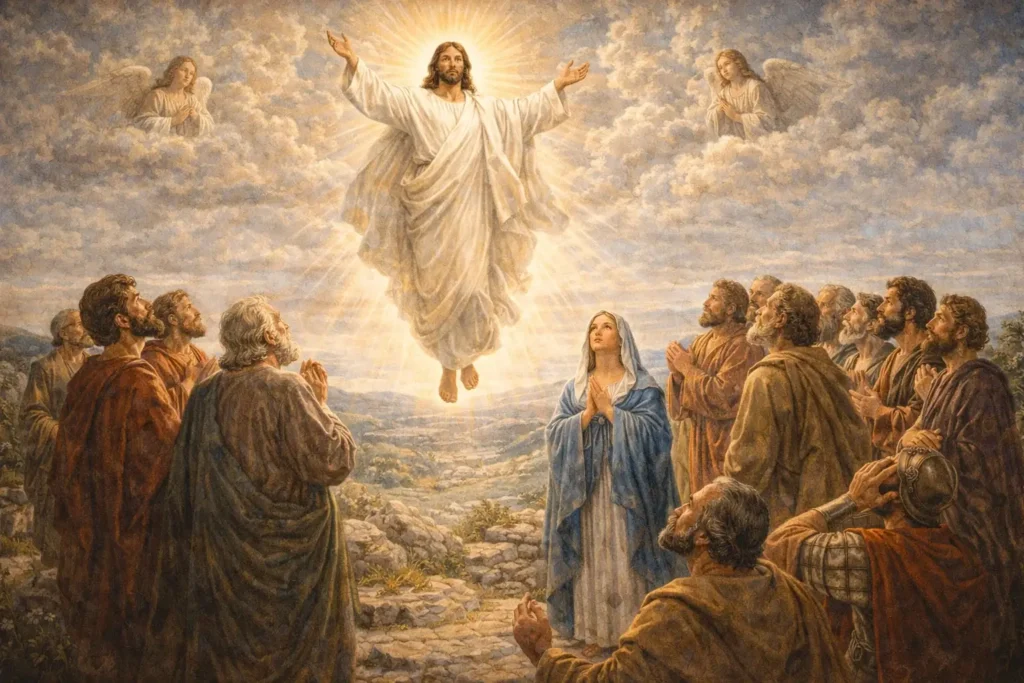
Ascension Rosary Meditation — Acts 1:6–14
The disciples are looking upward. Jesus has been taken from their sight, and for a moment they remain there, watching the place where they last saw him. They have received a promise and a mission, but the shape of the coming days is still beyond them.
We know something of standing between what has ended and what has not yet become clear. In this mystery, we bring that uncertain place into prayer. We contemplate the Lord exalted in glory and ask how to live faithfully while we await the fulfillment of his promises.
The Scripture of the Mystery
Scripture summary: Jesus tells the disciples that the Father’s timing is not theirs to determine. He promises the power of the Holy Spirit and sends them as witnesses to the ends of the earth. He is lifted up and a cloud takes him from their sight. Afterward, the disciples return to Jerusalem and devote themselves to prayer with Mary and the other believers.
Read the full passage: Acts 1:6–14.
Meditation on the Ascension
We often want a timetable before we are willing to trust. We would like to know how long a difficulty will last, when a calling will become clear, and whether the people we love will eventually be all right. Waiting becomes harder when we cannot tell what stage of the story we are in.
The Ascension invites us to place that desire for control before God. We can ask honest questions while accepting that some answers are not ours to arrange. Our part is to live the responsibility we have received, with enough humility to leave the final shape of the story in his hands.
Christ’s Ascension gives that trust a direction. The one who shares our humanity is glorified with the Father. Heaven is no longer an abstract word at the edge of a prayer. Our hope is turned toward Jesus himself, who has gone before us and whose love has not ceased.
We should not confuse his being beyond our sight with his becoming indifferent to our lives. The Church continues to meet him in the life he gives: through the Gospel, the sacraments, prayer, and the love that unites his people. We learn to seek him faithfully in these ordinary and enduring gifts.
There can be a temptation to keep looking backward toward a form of closeness we once knew. Perhaps prayer used to feel easier. Perhaps a person who helped us believe is no longer with us. We may be grateful for those gifts and still need to learn how faithfulness looks in a changed season.
The disciples’ return to prayer offers a simple beginning. They do not manufacture certainty by themselves. They gather. They wait together. We can do the same when a transition leaves us unsettled: return to a steady rhythm, pray with the Church, and allow others to help us remember what we have received.
The mission entrusted to them also keeps hope close to responsibility. We cannot love heaven while becoming careless about the people beside us. The person who needs food, reconciliation, patient teaching, or a faithful friend remains part of the life to which Christ sends us.
Witness begins in the place we actually inhabit. We may imagine a more dramatic setting in which we would finally become generous or courageous. Meanwhile, a family conversation, a workplace decision, or a neighbor’s need gives us a real opportunity to live the Gospel. The mission is already near enough to answer.
As we pray this decade, we can hold together longing and work. We long to be with Christ. We also receive this day as a place to love him. The two belong together: our hope of communion with him gives weight and purpose to the care we offer now.
Spiritual Fruit: Hope
Christian hope rests in the faithfulness of God. It is possible to lose confidence in a particular plan and still hope in him. A door may close. A situation may remain painful. We can acknowledge those facts without deciding that nothing good remains possible in the hands of the Lord.
Hope makes us patient with work whose results we may never see. Parents, teachers, caregivers, and those who pray for someone over many years know this hidden labor. We offer what is ours to give and entrust the growth to God, without making visible success the measure of love.
Hope also teaches us to receive joy along the way. A shared meal, a reconciled friendship, or a peaceful hour need not feel like disloyalty to the difficulty we carry. We can be grateful for the gifts of this life while waiting for the fullness of life with Christ.
How the Ascension Meets Us Today
Some of us are in a season of transition: leaving work, moving home, watching children become independent, or learning to live after a loss. We can ask what faithfulness requires in this new season rather than demanding that it reproduce the old one.
Others are weary of praying for the same intention. The Ascension allows us to renew that prayer without claiming to know God’s timetable. We can keep loving the person before us while releasing the need to control every outcome.
We can also choose one ordinary act of witness. We might speak honestly where evasion has become normal, make peace in a strained relationship, or fulfill a responsibility with care. Hope in heaven can take a practical shape before the day is over.
A Prayer for the Ascension
Jesus, exalted with the Father, turn our hearts toward the life you promise. Keep our hope close to you when the future is unclear.
Teach us to live without knowing every timetable. Give us patience for the prayers we have offered for years and wisdom for the responsibilities of today.
When familiar forms of comfort pass away, help us seek you in the gifts you continue to give. Draw us into the prayer and life of your Church.
Send us as faithful witnesses in our homes, work, and communities. Let our longing for heaven deepen the love we offer on earth.
Mary, who prayed with the disciples as they waited, pray with us, that we may hope steadily in your Son.
Amen.