

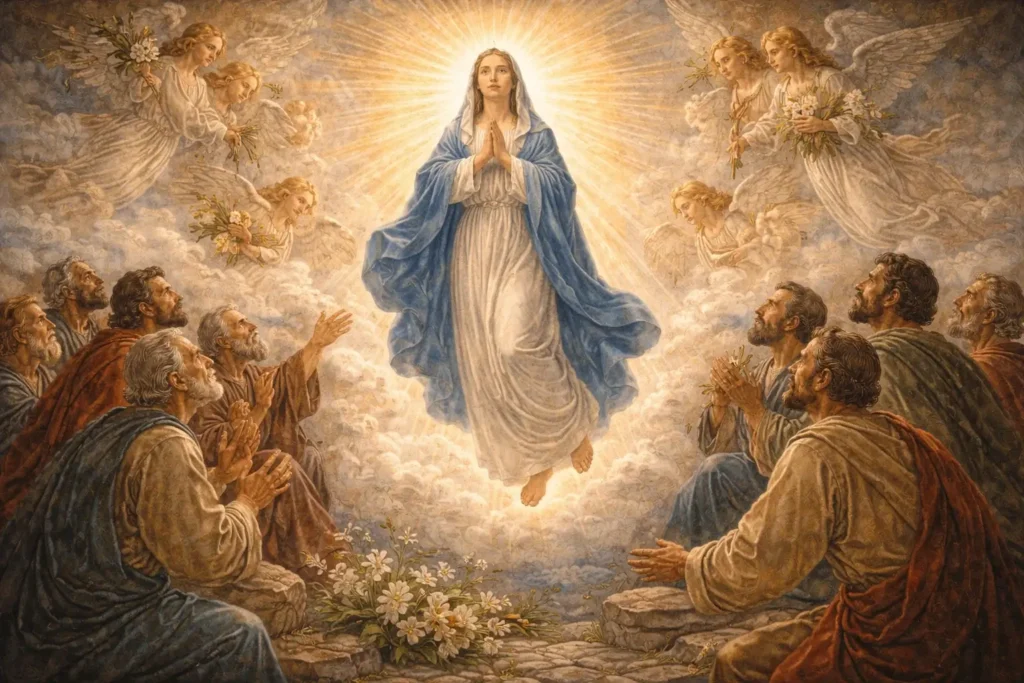
Assumption Rosary Meditation — 1 Corinthians 15:20–23; Catechism of the Catholic Church, 966
We have followed Mary through moments the Gospel lets us see: her listening, her journey to Elizabeth, her care for Jesus, her sorrow at the cross. In the fourth Glorious Mystery, the Church asks us to contemplate the completion of her earthly life in the glory of her Son.
We approach this mystery without inventing a scene Scripture does not give us. We receive what the Church teaches: Mary was taken body and soul into heavenly glory. Her Assumption turns our prayer toward the hope that God has prepared for us and toward the dignity of the bodies in which we live now.
The Scripture of the Mystery
Scripture summary: Saint Paul teaches that Christ has been raised from the dead and that those who belong to him will share in his Resurrection at his coming. His victory gives Christian hope its foundation.
Read the full passage: 1 Corinthians 15:20–23.
Scripture does not narrate Mary’s Assumption directly. The Church teaches this mystery through Sacred Tradition: at the completion of her earthly life, Mary was taken body and soul into heavenly glory. See the Catechism of the Catholic Church, 966.
Meditation on the Assumption
The body carries the story of a life. It bears the tiredness of work, the changes of age, the effects of illness, and the marks of care given over many years. We sometimes speak of these things as though the real person could be separated neatly from them. Yet so much of our loving has happened through the ordinary life of the body.
We have held children, prepared food, walked toward people who needed us, and sat beside those who could no longer speak. We have also known weakness and dependence. The hope of resurrection reaches the whole person we have been in all of this, not merely the parts of life we would choose to display.
In Mary’s Assumption, we contemplate a gift of Christ’s saving power. Mary receives glory from God. Her destiny rests in the victory of her Son, and directs our hope toward him. We honor her by receiving the grace to which her whole life points.
That hope can help us look more tenderly at our present lives. We may be ashamed of a body that no longer does what it once did. We may resent needing care or feel that weakness has made us less useful. Prayer can begin to loosen the cruel measures by which we judge ourselves.
The person who needs assistance has not become a lesser person. A body affected by illness has not become unworthy of tenderness. The time spent providing care is not wasted because the care cannot reverse every loss. Our hope in what God will bring to completion deepens the respect we owe one another now.
The Assumption also helps us examine our attachments. Many good things in this life are temporary: health, a familiar home, a role in a family, the ability to arrange our own day. We can love these gifts without requiring them to provide the lasting security only God can give.
Detachment is learned gently and honestly. We may grieve a change while accepting it. We may be grateful for the past while making room for what is asked of us today. Mary helps us turn toward God with the life we actually have, including the parts we would not have chosen.
We also remember that hope for heaven is shared. We pray for the dead, accompany those who mourn, and refuse to treat a person’s passing as though love had become meaningless. We entrust those we have lost to the mercy of Christ and ask to be faithful to the responsibilities love leaves in our hands.
This decade gives us time to place our own final hour before God. We do not need to imagine every detail or force ourselves into a feeling of fearlessness. We can ask simply to belong to Christ, to receive his mercy, and to be accompanied by the prayers of his mother as our earthly journey is completed.
Spiritual Fruit: Hope of Eternal Life
Hope of eternal life gives direction to the choices of the present. We are learning to love in a way that can be offered to God. An act of mercy, a truthful confession, a reconciliation, or a faithful duty matters even when it brings little visible reward.
This hope can also free us from demanding that every longing be satisfied immediately. We can accept the incompleteness of a day without giving up on goodness. Some wounds remain tender. Some questions remain open. We place them within a promise greater than our ability to resolve them.
We ask Mary to help us live with that patient expectation. Her life directs us toward a wholehearted response to God. We can renew that response in small acts, receiving today as a gift while remembering that our final home is with the Lord.
How the Assumption Meets Us Today
When we care for someone elderly or ill, we can guard the little things that preserve dignity: privacy, a preferred name, a patient explanation, time to answer. The person before us is worthy of attention even when a task must be repeated many times.
When we become anxious about our own aging, we can bring the fear into prayer and take responsible care of the life entrusted to us. Seeking help, arranging support, and speaking honestly with loved ones can be acts of trust rather than signs that trust has failed.
We can also remember a departed person by name during this decade. We ask for their purification and eternal rest, give thanks for the good we received through them, and consider how that good might continue through our own care for others.
A Prayer for the Assumption
Lord Jesus, you have conquered death. Deepen our hope in the life you prepare for those who belong to you.
Teach us to honor the whole person, especially when age, illness, or dependence makes life difficult. Help us give and receive care with tenderness.
Free us from clinging to what cannot last. Let us receive the gifts of today gratefully and entrust tomorrow to your mercy.
Remember our departed loved ones. Grant them rest and bring us, in your time, into the fullness of your presence.
Mary, assumed into heaven, pray for us now and at the hour of our death. Help us remain close to your Son through every season of our lives.
Amen.