

Learning how to pray the Rosary with Scripture helps us reflect on the life of Jesus Christ, from His Incarnation and public ministry to His Passion, Resurrection, and glory. This guide offers eight practical steps, Bible passages for all 20 mysteries, and a sample decade to follow.
Yet sometimes, even when we pray the Rosary regularly, we may find ourselves distracted or struggling to meditate on its mysteries.
One meaningful way to deepen our prayer is to pray the Rosary with Scripture.
By reading short passages from the Bible before each mystery, we can better understand the events we are contemplating and allow the Word of God to guide our hearts toward Jesus.
This approach is often called the Scriptural Rosary. It follows the traditional structure of the Holy Rosary while incorporating Sacred Scripture into our meditation.
Whether you are new to the Rosary or have prayed it for many years, this guide will help you discover how Scripture can enrich your daily prayer.
In this article
What Is a Scriptural Rosary?
A Scriptural Rosary is a way of praying the traditional Holy Rosary while including passages from the Bible that relate to each mystery.
Instead of announcing a mystery and immediately beginning the Our Father, we first read a short Scripture passage and spend a few moments reflecting on its meaning.
Some ways of praying the Rosary with Scripture include a different Bible verse before each Hail Mary. Others use one passage at the beginning of each decade.
Both approaches help us contemplate the life of Jesus Christ through the Word of God.
The essential prayers remain the same:
- The Apostles’ Creed
- The Our Father
- The Hail Mary
- The Glory Be
- The Fatima Prayer, where customary
- The concluding Rosary prayers
Scripture does not replace these prayers. Rather, it helps us enter more deeply into the mysteries we are praying.
Why Pray the Rosary with Scripture?
The Rosary is fundamentally a Christ-centered prayer.
Although we repeatedly ask for the intercession of the Blessed Virgin Mary, the mysteries themselves direct our attention toward the saving work of Jesus Christ.
Saint John Paul II emphasized this in his apostolic letter Rosarium Virginis Mariae, describing the Rosary as a prayer deeply rooted in the Gospel.
He also encouraged the use of a biblical passage when announcing each mystery, helping the faithful give greater attention to the Word of God.
Praying the Rosary with Scripture offers several spiritual benefits.
1. It Helps Us Focus on Jesus
Each mystery invites us to contemplate an important event in the life of Christ or in the life of His Blessed Mother as it relates to salvation.
Scripture helps us remember the people, places, and circumstances surrounding these events.
When we pray the Nativity, for example, reading Luke 2:1-20 can help us imagine the humble surroundings of Bethlehem and reflect on the great love of God revealed in the birth of Jesus.
2. It Deepens Our Understanding of the Mysteries
Familiarity with the Rosary does not always mean we fully understand every mystery.
Reading the corresponding biblical passages can reveal details we may have overlooked.
Through Scripture, we learn not only what happened but also how these events invite us to live our faith.
3. It Encourages More Meaningful Meditation
It is natural for our minds to wander during prayer.
A short Scripture passage can give us a particular thought or image to return to while praying the Hail Marys.
Rather than worrying about every distraction, we can gently return our attention to Jesus.
4. It Connects Our Daily Prayer with the Word of God
The Bible is central to Catholic life.
By bringing Scripture into the Rosary, we allow our meditation to be shaped by the Gospel and the saving works of Christ.
Over time, this practice can also encourage us to read Scripture more regularly.
How to Pray the Rosary with Scripture: Step-by-Step
You do not need special Rosary beads or a separate prayer book.
A Bible, a regular Rosary, and a quiet place to pray are enough.
Step 1: Prepare Your Heart for Prayer
Find a peaceful place where you can spend time with God.
You may place a Bible, crucifix, or image of the Blessed Virgin Mary nearby to help create a prayerful atmosphere.
Before beginning, take a moment to become aware of God’s presence.
You may pray:
Opening Prayer
Heavenly Father, as we begin this Holy Rosary, open our hearts to Your Word.
Through the intercession of the Blessed Virgin Mary, help us contemplate the life of Your Son, Jesus Christ, with greater faith, love, and understanding.
May the Scriptures we read guide our thoughts, strengthen our trust in You, and inspire us to live according to Your holy will.
Through Christ our Lord. Amen.
Step 2: Begin with the Traditional Opening Prayers
Make the Sign of the Cross.
Pray the Apostles’ Creed, followed by:
- One Our Father
- Three Hail Marys for an increase in faith, hope, and charity
- One Glory Be
You may also include the Fatima Prayer according to your usual devotional practice.
Step 3: Announce the First Mystery
Announce the mystery appropriate for the day.
For example:
“The First Joyful Mystery: The Annunciation.”
Pause briefly and remember the Angel Gabriel appearing to the Blessed Virgin Mary.
Step 4: Read the Scripture Passage
For the Annunciation, read Luke 1:26-38.
Pay particular attention to Mary’s willingness to accept God’s will.
You do not need to read the entire passage aloud every time. A few meaningful verses can be sufficient.
Allow the words to settle in your heart before continuing.
Step 5: Meditate on the Mystery
Spend a few moments reflecting on what the passage reveals about Jesus, Mary, and God’s plan of salvation.
You might ask yourself:
- What does this passage teach us about God?
- What virtue does Mary or Jesus demonstrate?
- How can we apply this lesson to our own lives?
For the Annunciation, we might reflect on Mary’s humility, courage, and trust in God’s promises.
Step 6: Pray the Decade
Pray one Our Father, followed by ten Hail Marys.
As you pray, gently keep the Scripture passage and the mystery in mind.
After the ten Hail Marys, pray the Glory Be and the Fatima Prayer.
Step 7: Continue with the Remaining Mysteries
Repeat the same process for each of the remaining four mysteries:
- Announce the mystery.
- Read the corresponding Scripture passage.
- Pause for meditation.
- Pray the Our Father and ten Hail Marys.
- Conclude with the Glory Be and Fatima Prayer.
Step 8: Conclude the Rosary
After completing the five decades, pray the Hail, Holy Queen and the traditional concluding Rosary prayer.
End with the Sign of the Cross.
Take a moment to thank God for the opportunity to reflect on His Word.
Bible Passages for All 20 Mysteries of the Rosary
The following Scripture references can be used when praying the Rosary with Scripture.
Some mysteries are directly narrated in the Gospels. Others, particularly the Assumption and Coronation of Mary, are Catholic teachings illuminated by biblical passages rather than events explicitly narrated in Scripture.
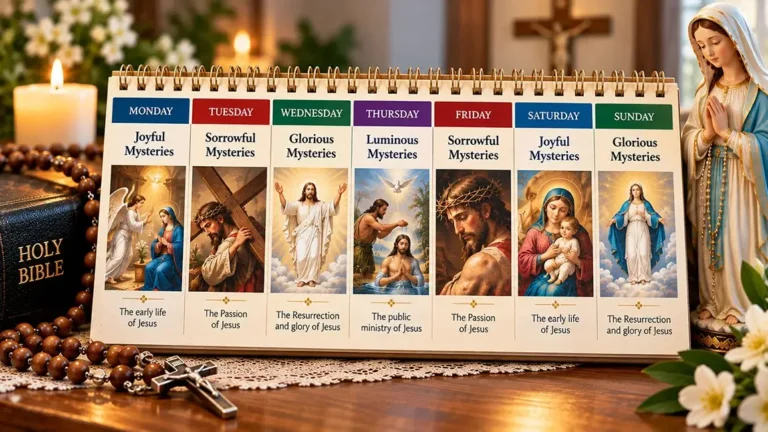
The Joyful Mysteries
Traditionally prayed on Mondays and Saturdays.
1. The Annunciation
Scripture: Luke 1:26-38
The Angel Gabriel announces that Mary has been chosen to become the Mother of Jesus.
Meditation: Reflect on Mary’s trust in God and her willingness to accept His will.
Spiritual fruit: Humility.
2. The Visitation
Scripture: Luke 1:39-56
Mary visits her cousin Elizabeth, who recognizes the blessing of the child Mary carries.
Meditation: Consider how Mary brings Christ to others through her loving service.
Spiritual fruit: Love of neighbor.
3. The Nativity
Scripture: Luke 2:1-20
Jesus is born in Bethlehem and laid in a manger.
Meditation: Contemplate the humility of the Son of God, who enters the world in poverty and simplicity.
Spiritual fruit: Poverty of spirit.
4. The Presentation of Jesus in the Temple
Scripture: Luke 2:22-38
Mary and Joseph present the infant Jesus in the Temple, where Simeon and Anna recognize Him.
Meditation: Reflect on the faithfulness of Mary and Joseph and their obedience to God’s law.
Spiritual fruit: Obedience.
5. The Finding of Jesus in the Temple
Scripture: Luke 2:41-52
After searching for three days, Mary and Joseph find Jesus among the teachers in the Temple.
Meditation: Ask for the grace to seek Jesus faithfully, especially when we feel spiritually distant from Him.
Spiritual fruit: Love of God.
The Luminous Mysteries
Traditionally prayed on Thursdays.
1. The Baptism of Jesus in the Jordan
Scripture: Matthew 3:13-17
Jesus is baptized by John, and the Father reveals Him as His beloved Son.
Meditation: Remember the grace of our own Baptism and our calling to live as children of God.
Spiritual fruit: Openness to the Holy Spirit.
2. The Wedding at Cana
Scripture: John 2:1-11
At Mary’s request, Jesus performs His first sign by changing water into wine.
Meditation: Reflect on Mary’s trust in Jesus and her invitation to follow His instructions.
Spiritual fruit: Trust in Jesus.
3. The Proclamation of the Kingdom of God
Scripture: Mark 1:14-15
Jesus proclaims the Kingdom of God and calls people to repentance and faith.
Meditation: Consider how Christ invites us to turn away from sin and follow the Gospel.
Spiritual fruit: Conversion of heart.
4. The Transfiguration
Scripture: Luke 9:28-36
Jesus reveals His glory before Peter, James, and John.
Meditation: Ask for the grace to listen to Christ and remain faithful even during difficult times.
Spiritual fruit: Desire for holiness.
5. The Institution of the Holy Eucharist
Scripture: Luke 22:14-20
At the Last Supper, Jesus gives His Body and Blood to His disciples.
Meditation: Reflect on Christ’s gift of Himself and His enduring presence in the Holy Eucharist.
Spiritual fruit: Love for the Eucharist.
The Sorrowful Mysteries
Traditionally prayed on Tuesdays and Fridays.
1. The Agony in the Garden
Scripture: Luke 22:39-46
Jesus prays in the Garden of Gethsemane before His arrest.
Meditation: Reflect on Christ’s surrender to the Father’s will, even in the midst of great suffering.
Spiritual fruit: Contrition for sins.
2. The Scourging at the Pillar
Scripture: John 19:1
Jesus is scourged before His Crucifixion.
Meditation: Contemplate the suffering Christ willingly endured for our salvation.
Spiritual fruit: Purity.
3. The Crowning with Thorns
Scripture: Matthew 27:27-31
Jesus is mocked and crowned with thorns by the soldiers.
Meditation: Reflect on Christ’s humility and patience in the face of humiliation.
Spiritual fruit: Moral courage.
4. The Carrying of the Cross
Scripture: Luke 23:26-32
Jesus carries His Cross toward Calvary.
Meditation: Ask for strength to carry our daily crosses with patience and trust.
Spiritual fruit: Perseverance.
5. The Crucifixion and Death of Jesus
Scripture: John 19:25-30
Jesus gives His life upon the Cross, with His Mother standing nearby.
Meditation: Contemplate the depth of Christ’s love and the sacrifice He offered for our salvation.
Spiritual fruit: Love of Christ.
The Glorious Mysteries
Traditionally prayed on Wednesdays and Sundays.
1. The Resurrection
Scripture: Matthew 28:1-10
Jesus rises from the dead, fulfilling His promise and conquering death.
Meditation: Rejoice in Christ’s victory and renew our hope in eternal life.
Spiritual fruit: Faith.
2. The Ascension
Scripture: Acts 1:6-11
Jesus ascends into heaven before His disciples.
Meditation: Remember that our ultimate home is with God.
Spiritual fruit: Hope.
3. The Descent of the Holy Spirit
Scripture: Acts 2:1-13
The Holy Spirit descends upon the disciples at Pentecost.
Meditation: Ask the Holy Spirit to strengthen our faith and guide our daily lives.
Spiritual fruit: Love of God and zeal for the faith.
4. The Assumption of the Blessed Virgin Mary
Scripture for reflection: Luke 1:46-55
The Church teaches that Mary was assumed body and soul into heavenly glory at the end of her earthly life.
Meditation: Reflect on Mary’s faithfulness and the promise of heavenly glory.
Spiritual fruit: Grace of a holy death.
Note: Mary’s Assumption is a dogma of the Catholic Church. It is not directly narrated in the Bible. The Magnificat offers a fitting biblical reflection on God’s saving work in Mary.
5. The Coronation of Mary as Queen of Heaven and Earth
Scripture for reflection: Revelation 12:1
The Church honors Mary as Queen of Heaven and Earth, sharing in the glory of her Son.
Meditation: Ask Mary to intercede for us and help us remain faithful to Jesus.
Spiritual fruit: Trust in Mary’s intercession.
Note: Revelation 12:1 presents the woman clothed with the sun. Catholic tradition recognizes Marian significance in this image, while the passage also carries broader symbolism concerning God’s people and the Church.
Example: Praying One Scriptural Rosary Decade
If you are beginning this practice for the first time, try praying just one decade with Scripture.
First Joyful Mystery: The Annunciation
Scripture: Luke 1:26-38
Read the passage slowly.
Imagine the moment when the Angel Gabriel appeared to Mary. Consider how unexpected this message must have been and how deeply Mary trusted God.
Meditation
Blessed Virgin Mary, you received God’s message with humility and faith. Help us to trust in His plans, especially when the future is uncertain.
Teach us to say yes to God with the same generosity and courage that you showed at the Annunciation.
Now pray:
- One Our Father
- Ten Hail Marys
- One Glory Be
- The Fatima Prayer
During the Hail Marys, return your thoughts to Mary’s trust in God.
This simple practice can make a familiar decade more reflective and meaningful.
Two Ways to Pray the Scriptural Rosary
There are two practical approaches you can follow.
Method 1: One Scripture Passage per Mystery
Read one Bible passage before beginning each decade.
Pause for a short meditation, then pray the decade normally.
This is the simplest method and is especially suitable for beginners, families, and daily prayer.
Method 2: One Scripture Verse per Hail Mary
In this method, a short Scripture verse is read before each of the ten Hail Marys.
The verses usually follow the events of the mystery in sequence.
For example, during the Annunciation, the verses may describe Gabriel’s greeting, Mary’s response, and the promise of the Savior’s birth.
This method offers a more detailed meditation but usually requires additional preparation or a dedicated guide to praying the Rosary with Scripture.
Both methods are valid devotional approaches.
For daily prayer, beginning with one passage per mystery is often easier to sustain.
Tips for Making Scripture Meditation Part of Your Daily Rosary
Start with One Decade
You do not need to pray a complete five-decade Rosary with Scripture on your first attempt.
Try adding Scripture to one decade until the practice becomes familiar.
Read Slowly
Scripture meditation is not a race.
Allow yourself enough time to understand the passage and reflect on its meaning.
Focus on One Spiritual Lesson
Rather than trying to remember every detail, choose one virtue or message to contemplate.
For example, the Agony in the Garden may remind us to trust God during suffering.
Pray with Your Family
Praying the Rosary with Scripture can become a meaningful family prayer practice.
One family member may read the Bible passage while others lead the prayers.
Children can participate by reading short verses or announcing the mysteries.
Use a Catholic Bible
Choose a Bible translation suitable for Catholic reading and study.
A Catholic edition includes the full canon of Scripture, including the deuterocanonical books.
Do Not Worry About Distractions
Even experienced Catholics sometimes struggle to concentrate during the Rosary.
When distractions arise, gently return your attention to the mystery and continue praying.
Prayer is an act of love, not a test of perfect concentration.
Frequently Asked Questions
Is the Scriptural Rosary different from the traditional Rosary?
The Scriptural Rosary follows the traditional Rosary structure but includes Bible passages to support meditation on each mystery. The prayers and decades remain the same.
Do I need to read the Bible before every Hail Mary?
No. You may read one passage before each mystery or a short verse before every Hail Mary. Both methods can help deepen meditation.
Can beginners pray the Rosary with Scripture?
Yes. Beginners may find it especially helpful because the Bible passages explain the events being contemplated in each mystery.
How long does it take to pray the Rosary with Scripture?
A five-decade Rosary commonly takes around 15 to 25 minutes. Adding Scripture readings and pauses for meditation may extend it to approximately 25 to 40 minutes, depending on the method and pace.
Can I pray the Rosary with Scripture alone?
Yes. You can pray privately, with family, in a parish prayer group, or alongside a guided Rosary video.
Are all 20 Rosary mysteries found directly in the Bible?
Not all are explicitly narrated in Scripture. The Assumption and Coronation of Mary are teachings of Catholic tradition that can be contemplated alongside relevant biblical passages.
Can I use any Catholic Bible translation?
Yes. You may use an approved Catholic Bible translation that is suitable for personal prayer and study.
Grow Closer to Jesus Through the Rosary and Scripture
The Holy Rosary invites us to walk with the Blessed Virgin Mary as we contemplate the life, suffering, death, and glory of her Son.
When we include Sacred Scripture in our prayer, the mysteries become more vivid and meaningful.
We begin to see the people, hear the words, and reflect on the events through which God revealed His saving love.
Above all, we are reminded that the purpose of the Rosary is not simply to complete a series of prayers but to grow in our relationship with Jesus Christ.
At Holy Rosary Today, we invite you to continue this journey of prayer and reflection with our daily Rosary community.
Whether you pray one decade or all five, may the Word of God strengthen your faith and help you draw closer to Christ through the loving intercession of His Blessed Mother.
Related Articles