
Nativity Rosary Meditation — Luke 2:1-20
A government official far away signed an order for a census, never knowing that his decree would send a young woman in the last days of pregnancy on a long journey to a small town called Bethlehem. Caesar Augustus thought he was counting his empire. He had no idea he was setting the stage for something he would never hear about in his own lifetime.
That is where the mystery begins. Not with angels or glory, but with an ordinary government order, and two ordinary people caught up in it, walking toward a town with no room ready for them.
The Scripture of the Mystery
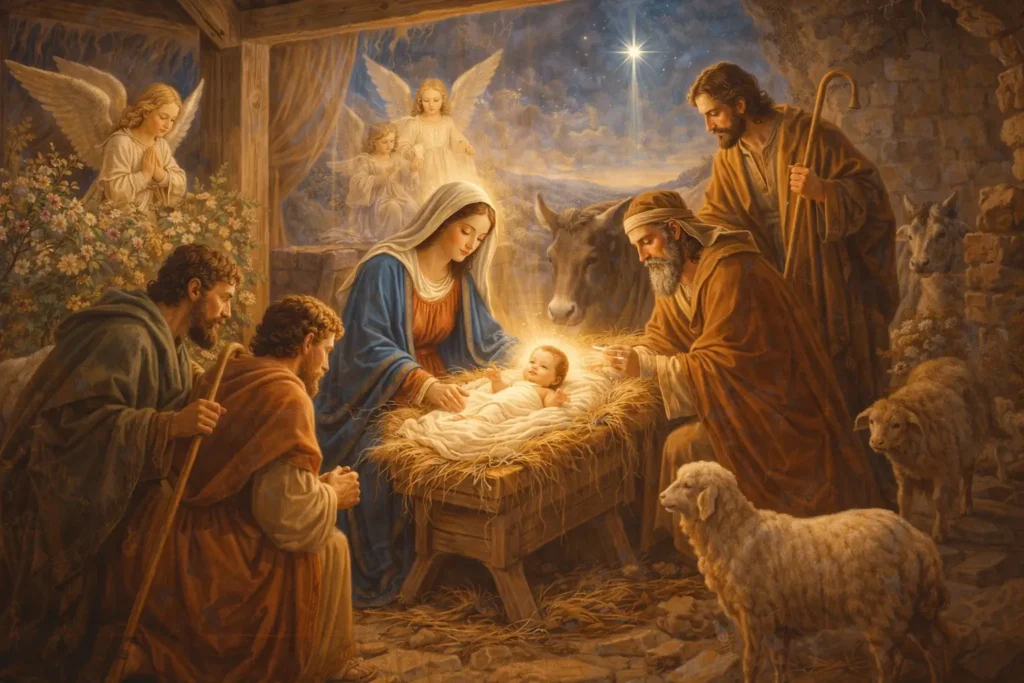
While they were there, the time came for her to have her child, and she gave birth to her firstborn son. She wrapped him in swaddling clothes and laid him in a manger, because there was no room for them in the inn.
Now there were shepherds in that region living in the fields and keeping the night watch over their flock. The angel said to them, “Do not be afraid; for behold, I proclaim to you good news of great joy… today in the city of David a savior has been born for you.”
So they went in haste and found Mary and Joseph, and the infant lying in the manger.
And Mary kept all these things, reflecting on them in her heart.
(Luke 2:1-20)
Meditation on the Nativity
The journey to Bethlehem was not short or easy. Mary was near the end of her pregnancy, and the road from Nazareth ran through hill country for many miles. Luke does not describe the hardship of that trip. He simply tells us it happened, and that once they arrived, there was no room for them anywhere fitting. The town was full. Nobody in Bethlehem that night knew who had just arrived at their door, tired and without a place to stay.
And then, in whatever space they found, the birth simply happens. Luke states it plainly. She gave birth to her firstborn son. No fanfare surrounds the sentence. The eternal Son of God, through whom everything was made, enters human history in a moment as quiet and as real as any other birth. This is the Incarnation, not as an idea to explain, but as an actual event, happening to an actual woman, in an actual place that had no room prepared for it.
What Mary does next is worth noticing closely. She wraps him in swaddling clothes and lays him in a manger. This is an ordinary act, the same kind of care any mother gives a newborn. Yet the child she is wrapping is the one through whom the world itself was made. There is something almost startling about how ordinary her care looks, set against who he actually is. God did not arrive needing something extraordinary done for him. He arrived needing to be wrapped and held, the way any infant does.
Not far away, shepherds are doing the most unremarkable work imaginable. They are watching sheep through the night, the kind of task that draws no attention and earns little respect. It is to them, not to anyone with standing or influence, that the announcement comes first. An angel tells them a savior has been born, and suddenly the sky is filled with the sound of heaven’s praise. Then, just as suddenly, it is quiet again, and the choice belongs to the shepherds. They go in haste, Luke tells us, the same word used earlier for Mary’s journey to Elizabeth. They find exactly what they were told they would find. A child, wrapped in cloth, lying in a manger.
Word begins to spread from there, carried by shepherds, the least likely witnesses anyone would have chosen for the birth of a king. And through all of it, Mary says very little. Luke tells us she kept these things, reflecting on them in her heart. She does not try to explain what has happened, or to make sense of it out loud for others. She holds it. She turns it over slowly, the way someone treasures something too large to understand all at once.
The King of the universe enters the world without a throne, without an audience prepared for him, without anyone of importance taking notice. And yet nothing about this diminishes who he is. It reveals something about how he chooses to come. Not through spectacle, but through weakness. Not to those with power to receive him properly, but to shepherds, and to a mother who simply wrapped him and laid him down.
Spiritual Fruit: Poverty of Spirit
The fruit given to this mystery is poverty of spirit, and the Nativity itself is where this fruit becomes visible rather than abstract.
Poverty of spirit is not only about having little. It is about not needing to have much, not needing status, comfort, recognition, or control to feel secure. Christ shows this from the very first moment of his human life. He arrives with no property, no title, no reputation, and no guarantee of shelter. He does not enter the world protected by wealth or position. He enters completely dependent, wrapped in cloth by his mother’s hands, resting in a feeding trough because nothing better was available.
Mary and Joseph live this same poverty of spirit without complaint. They do not appear to resent the lack of proper lodging or demand better treatment. They simply do what the moment requires. There is no record of Mary insisting that her son deserved more than a manger. She wraps him, and she lays him down, and she treasures what is happening rather than protesting what is missing.
This is the deeper meaning of poverty of spirit. It is the freedom that comes from not measuring your worth, or God’s presence, by what you possess or how you are received by others. The shepherds embody this too. They have nothing to offer Christ except their presence and their willingness to go see him. They do not arrive with gifts or credentials. They come as they are, straight from the fields, and that is enough.
How the Nativity Meets Us Today
Many people know what it feels like to arrive somewhere and find no room waiting for them. A new season of life begins, and the resources are not there yet. A family welcomes a child into circumstances that are far from ideal. Someone starts over with less than they had before, uncertain how the next months will be provided for. The Nativity does not promise that these situations will resolve easily. It shows that God has already entered exactly this kind of uncertainty, and that his presence does not wait for better conditions to arrive first.
There is also the experience of being overlooked, the way the shepherds were overlooked by nearly everyone in their own time. Work that goes unnoticed, effort that draws no recognition, days that feel too ordinary to matter. The Nativity suggests that God’s most important announcements are not always made to the people the world considers significant. They are made in fields, at night, to people simply doing what needed to be done.
And there is Mary’s pondering, which offers its own quiet lesson. Not everything that happens needs to be explained, defended, or immediately understood. Some things are meant to be treasured first, carried quietly, turned over slowly in the heart before they make full sense. Ordinary homes and ordinary days can hold more than they appear to, the way one small manger once held more than anyone in Bethlehem that night could have guessed.
A Prayer for the Nativity of our Lord
Lord, you entered the world with nothing but a mother’s care and a manger to receive you.
Teach me to need less than I think I need, and to find my security in you rather than in what I have or how I am seen by others.
When I feel overlooked, remind me that you have always spoken first to the ones the world passes by. When my circumstances feel too ordinary or too difficult to hold your presence, show me that you have already chosen to dwell in exactly such places.
Give me a heart like Mary’s, willing to treasure what I do not yet understand, instead of demanding an explanation before I will believe.
Help me welcome you into my home and my days as simply as she welcomed you that night, with whatever I have, and nothing more.
Amen.