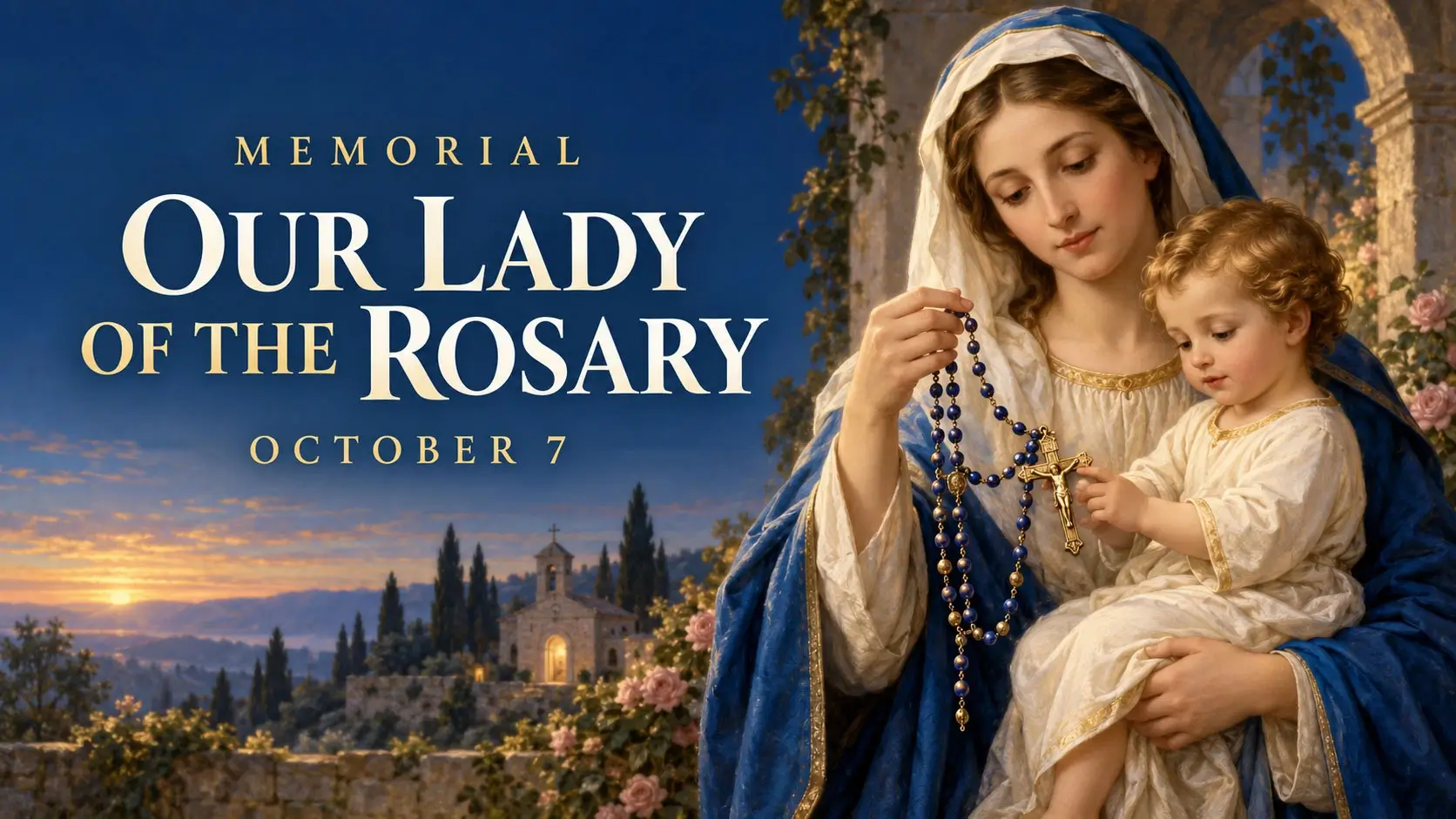
The Memorial of Our Lady of the Rosary celebrates a prayer that is simple enough to learn in childhood and deep enough to accompany us throughout life.
With Mary, we return to the central events of the Gospel. We contemplate the Incarnation, the ministry of Jesus, his Passion and death, and the glory of his Resurrection. The familiar prayers give our lips something steady to say while the mysteries direct our minds and hearts toward Christ.
On October 7, the Church invites us not only to admire the Rosary but to take it into our hands and pray.
Why the Church Celebrates This Memorial
The feast has historical roots in the sixteenth century. Pope Saint Pius V encouraged Christians to pray the Rosary during a period of grave danger in Europe. Following the Christian victory at the Battle of Lepanto on October 7, 1571, he established a feast of Our Lady of Victory in thanksgiving. The observance later became known as the feast of Our Lady of the Rosary.
The history explains the date, but the enduring meaning of the memorial is broader than one military event. The Church continues to recommend the Rosary as a prayer for conversion, peace, family life, perseverance, and deeper union with Jesus.
The Rosary is not magic, and its power does not come from beads or repeated words by themselves. Its spiritual fruit comes from God’s grace as we pray with faith, meditate on the mysteries of Christ, and seek the intercession of his Mother.
A Marian Prayer Centered on Christ
The Rosary is unmistakably Marian, but its heart is Jesus.
Saint John Paul II described it as a Christ-centered prayer and a summary of the Gospel. Each mystery presents an event from the life of Christ or an event in Mary’s life that receives its meaning from him.
In the Joyful Mysteries, we contemplate the Son of God taking flesh, being born in Bethlehem, and growing within the Holy Family. In the Luminous Mysteries, we follow Christ through his public ministry. In the Sorrowful Mysteries, we remain with him through his Passion. In the Glorious Mysteries, we rejoice in his Resurrection, Ascension, and victory.
Even the Hail Mary keeps the name of Jesus at its center: “Blessed is the fruit of thy womb, Jesus.”
Mary does not draw us away from her Son. She teaches us to look at him with faith, remember his words, remain near him in suffering, and rejoice in his saving work.
The Rosary Is a Scriptural Prayer
The Rosary is deeply rooted in Scripture.
The Apostles’ Creed summarizes the central truths of Christian faith. The Our Father comes directly from the teaching of Jesus. The first words of the Hail Mary echo the greetings of the angel Gabriel and Saint Elizabeth in the Gospel of Luke. The Glory Be praises the Holy Trinity.
The mysteries themselves lead us through the Gospel. A short Scripture passage before each decade can help us enter the scene more attentively.
For example, before the First Joyful Mystery, we can read Luke 1:26-38 and hear Gabriel’s announcement to Mary. Before the Third Sorrowful Mystery, we can read the account of Jesus being mocked and crowned with thorns. Before the First Glorious Mystery, we can read the women’s discovery of the empty tomb.
The Rosary is not a replacement for reading the Bible. It is one way of receiving and remembering the saving events Scripture proclaims.
Repetition That Creates Space for Contemplation
Some people struggle with the repetition of the Rosary. They may feel distracted, rushed, or unable to hold the mystery in mind while saying the prayers.
The repeated Hail Marys are not meant to be empty words. Their steady rhythm can quiet the mind and create space for contemplation. We do not have to analyze every sentence while also imagining every detail of the mystery.
It can help to focus on one person, action, or grace:
- Notice Mary’s trust during the Annunciation.
- Consider Jesus’ compassion during the proclamation of the Kingdom.
- Remain beside him during the Agony in the Garden.
- Give thanks for the hope of the Resurrection.
When distraction comes, return without frustration. The goal is not a flawless performance. The goal is faithful prayer.
Bringing Real Life into the Rosary
The mysteries of the Rosary are not distant scenes with no connection to daily life. They reveal Christ entering real human experiences: family life, work, celebration, misunderstanding, fear, suffering, death, and hope.
The Rosary gives us a place to bring the people and situations we carry.
We can pray the Joyful Mysteries for expectant mothers, children, families, and those beginning a new responsibility. We can offer the Luminous Mysteries for people seeking conversion, teachers of the faith, priests, and those preparing for the sacraments.
We can pray the Sorrowful Mysteries for the sick, the grieving, victims of violence, persecuted Christians, and anyone carrying a heavy cross. We can offer the Glorious Mysteries for those who have died, those losing hope, and those who need renewed faith in God’s promises.
Our intentions do not distract from the mysteries. They are placed within them. We bring our needs to Jesus while contemplating what he has done for our salvation.
A Prayer for Peace
The history of this memorial makes prayer for peace especially appropriate.
The Rosary should never be used to glorify conflict or treat other people with contempt. It leads us to Christ, who calls us to repentance, justice, mercy, and love of neighbor.
Saint John Paul II encouraged the Rosary as a prayer for peace. To pray sincerely for peace also commits us to become peacemakers in our own homes and communities.
This may begin with refusing cruel speech, apologizing after an argument, listening before judging, forgiving an old offense, or helping someone who has been treated as an enemy.
If the Rosary does not gradually shape how we treat people, we have missed part of its purpose. Contemplating Christ should form in us the mind and heart of Christ.
The Rosary in Family Life
Family prayer can be difficult. Schedules conflict, children become restless, adults feel tired, and attention wanders. A perfect setting is not required.
A family can begin with one decade. Choose an intention, announce the mystery, read one or two verses of Scripture, and pray slowly. Five focused minutes are better than postponing prayer because the full Rosary feels impossible.
Families can also divide the Rosary throughout the day or assign parts to different family members. What matters is building a realistic practice that can continue.
The beads may eventually become associated with ordinary moments: a quiet morning, a car journey, a hospital room, a sleepless night, or the end of a difficult day. The Rosary becomes part of family memory.
When the Rosary Feels Difficult
There will be days when prayer feels dry. We may finish a decade and realize we barely noticed the words. We may feel guilty because our mind kept returning to worries.
Those moments do not make the prayer worthless.
Bring the distraction itself into prayer. If you keep thinking about someone who is suffering, offer the decade for that person. If anxiety dominates your attention, place the fear within the mystery and ask Mary to help you remain close to Jesus.
Slowing down can also help. Pause after announcing the mystery. Picture the scene briefly. Emphasize the name of Jesus in each Hail Mary. Leave a few seconds of silence after the decade.
Perseverance matters more than emotional satisfaction.
A Simple Practice for October 7
Set aside time today to pray at least one decade of the Rosary.
Before beginning, name one person or situation you want to entrust to God. Read a short Gospel passage connected with the mystery. Pray at a calm pace, and ask for the grace to imitate what the mystery reveals.
If possible, pray with your family, parish, or another person. If you are alone, remember that you are united with Catholics throughout the world who are turning to Christ with Mary.
Prayer to Our Lady of the Rosary
Our Lady of the Rosary, Mother of Jesus and Mother of the Church, teach us to contemplate the face of your Son.
Help us to receive the Gospel with faith, carry our crosses with courage, and live with hope in the Resurrection. When we are distracted, teach us to return gently to prayer. When we are afraid, remind us that Christ remains with us.
Intercede for our families, for those who are sick or grieving, for people facing violence and persecution, and for peace among nations.
May every Rosary we pray lead us toward deeper conversion, greater charity, and more faithful service to Jesus.
Our Lady of the Rosary, pray for us. Amen.
Related Articles