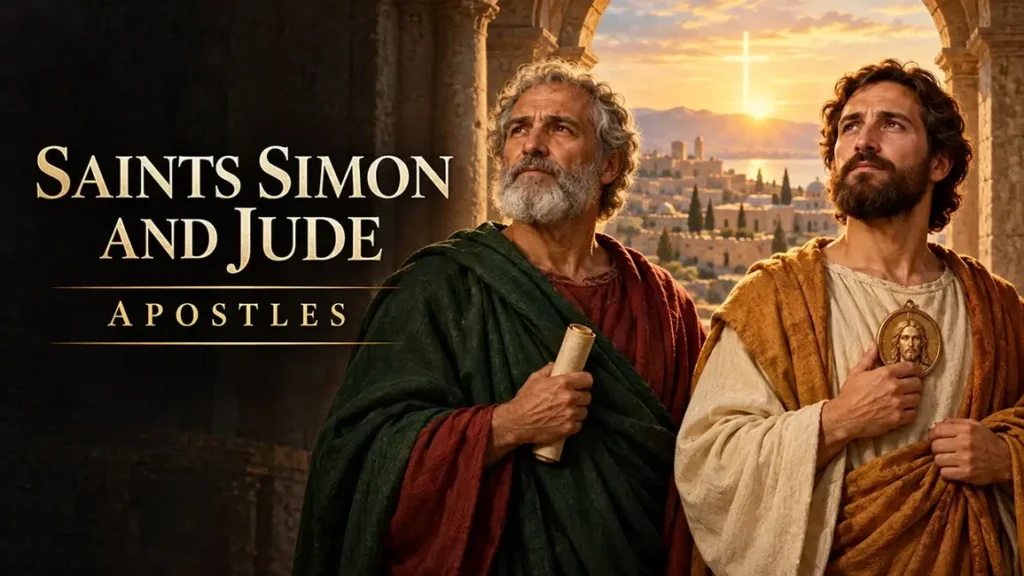
On October 28, the Church celebrates Saints Simon and Jude, two of the twelve Apostles chosen by Jesus. The Gospels tell us far less about them than about Peter, John, or Matthew. They do not occupy many pages of Scripture, and few details of their later ministry can be established with certainty.
Yet their names remain in the Gospel and in the Church’s prayer. They followed Christ, received his teaching, witnessed his saving work, and were sent to proclaim the Good News.
Their feast reminds us that a life does not need to attract attention to become fruitful in the hands of God. Much of Christian faithfulness happens quietly, through prayer, ordinary duties, hidden sacrifices, and service that may never receive public recognition.
God still sees it.
Who Was Saint Simon the Apostle?
Saint Simon is called the Zealot in the Gospel of Luke and Simon the Cananaean in Matthew and Mark. He should not be confused with Simon Peter, whom Jesus appointed to lead the Apostles.
The title “Zealot” may describe Simon’s fervor, or it may connect him with a religious or political movement known for its strong opposition to Roman rule. The Gospels do not give enough information to settle the question.
What matters most is that Jesus called him.
If Simon carried strong political convictions before becoming a disciple, following Christ would have required him to place those convictions under the authority of the Gospel. Among the Twelve was also Matthew, a former tax collector associated with the Roman system. By ordinary human standards, Simon and Matthew could have viewed each other as enemies.
Jesus brought them into the same apostolic community.
This does not mean their differences became meaningless. It means allegiance to Christ was greater than the divisions that once defined them.
That lesson remains difficult and necessary. Christians will not agree about every social, political, or practical question. We are still called to speak truthfully, listen carefully, refuse contempt, and remember that no political identity can replace our identity in Christ.
Who Was Saint Jude Thaddeus?
Saint Jude is also known as Jude Thaddeus or Judas Thaddeus. He must not be confused with Judas Iscariot, who betrayed Jesus.
In the Gospel of John, Jude asks Jesus why he will reveal himself to his disciples and not to the world. Jesus answers by speaking about love and obedience: those who love him will keep his word, and the Father will dwell with them.
Jude’s question gives Jesus an opportunity to explain that God’s presence is received through a relationship of love and faithfulness. Christ is not merely displaying power to impress the world. He is forming disciples who will hear his word, keep it, and become places where God dwells.
Catholic devotion has long invoked Saint Jude as a patron in desperate or seemingly impossible situations. This devotion should never become superstition. The saint does not replace Christ or guarantee that every request will be answered exactly as we want. Saint Jude intercedes for us and points us toward Jesus, especially when discouragement makes prayer difficult.
His witness encourages us to keep praying when circumstances appear closed, confusing, or beyond repair.
Chosen After a Night of Prayer
The Gospel proclaimed on this feast is Luke 6:12-16. Before choosing the Twelve, Jesus goes to the mountain and spends the night in prayer to God.
Only after that night of prayer does he call his disciples and name twelve of them Apostles, including Simon the Zealot and Judas the son of James.
Their vocation begins in the prayer of Jesus.
This is deeply consoling. The Apostles were not selected because they had perfect personalities, complete understanding, or impressive records. They were chosen by Christ. He knew their strengths, their limitations, the questions they would ask, and the fear they would experience.
He called them anyway.
Our own vocation also begins with God’s initiative. We may feel ordinary, unprepared, or uncertain. We may see our weaknesses more clearly than our gifts. But discipleship is not built on self-confidence alone. It rests on the grace of the One who calls us.
Before making an important decision, beginning a ministry, accepting a responsibility, or responding to conflict, we should follow the pattern of Jesus and pray first.
Prayer does not remove every difficulty. It places our choices before the Father so that our actions can grow from obedience rather than impulse.
Built on the Foundation of the Apostles
The first reading for the feast comes from Ephesians 2:19-22. Saint Paul tells Christians that they are no longer strangers but members of God’s household, built upon the foundation of the Apostles and prophets, with Christ Jesus as the cornerstone.
Simon and Jude matter because the apostolic foundation matters.
The Catholic faith is not reinvented in every generation. It is received, lived, handed on, and guarded within the Church. The Apostles received the Gospel from Christ and were sent to proclaim it. Their mission continues through the life, teaching, worship, and sacramental ministry of the Church.
At the same time, Christ remains the cornerstone. Apostles, pastors, teachers, and communities serve faithfully only when they remain aligned with him.
This protects us from two opposite errors. We should not separate Christ from the Church he established, but neither should we place any human personality above Christ.
Our foundation is apostolic, and our cornerstone is Jesus.
Different Men, One Mission
Simon and Jude had different names, histories, temperaments, and experiences. Jesus did not erase their individuality. He gave them one mission.
The Church continues to contain people from different cultures, social backgrounds, generations, and political perspectives. Unity does not require uniformity. It requires a shared center.
When Christ is truly at the center, differences can become gifts rather than weapons. We learn from one another. We correct one another with charity. We serve together even when our preferences are not identical.
When Christ is displaced, secondary concerns become absolute. Communities divide over status, personalities, methods, and loyalties that should never rival the Gospel.
Saints Simon and Jude call us back to the mission given by Jesus: proclaim the Kingdom, bear witness to the truth, serve the suffering, forgive, and lead others toward God.
Faithfulness Without Recognition
We know little about the daily work of Simon and Jude after Pentecost. Ancient Christian traditions associate them with missionary activity and martyrdom, but the historical details vary.
Their relative obscurity is part of what makes their feast valuable.
Many faithful Christians will never have a public ministry or a widely known name. Their discipleship unfolds in homes, workplaces, parishes, hospitals, classrooms, and ordinary conversations.
A parent quietly teaches a child to pray. A worker refuses dishonesty even when it would be profitable. A caregiver stays beside someone who can no longer say thank you. A parish volunteer completes an unnoticed task. A grieving person continues to attend Mass despite carrying questions and pain.
These acts may look small, but they belong to the mission of the Church.
The lives of Simon and Jude tell us that being known by Christ matters more than being known by the world.
Hope When a Situation Feels Impossible
Devotion to Saint Jude has brought comfort to generations of Catholics facing illness, financial hardship, family conflict, addiction, grief, and situations that seem beyond human repair.
Christian hope is not denial. It does not pretend that every problem has an easy solution. Hope means that no circumstance lies outside God’s presence, mercy, and final authority.
Sometimes prayer leads to an unexpected change. Sometimes it gives us courage to take the next practical step. Sometimes it helps us endure what cannot yet be changed. Sometimes it exposes the need to seek medical, pastoral, legal, or professional help.
In every case, hope keeps us from surrendering our hearts to despair.
If you are carrying a difficult situation, you may share your prayer request or learn how to offer an intention through the Rosary. You can also follow our simple guide to praying the Rosary or pray today’s mysteries.
Living the Feast of Saints Simon and Jude
We can honor these Apostles through a few practical choices:
- Pray before making an important decision.
- Place loyalty to Christ above political or personal divisions.
- Complete one hidden act of service without seeking recognition.
- Pray for someone facing a desperate situation.
- Support the apostolic mission of the Church through prayer, service, or generosity.
- Pray one decade of the Rosary for missionaries and persecuted Christians.
The goal is not to imitate every detail of another person’s vocation. It is to answer Christ faithfully within our own.
Prayer to Saints Simon and Jude
Saints Simon and Jude, faithful Apostles of Jesus Christ, pray for us.
Teach us to place Christ above every division and to remain united in truth and charity. Help us pray before we act, listen before we judge, and serve without seeking recognition.
Saint Simon, pray that our zeal may be purified by the Gospel and directed toward the glory of God.
Saint Jude, pray for those facing desperate situations, especially those who feel discouraged, forgotten, or afraid to hope again.
May we remain faithful to the teaching of the Apostles, devoted to prayer, and ready to carry the Gospel into our homes, workplaces, and communities.
Saints Simon and Jude, Apostles of Christ, pray for us. Amen.
Sources
- Pope Benedict XVI, General Audience on Simon and Jude
- Vatican News, Saints Simon and Jude, Apostles
- USCCB, October 2026 Liturgical Calendar and Readings
- Vatican News, Gospel and Word of the Day for October 28, 2026
Related Articles