- Feast Day
- November 10
- Saint Types
- Doctor of the Church, Pope
- Invoked For
- Defense of the faith, the Tome of Leo, the Council of Chalcedon, and pastoral leadership during the decline of the Western Roman Empire
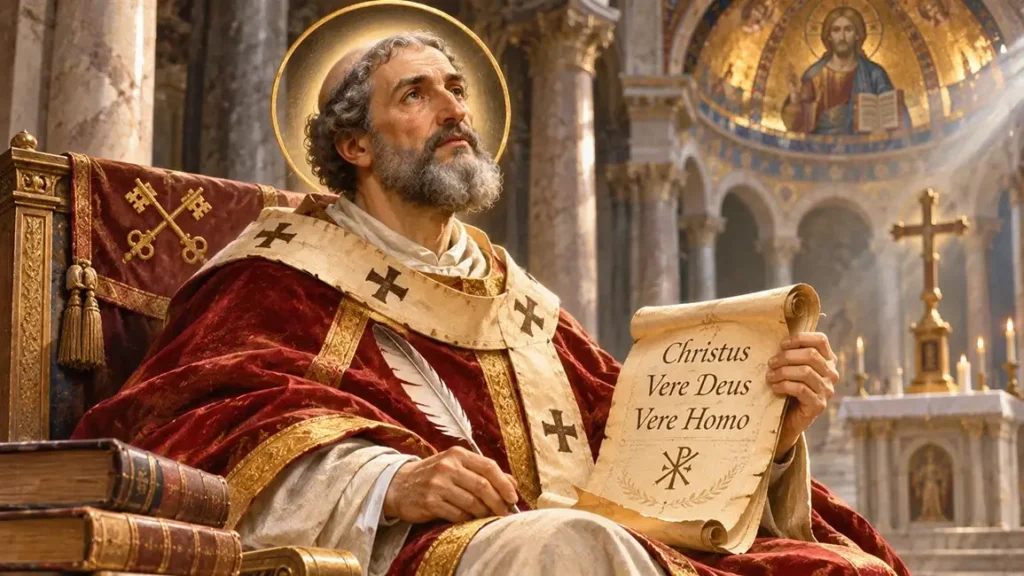
Saint Leo the Great was one of the most influential popes of the early Catholic Church. Serving as Bishop of Rome from 440 to 461, he guided Christians through a period of political uncertainty, theological controversy, and growing instability in the Western Roman Empire.
He is especially remembered for defending the Church’s teaching that Jesus Christ is truly God and truly man, for his important contribution to the Council of Chalcedon, and for his courageous pastoral leadership.
Saint Leo also left behind sermons and letters that continue to inspire Catholics to live their faith with humility, charity, and confidence in Jesus Christ.
Recognized as a Doctor of the Church, he is one of the few popes honored with the title “the Great.”
The Catholic Church celebrates his feast day on November 10.
His life reminds us that faithfulness to Christ requires both a clear understanding of the truth and a compassionate heart toward those in need.
Early Life and Service to the Church
Saint Leo the Great was born toward the end of the fourth century, although the exact date and location of his birth are uncertain.
Tradition associates his origins with Tuscany in Italy.
Before becoming pope, Leo served as a deacon of the Roman Church and earned a reputation for wisdom, theological knowledge, and diplomatic ability.
He became a trusted figure in ecclesiastical affairs during a period when the Western Roman Empire faced increasing political and military instability.
His responsibilities included helping to resolve disputes and supporting the work of the Church in Rome.
By the time he was chosen to become pope, Leo had already demonstrated the leadership qualities that would define his pontificate.
His early life reminds us that God often prepares people for greater responsibilities through years of faithful service.
Election as Pope in 440
Saint Leo became Bishop of Rome in September 440, succeeding Pope Sixtus III.
His election came at a difficult moment in the history of the Western Church.
The Roman Empire was weakening, political authority was increasingly unstable, and Christian communities faced both external dangers and internal theological disputes.
Saint Leo understood that his responsibility extended beyond the administration of the Church.
He was called to strengthen the faith of Christians, defend sound teaching, encourage unity, and care for the spiritual needs of the people.
Throughout his papacy, he emphasized the pastoral responsibility of the Bishop of Rome and the importance of remaining faithful to the apostolic faith.
His leadership combined theological conviction with practical concern for the Church.
Defender of the Divinity and Humanity of Jesus Christ
One of Saint Leo the Great’s most important contributions was his defense of the Church’s teaching about the person of Jesus Christ.
During the fifth century, Christians were engaged in serious theological debates concerning how the divine and human natures of Jesus should be understood.
Some teachings risked confusing or diminishing either His true divinity or His true humanity.
Saint Leo strongly affirmed that Jesus Christ is one divine Person who is truly God and truly man.
He taught that the Son of God took on a complete human nature without ceasing to be divine.
This truth is essential to the Christian understanding of salvation.
Because Jesus is truly human, He shares in our human condition, apart from sin.
Because He is truly divine, His saving work reveals God’s love and brings humanity into communion with Him.
Saint Leo’s teaching helped the Church express this mystery with greater clarity.
His example reminds us that Catholic doctrine is not merely a collection of abstract ideas.
It protects the truth about Jesus Christ, the One who came to save us.
The Tome of Leo and the Council of Chalcedon
In 449, Saint Leo wrote a doctrinal letter to Flavian, the Patriarch of Constantinople.
This letter became known as the Tome of Leo.
In it, he explained the Church’s teaching concerning the two natures of Jesus Christ.
The letter became especially influential at the Council of Chalcedon in 451.
The council affirmed that Jesus Christ is one and the same Son, fully divine and fully human, acknowledged in two natures without confusion, change, division, or separation.
Saint Leo’s teaching helped shape the council’s doctrinal formulation.
The Council of Chalcedon became one of the defining events in the history of Christian theology.
For Catholics, its teaching remains central to the profession of faith in Jesus Christ.
Saint Leo’s contribution reminds us that the Church’s understanding of the faith develops through careful reflection on divine revelation, always seeking to remain faithful to the truth received from the apostles.
Saint Leo the Great and Attila the Hun
Saint Leo is also remembered for his encounter with Attila the Hun in 452.
At the time, Attila’s forces had invaded northern Italy, creating widespread fear.
Saint Leo joined a Roman delegation that met Attila near the River Mincio.
Following the negotiations, Attila withdrew his forces from Italy.
The precise reasons for his withdrawal remain debated by historians.
Later Christian traditions describe miraculous elements associated with the encounter, but these details cannot be established with historical certainty.
What is historically significant is Saint Leo’s willingness to participate in a dangerous diplomatic mission during a time of crisis.
His actions demonstrated his concern for the safety and well-being of the people.
Saint Leo reminds us that Christian leadership sometimes requires courage in situations where the outcome is uncertain.
His Leadership During the Sack of Rome
In 455, Rome faced another devastating crisis when the Vandals, led by King Genseric, entered the city.
Saint Leo intervened during this dangerous period.
Traditional accounts credit him with helping secure limitations on the violence and destruction associated with the invasion.
Although Rome was plundered, Leo’s role in the crisis became an important part of his historical legacy.
He continued caring for the people and supporting the Church during the difficult aftermath.
His example shows that pastoral leadership involves more than teaching and preaching.
It also requires practical concern for the safety, dignity, and needs of the community.
A Pope Who Taught Through His Sermons
Saint Leo the Great was an accomplished preacher.
Many of his sermons have survived, providing valuable insight into the faith and worship of the early Church.
His preaching addressed the mysteries of Jesus Christ, the meaning of Christmas and Easter, the importance of repentance, and the responsibilities of Christian life.
He frequently encouraged believers to recognize the dignity they had received through Baptism.
For Saint Leo, the Christian vocation was not limited to outward religious observance.
It required a transformed life.
He called the faithful to reject sin, practice charity, and live in a manner worthy of their calling as followers of Jesus Christ.
His sermons continue to remind us that faith should shape our decisions, relationships, and everyday actions.
Saint Leo the Great and the Mystery of the Incarnation
Saint Leo placed particular emphasis on the Incarnation, the mystery of the eternal Son of God becoming man.
He taught that in Jesus Christ, God truly entered human history without surrendering His divinity.
This mystery is central to the Christian faith and especially meaningful during the seasons of Advent and Christmas.
The birth of Jesus in Bethlehem reveals the humility and love of God.
The eternal Son accepted our human condition so that humanity might be reconciled with the Father.
Saint Leo encouraged Christians to reflect on the greatness of this gift.
His teachings invite us to approach the mysteries of Christ’s life with gratitude, reverence, and wonder.
For those who pray the Holy Rosary, his reflections on the Incarnation offer a meaningful connection to the Joyful Mysteries, especially the Annunciation and the Nativity of Jesus.
Saint Leo the Great and the Holy Rosary
Saint Leo the Great lived in the fifth century, long before the Holy Rosary developed into the familiar devotion prayed by Catholics today.
For this reason, it would not be historically accurate to describe him as a promoter of the modern Rosary.
Nevertheless, his teachings provide rich spiritual reflections for Catholics who meditate on the mysteries of Jesus Christ.
The Rosary is a Christ-centered prayer that invites us to contemplate the life, death, and Resurrection of our Savior with the Blessed Virgin Mary.
Saint Leo’s sermons on the Incarnation, Passion, and Resurrection can deepen our appreciation of these mysteries.
When we meditate on the Annunciation, we remember that the eternal Son of God became man through the power of the Holy Spirit.
When we contemplate the Nativity, we give thanks for the humility of Christ, who entered the world as a child.
When we reflect on the Sorrowful Mysteries, we remember that Jesus truly suffered and died for our salvation.
And in the Glorious Mysteries, we celebrate His victory over sin and death.
Saint Leo’s teachings help us recognize the profound truth at the heart of every Rosary: Jesus Christ is truly God and truly man, our Lord and Savior.
His Teaching on Charity and Christian Responsibility
Saint Leo the Great believed that genuine faith must be expressed through charity.
In his sermons, he frequently encouraged Christians to care for the poor and practice generosity.
He taught that fasting, prayer, and almsgiving belong together as expressions of Christian conversion.
Religious practices should not become empty routines.
They should lead us toward greater love for God and compassion for others.
Saint Leo reminded the faithful that helping those in need is an essential part of Christian discipleship.
His teaching remains relevant today.
Whether we are supporting a struggling family, caring for someone who is sick, or offering assistance to a neighbor, we are called to put our faith into action.
His Final Years and Death
Saint Leo the Great continued guiding the Church through theological controversies and political instability until the end of his life.
He died on November 10, 461, after serving as pope for approximately twenty-one years.
His writings and pastoral leadership left a lasting influence on the Catholic Church.
In 1754, Pope Benedict XIV declared him a Doctor of the Church in recognition of his important theological contributions.
He is remembered as one of the most significant popes of Christian antiquity.
His feast day is celebrated on November 10.
Through his teaching, courage, and dedication to the Church, Saint Leo continues to inspire Catholics to remain faithful to Jesus Christ.
Lessons We Can Learn from Saint Leo the Great
1. Know and love the truth about Jesus Christ
Saint Leo devoted himself to defending the Church’s teaching about the divinity and humanity of Jesus.
His example encourages us to deepen our understanding of the Catholic faith.
2. Remain courageous during difficult times
Saint Leo led the Church during periods of invasion, instability, and fear.
He reminds us to trust in God and remain faithful when circumstances become uncertain.
3. Let prayer transform your life
His preaching emphasized that Christian worship must be accompanied by genuine conversion.
Prayer should lead us toward greater humility, charity, and obedience to God.
4. Serve others with compassion
Saint Leo encouraged Christians to practice generosity and care for the poor.
His example reminds us that love for Christ must be expressed through love for our neighbors.
5. Remember the dignity of your Christian calling
Through Baptism, we are called to live as followers of Jesus Christ.
Saint Leo encourages us to honor this calling through faithful and holy lives.
Prayer to Saint Leo the Great
Saint Leo the Great, faithful shepherd of the Church and courageous defender of the Catholic faith, we ask for your intercession as we seek to follow Jesus Christ more closely.
Pray for our Holy Father, bishops, priests, and all who teach and defend the faith, that they may be guided by the Holy Spirit and remain faithful to the truth of the Gospel.
Help us to grow in our understanding of Jesus Christ, truly God and truly man, and to place our trust in His saving love.
Intercede for our families and communities, especially those experiencing conflict, fear, division, and uncertainty.
Teach us to remain courageous in difficult times, compassionate toward those who suffer, and generous in helping the poor.
Through the loving intercession of the Blessed Virgin Mary, may we contemplate the mysteries of Christ’s life with greater faith and grow in holiness through prayer and charity.
Saint Leo the Great, pray for us, that we may remain faithful to Jesus Christ and His Church.
Amen.
Frequently Asked Questions About Saint Leo the Great
When is the feast day of Saint Leo the Great?
The Catholic Church celebrates the feast day of Saint Leo the Great on November 10, the anniversary of his death in 461.
Who was Saint Leo the Great?
Saint Leo the Great was Pope Leo I, who served as Bishop of Rome from 440 to 461. He was an influential theologian, pastor, and defender of Catholic doctrine.
Why is Saint Leo called “the Great”?
He is called “the Great” because of his outstanding contributions to the Church, particularly his theological teaching, pastoral leadership, and defense of the faith during a difficult period of history.
What is Saint Leo the Great known for?
He is best known for the Tome of Leo, his contribution to the Council of Chalcedon, his teachings about Jesus Christ, and his leadership during invasions of the Western Roman Empire.
What did Saint Leo teach about Jesus Christ?
Saint Leo taught that Jesus Christ is one divine Person who is truly God and truly man. His teaching helped shape the Church’s doctrinal formulation at the Council of Chalcedon.
Did Saint Leo the Great meet Attila the Hun?
Yes. In 452, Saint Leo participated in a Roman delegation that met Attila during his invasion of Italy. Attila subsequently withdrew, although historians debate the reasons for his decision.
Is Saint Leo the Great a Doctor of the Church?
Yes. Pope Benedict XIV declared Saint Leo the Great a Doctor of the Church in 1754.
Did Saint Leo the Great promote the Holy Rosary?
Saint Leo lived centuries before the modern Rosary developed. However, his teachings on the Incarnation, Passion, and Resurrection of Jesus Christ provide meaningful reflections for Catholics who pray the Rosary.
Where is Saint Leo the Great buried?
Saint Leo the Great’s remains are venerated in Saint Peter’s Basilica in Vatican City.
Conclusion
Saint Leo the Great dedicated his life to defending the Catholic faith, strengthening the Church, and guiding Christians through a period of profound uncertainty.
His teachings on the divinity and humanity of Jesus Christ remain central to Catholic belief, while his pastoral courage and commitment to charity continue to inspire the faithful.
As we celebrate his feast day on November 10, may we follow his example by growing in our knowledge of the faith, remaining steadfast in difficult times, and serving others with compassion.
Through the intercession of the Blessed Virgin Mary, may our meditation on the mysteries of Jesus Christ deepen our love for Him and strengthen our commitment to His Gospel.
Saint Leo the Great, pray for us.