
- Feast Day
- December 13
- Patronage Details
- People who are blind, those with eye diseases, and the city of Syracuse
- Invoked For
- Faithfulness to Jesus Christ, traditional martyrdom during Roman persecution, and patronage of eyesight
Saint Lucy of Syracuse was an early Christian virgin and martyr whose courage and faith have inspired Catholics for centuries.
She is traditionally believed to have lived in Syracuse, Sicily, during the persecution of Christians under the Roman Emperor Diocletian in the early fourth century.
Although many details of her life come from later devotional accounts, her veneration is ancient and deeply rooted in the Christian tradition.
Saint Lucy is especially remembered for her steadfast commitment to Jesus Christ, her generosity toward the poor, and her willingness to remain faithful despite persecution.
She is also widely honored as the patron saint of people experiencing blindness and eye diseases.
The Catholic Church celebrates her memorial on December 13, during the Advent season.
Her name, associated with light, reminds us of Jesus Christ, the true Light who brings hope into the darkness of the world.
As we reflect on her life, we are invited to grow in faith, remain courageous during trials, and allow the light of Christ to guide our daily lives.
Quick Facts About Saint Lucy of Syracuse
- Name: Saint Lucy of Syracuse
- Also Known As: Santa Lucia, Saint Lucia
- Birth: Traditionally placed in the late third century
- Birthplace: Syracuse, Sicily, Roman Empire
- Death: Traditionally around AD 304
- Place of Martyrdom: Syracuse, Sicily
- Feast Day: December 13
- Saint Type: Virgin, Martyr
- Known For: Faithfulness to Jesus Christ, traditional martyrdom during Roman persecution, and patronage of eyesight
- Patronage: People who are blind, those with eye diseases, and the city of Syracuse
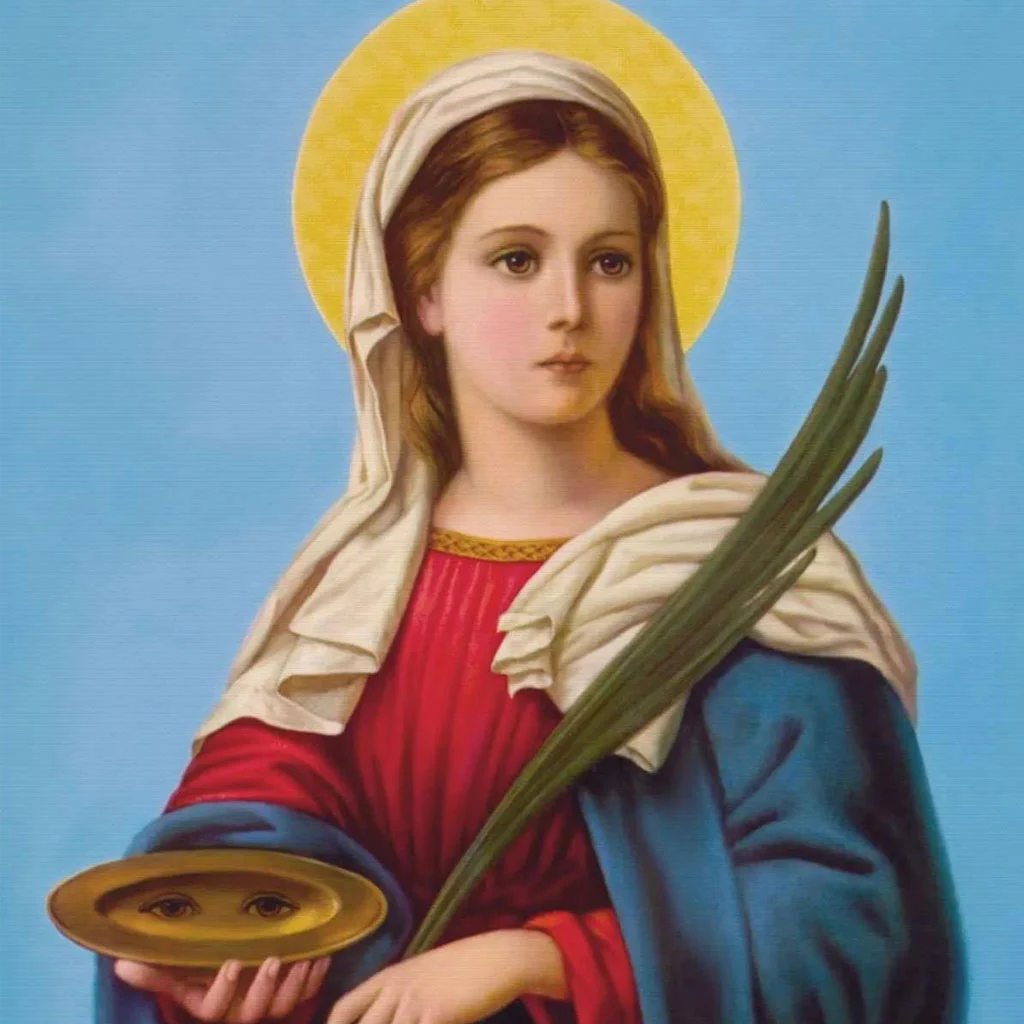
- Common Symbols: Palm branch, lamp, candle, sword, and a dish holding eyes
- Liturgical Significance: Named in the Roman Canon, or Eucharistic Prayer I
- Historical Note: Her early veneration is well attested, but many familiar biographical details come from later traditions
Who Was Saint Lucy of Syracuse?
Saint Lucy is traditionally remembered as a young Christian woman who lived in Syracuse, an important city on the island of Sicily.
Her life is commonly placed during the persecution of Christians under Emperor Diocletian.
This period was marked by efforts to suppress Christian worship and compel believers to participate in Roman religious practices.
According to later accounts, Lucy belonged to a prosperous family and was raised in the Christian faith.
She developed a deep devotion to Jesus Christ and resolved to dedicate her life to Him.
Her story describes a young woman who valued faithfulness to God more than wealth, social expectations, or personal safety.
Although the precise details of her childhood and family circumstances cannot be established from contemporary records, her reputation as a virgin martyr became firmly established in the early Church.
Her example continues to encourage Catholics to place their trust in Christ.
Early Life and Christian Faith
Traditional accounts describe Saint Lucy as the daughter of a wealthy family in Syracuse.
Her father is said to have died while she was young, leaving her mother, Eutychia, to care for her.
Lucy was raised in an environment where Christianity had already taken root, although Christians continued to face periods of persecution.
As she grew older, Lucy reportedly developed a strong desire to dedicate her life entirely to Jesus Christ.
She resolved to remain unmarried and preserve her virginity as an expression of her commitment to God.
Her decision reflected the early Christian understanding that a life of consecrated virginity could be a particular form of discipleship.
In the Church, both marriage and consecrated life are honored as paths through which believers can respond to God’s call.
Saint Lucy’s traditional witness reminds us that every vocation requires faithfulness, generosity, and trust in the Lord.
Saint Lucy and the Healing of Her Mother
One of the best-known traditions about Saint Lucy concerns her mother, Eutychia, who reportedly suffered from a serious illness involving persistent bleeding.
According to the story, Lucy accompanied her mother on a pilgrimage to the tomb of Saint Agatha in Catania, Sicily.
Saint Agatha was another early Christian virgin and martyr whose intercession was widely sought.
During the pilgrimage, Lucy prayed earnestly for her mother’s healing.
The tradition recounts that Eutychia was healed through the intercession of Saint Agatha.
Lucy then encouraged her mother to allow her to distribute family wealth to people experiencing poverty.
This account belongs to the later devotional narratives surrounding Saint Lucy rather than to contemporary historical documentation.
Nevertheless, it communicates an important spiritual message.
Prayer and gratitude should inspire us to respond generously to the needs of others.
Saint Lucy’s Generosity Toward the Poor
Saint Lucy is traditionally remembered for her desire to share her family’s possessions with the poor.
According to her later biography, she began distributing money and property to people in need after her mother’s healing.
Her generosity was connected to her decision to dedicate her life to Jesus Christ.
She believed that material wealth should not prevent her from responding fully to God’s call.
The traditional account describes her willingness to sacrifice personal comfort for the sake of others.
Although the historical details cannot be independently verified, the story reflects a central teaching of the Gospel.
Jesus calls His followers to love their neighbors and care for those who are vulnerable.
Saint Lucy’s example encourages us to examine how we use the blessings entrusted to us.
Even when we cannot give much financially, we can offer time, compassion, prayer, and practical assistance.
Saint Lucy and the Roman Persecution
Saint Lucy’s martyrdom is traditionally placed during the persecution of Christians under Emperor Diocletian.
In the early fourth century, imperial authorities issued measures against Christian communities.
Churches were destroyed, sacred writings were confiscated, and some Christians were pressured to renounce their faith.
Later accounts describe Lucy being denounced to Roman authorities after she refused a proposed marriage.
The rejected suitor reportedly accused her of being a Christian.
Lucy was then brought before a Roman official and ordered to abandon her faith.
According to the tradition, she refused.
She remained committed to Jesus Christ despite threats and punishment.
The detailed conversations and events in these narratives were recorded long after her lifetime and should not be treated as verified historical transcripts.
However, Saint Lucy’s ancient veneration as a martyr reflects the Church’s enduring memory of her witness to Christ.
The Martyrdom of Saint Lucy
The traditional account of Saint Lucy’s martyrdom describes her steadfast refusal to renounce Christianity.
When threats failed to change her decision, the Roman authorities reportedly ordered her to be punished.
Some versions of the story describe attempts to move her by force, but she remained miraculously immovable.
Other accounts include attempts to harm her through fire.
The tradition ultimately describes her death by a sword or dagger wound.
These dramatic details belong to later hagiographical narratives and cannot be independently confirmed.
Saint Lucy is traditionally believed to have died around AD 304 in Syracuse.
Her witness has long been honored as an example of fidelity to Jesus Christ.
For Catholics, the meaning of martyrdom is not found in suffering for its own sake.
It is found in the love and faithfulness of those who refuse to abandon Christ.
Why Is Saint Lucy the Patron Saint of Eyesight?
Saint Lucy is widely honored as the patron saint of people who are blind or experiencing problems with their eyes.
Her association with eyesight developed through devotional traditions and the symbolism of her name.
The name Lucy comes from the Latin word lux, meaning light.
Over time, this association contributed to her patronage of vision and her depiction in religious art.
Later stories also describe miraculous events involving her eyes.
Some versions claim that her eyes were removed during persecution, while others describe her offering them as a sign of devotion.
These stories are not supported by the earliest evidence for her life.
Nevertheless, Saint Lucy’s patronage has remained meaningful for generations of Catholics.
People pray for her intercession when facing eye diseases, vision loss, or medical procedures involving their eyesight.
Her example also encourages us to ask God for spiritual sight: the grace to recognize His presence and follow His will.
Why Is Saint Lucy Shown Holding a Dish with Eyes?
One of the most recognizable images of Saint Lucy depicts her holding a small dish or plate containing two eyes.
This unusual symbol refers to later devotional traditions concerning her eyesight.
The eyes also reflect her association with light and vision.
Other common symbols include a palm branch, representing martyrdom, and a lamp or candle, representing light.
Saint Lucy is sometimes shown holding a sword, which refers to the traditional account of her death.
These symbols help communicate her spiritual legacy through Christian art.
They remind us of courage, faithfulness, and the hope that Jesus Christ brings to those who experience suffering.
Saint Lucy and the Light of Jesus Christ
The symbolism of light is central to devotion to Saint Lucy.
Her name is closely connected with the Latin word for light.
For Christians, light is a powerful biblical image of truth, hope, holiness, and the presence of God.
Jesus Christ identifies Himself as the Light of the World.
His coming brings hope to humanity and reveals the path toward salvation.
Saint Lucy’s traditional witness reminds us that faith can remain strong even when life becomes difficult.
We may experience darkness through illness, grief, uncertainty, or personal struggles.
Yet the love of Christ continues to guide us.
Saint Lucy encourages us to trust that God’s light is stronger than fear and despair.
Her example is especially meaningful during Advent, when the Church prepares to celebrate the birth of Jesus Christ.
Saint Lucy’s Feast Day and Advent
The Catholic Church celebrates the memorial of Saint Lucy on December 13.
Her feast falls during the Advent season, a time of preparation for Christmas.
Advent invites Catholics to renew their hope in Jesus Christ and prepare their hearts for His coming.
Saint Lucy’s association with light fits naturally within this season.
As the Church awaits the celebration of Christ’s birth, her example encourages believers to remain faithful and hopeful.
In several European countries, especially Sweden, Saint Lucy’s Day is marked by processions and celebrations involving candles and white clothing.
These customs developed long after her lifetime and reflect regional Christian traditions.
For Catholic families, her feast day offers an opportunity to pray for courage, help those in need, and remember that Jesus Christ is the true Light of the World.
Saint Lucy in the Roman Canon
Saint Lucy holds a special place in the liturgical tradition of the Catholic Church.
Her name is included among the women martyrs commemorated in the Roman Canon, now known as Eucharistic Prayer I.
This ancient Eucharistic prayer also remembers saints such as Agatha, Agnes, Cecilia, Anastasia, and others.
Her inclusion reflects the longstanding importance of her veneration within the Church.
During the celebration of the Eucharist, Catholics are united in worship with the saints who have gone before us in faith.
Saint Lucy’s name reminds us of the courage of the early Christian martyrs and their enduring witness to Jesus Christ.
The Relics and Veneration of Saint Lucy
Devotion to Saint Lucy began in Sicily and spread throughout the Christian world.
Her association with Syracuse remains especially strong.
An early inscription from Syracuse provides important evidence of devotion to Lucy in late antiquity.
Over the centuries, churches were dedicated to her, and her feast became widely celebrated.
Relics attributed to Saint Lucy have been associated with different locations, including Venice and Syracuse.
The history of their transfers is complex and includes medieval traditions.
Her enduring veneration demonstrates how deeply her witness has influenced Christian prayer and devotion.
Today, Saint Lucy continues to be honored in Catholic and Eastern Christian communities.
Saint Lucy and the Blessed Virgin Mary
Saint Lucy’s traditional witness reflects virtues that Catholics also contemplate in the life of the Blessed Virgin Mary.
Both are associated with faithfulness, purity, humility, and trust in God.
Mary responded to the angel Gabriel with a generous acceptance of God’s will.
She remained faithful to Jesus throughout His earthly life, including during His suffering and death.
Saint Lucy’s story similarly encourages us to remain committed to Christ during times of difficulty.
Although no reliable historical evidence establishes the details of Lucy’s personal Marian devotions, her example can inspire Catholics to imitate Mary’s faith.
Through the intercession of the Blessed Virgin Mary, we can ask for the grace to remain courageous, pure of heart, and faithful to Jesus Christ.
Saint Lucy of Syracuse and the Holy Rosary
Saint Lucy lived in the early fourth century, long before the Holy Rosary developed into the form familiar to Catholics today.
It would therefore be historically inaccurate to claim that she practiced the modern Rosary.
Nevertheless, her witness offers meaningful reflections for those who meditate on the mysteries of Jesus Christ.
The Joyful Mysteries invite us to contemplate the coming of Jesus, the Light of the World.
During Advent, the Annunciation and Nativity remind us that God entered human history to bring salvation.
The Sorrowful Mysteries encourage us to reflect on the suffering and sacrifice of Jesus Christ.
Saint Lucy’s traditional martyrdom reminds us of the courage needed to remain faithful during trials.
The Glorious Mysteries invite us to contemplate Christ’s victory over death and the hope of eternal life.
As we pray the Holy Rosary, we can ask God to strengthen our faith and help us bring His light into the lives of others.
Lessons We Can Learn from Saint Lucy of Syracuse
1. Remain faithful during difficulties
Saint Lucy’s traditional witness reminds us that faith in Jesus Christ should remain strong even when life becomes challenging.
2. Let Christ guide our lives
Her association with light encourages us to seek guidance through prayer, Scripture, and the teachings of the Church.
3. Practice generosity toward others
The stories of her charity remind us that love for God should inspire concern for people experiencing poverty and hardship.
4. Pray for those who are sick
As a patron saint of eyesight, Saint Lucy reminds us to accompany those facing illness with compassion and prayer.
5. Prepare our hearts during Advent
Her December 13 memorial encourages us to approach Christmas with hope, prayer, and renewed love for Jesus Christ.
Prayer to Saint Lucy of Syracuse
Saint Lucy of Syracuse, courageous virgin and martyr of Jesus Christ, we ask for your intercession as we seek to grow in faith, hope, and love.
You are remembered for remaining faithful to the Lord during persecution and for your compassion toward those in need.
Pray for all who suffer from blindness, eye diseases, or difficulties with their vision.
Intercede for those awaiting medical treatment, recovering from surgery, or facing uncertainty about their health.
Comfort their families and guide the hands of those who care for them.
Help us also to receive the gift of spiritual sight, that we may recognize God’s presence, understand His will, and follow the teachings of Jesus Christ.
Through the loving intercession of the Blessed Virgin Mary, may we remain steadfast in prayer and allow the light of Christ to shine through our words and actions.
Saint Lucy of Syracuse, pray for us, that we may walk faithfully in the light of the Lord.
Amen.
Frequently Asked Questions About Saint Lucy of Syracuse
When is the feast day of Saint Lucy of Syracuse?
The Catholic Church celebrates the memorial of Saint Lucy of Syracuse on December 13.
Who was Saint Lucy of Syracuse?
Saint Lucy was an early Christian virgin and martyr traditionally associated with Syracuse, Sicily, during the persecution under Emperor Diocletian.
What is Saint Lucy the patron saint of?
Saint Lucy is widely honored as the patron saint of people who are blind and those experiencing eye diseases or vision problems.
Why is Saint Lucy associated with eyes?
Her association with eyesight developed through the meaning of her name, which is connected with light, and through later devotional stories concerning her eyes.
Why is Saint Lucy depicted holding a plate with eyes?
The dish containing eyes refers to later traditions about her martyrdom and symbolizes her patronage of eyesight.
How did Saint Lucy die?
According to traditional accounts, Saint Lucy was martyred in Syracuse during the early fourth century. The details of her death vary among later narratives and cannot be independently verified.
Why is Saint Lucy celebrated during Advent?
Her feast day falls on December 13, during Advent. Her association with light offers a meaningful reminder of Jesus Christ, the Light of the World.
Is Saint Lucy mentioned in the Catholic Mass?
Yes. Saint Lucy is named among the women martyrs commemorated in Eucharistic Prayer I, also known as the Roman Canon.
Where are Saint Lucy’s relics?
Relics attributed to Saint Lucy have been venerated in Venice and Syracuse. Their history involves several medieval transfers and traditions.
Did Saint Lucy pray the Holy Rosary?
Saint Lucy lived centuries before the modern Rosary developed. Her courage and faithfulness can nevertheless inspire Catholics who meditate on the mysteries of Jesus Christ.
Conclusion
Saint Lucy of Syracuse remains an enduring symbol of Christian courage, purity, and hope.
Although many details of her traditional biography cannot be historically verified, her ancient veneration reflects the lasting influence of her witness to Jesus Christ.
As we commemorate her feast day on December 13, may her example encourage us to remain faithful during suffering, show compassion to those in need, and seek the light of Christ in every circumstance.
During Advent, may we prepare our hearts to welcome Jesus, the true Light of the World.
Through the intercession of the Blessed Virgin Mary, may our prayers strengthen our faith and help us bring hope to others.
Saint Lucy of Syracuse, pray for us.