
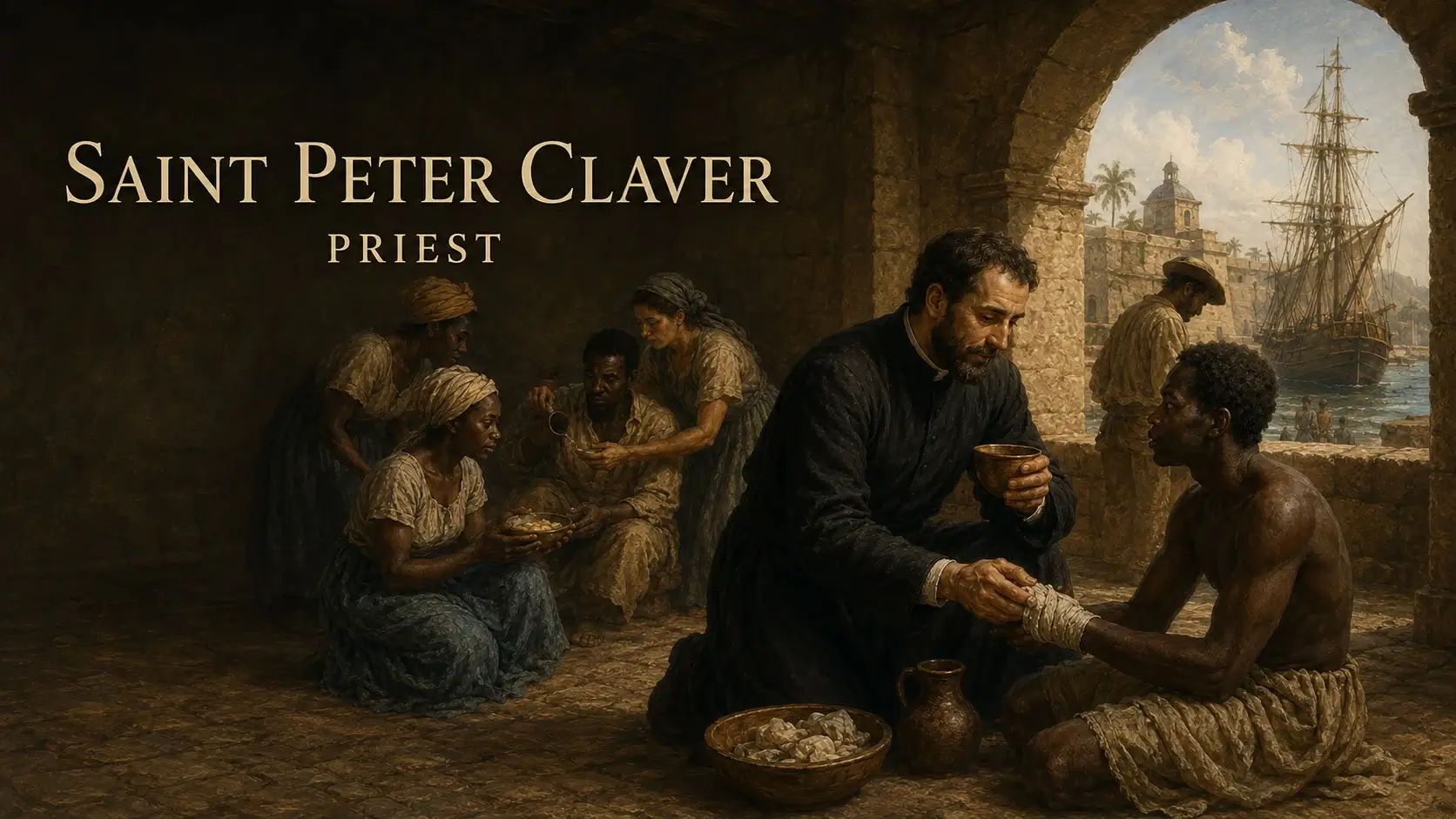
On September 9, the Church remembers Saint Peter Claver, a Jesuit priest who devoted his life to serving enslaved Africans arriving at the port of Cartagena in present-day Colombia.
He encountered men, women and children who had survived a brutal journey across the Atlantic. They arrived hungry, sick, injured and separated from their homes and families. In a society that treated them as property, Peter Claver approached them as persons made in the image of God.
He brought food, water and medicine. He cleaned wounds, sought the help of interpreters and remained close to people whose suffering others preferred not to see. His ministry reminds us that Christian mercy cannot remain only a feeling. Mercy draws near, recognizes a person’s dignity and responds to concrete needs.
A Life Sent Beyond the Familiar
Peter Claver was born in 1580 in Catalonia, Spain. As a young man, he entered the Society of Jesus. During his formation, he was encouraged by Saint Alphonsus Rodriguez to consider missionary service in the Americas.
He arrived in the region in 1610, completed his theological studies and was ordained a priest in Cartagena in 1616. Cartagena was then a major port in the transatlantic slave trade. Ships carried captive Africans into the city after voyages marked by confinement, disease, hunger and death.
Peter could not dismantle that vast and violent system by himself. Nor should his personal ministry be mistaken for the abolition of slavery. What he did was refuse the indifference that allowed dehumanization to continue unchallenged. He entered the places others avoided and served people whom the surrounding culture had rejected.
He would spend decades in this work.
Mercy Expressed Through Hands and Assistance
When a slave ship arrived, Peter gathered provisions he had begged from others. With interpreters and assistants, he went to meet the captives. He offered fruit, bread, water, medicine and clothing. He tended the sick and injured, then shared the Christian faith with those he served.
An account preserved by the Jesuits records his conviction that the first response could not consist only of speech. He addressed people through his hands and his assistance.
That approach carries a lasting spiritual lesson. Words about God’s love become difficult to hear when a person’s hunger, wounds or fear are being ignored. Peter understood that care could prepare the way for trust. His actions did not replace the proclamation of Christ. They gave visible form to the love he proclaimed.
The works of mercy still ask the same of us. A hungry person needs food. A sick person needs care. A lonely person needs presence. A migrant or refugee needs to be treated as a human being rather than a problem. A person experiencing discrimination needs more than our private disapproval. Christian love must become action.
Seeing the Person Others Have Reduced to a Label
Slavery depends upon a terrible lie: that one human being may possess another and deny that person’s freedom, family, history and dignity. Peter Claver entered a society shaped by this lie and chose to meet enslaved people face to face.
He did not encounter an anonymous mass. He relied on interpreters to communicate across languages. He listened, taught, comforted and cared for individuals. His ministry was imperfectly situated within the limitations of his time, but his sustained presence testified to a truth the slave trade denied: every person belongs to God.
Our own age uses different labels, but the temptation to stop seeing the person remains. People may be reduced to their poverty, race, illness, immigration status, disability, addiction, past mistakes or usefulness to society. Once someone becomes only a category, indifference becomes easier.
Saint Peter Claver challenges us to look again. Who is being spoken about but rarely listened to? Who is present in our community but treated as invisible? Whose suffering have we accepted because addressing it would disturb our comfort?
Faith That Enters Difficult Places
Peter’s ministry was physically and emotionally demanding. He entered crowded ship holds and cared for people suffering from disease. He also visited hospitals, prisoners and people with leprosy. His service placed him repeatedly near pain, infection and death.
He did not wait for suffering to become clean, convenient or easy to understand. He went where people needed him.
This does not mean every Christian is called to the same work. It does mean that discipleship will sometimes require us to cross a boundary of discomfort. We may need to sit beside someone in grief when we have no answer, welcome someone whom our social circle distrusts, challenge a demeaning remark or give time and resources to a need that offers us nothing in return.
We should also recognize that charity and justice belong together. Immediate care matters, but so does resisting the conditions that keep people oppressed. We are called both to help the person who is suffering and to reject the attitudes and structures that deny human dignity.
The People Who Need Us to Draw Near
The forms of slavery have not disappeared. Human trafficking, forced labor, sexual exploitation, debt bondage and the abuse of migrant workers continue to harm millions of people. Racism and discrimination also continue to exclude people from safety, opportunity and belonging.
The example of Saint Peter Claver does not allow us to treat these realities as distant issues. His life asks what mercy requires from us now.
For some, the answer may involve supporting organizations that protect trafficking survivors or displaced families. For others, it may mean treating workers fairly, refusing exploitative services, learning to recognize signs of abuse or using professional skills to serve a community that lacks access.
The first step is often simple: refuse to look away.
Prayer Through the Intercession of Saint Peter Claver
Heavenly Father,
You gave Saint Peter Claver the courage to recognize and serve Your beloved children in the midst of cruelty and injustice. Through his intercession, open our eyes to every person whose dignity is ignored or denied.
Free those who are trapped in human trafficking, forced labor and every form of modern slavery. Protect migrants, refugees, prisoners, the poor and all who suffer discrimination. Strengthen those who work for their freedom, healing and protection.
Give us compassionate hearts, but do not let our compassion remain only in words. Show us how to offer practical help, defend what is right and draw near to those whom others avoid.
May we recognize Christ in every person and serve Him with humility, courage and love.
Saint Peter Claver, pray for us.
Amen.
Sources
- Society of Jesus, Saint Peter Claver
- Society of Jesus, Saint Peter Claver: Total Self-Giving Through Generous Hospitality
- USCCB, Memorial of Saint Peter Claver
- USCCB, Readings for the Memorial of Saint Peter Claver, September 9, 2026
Related Articles