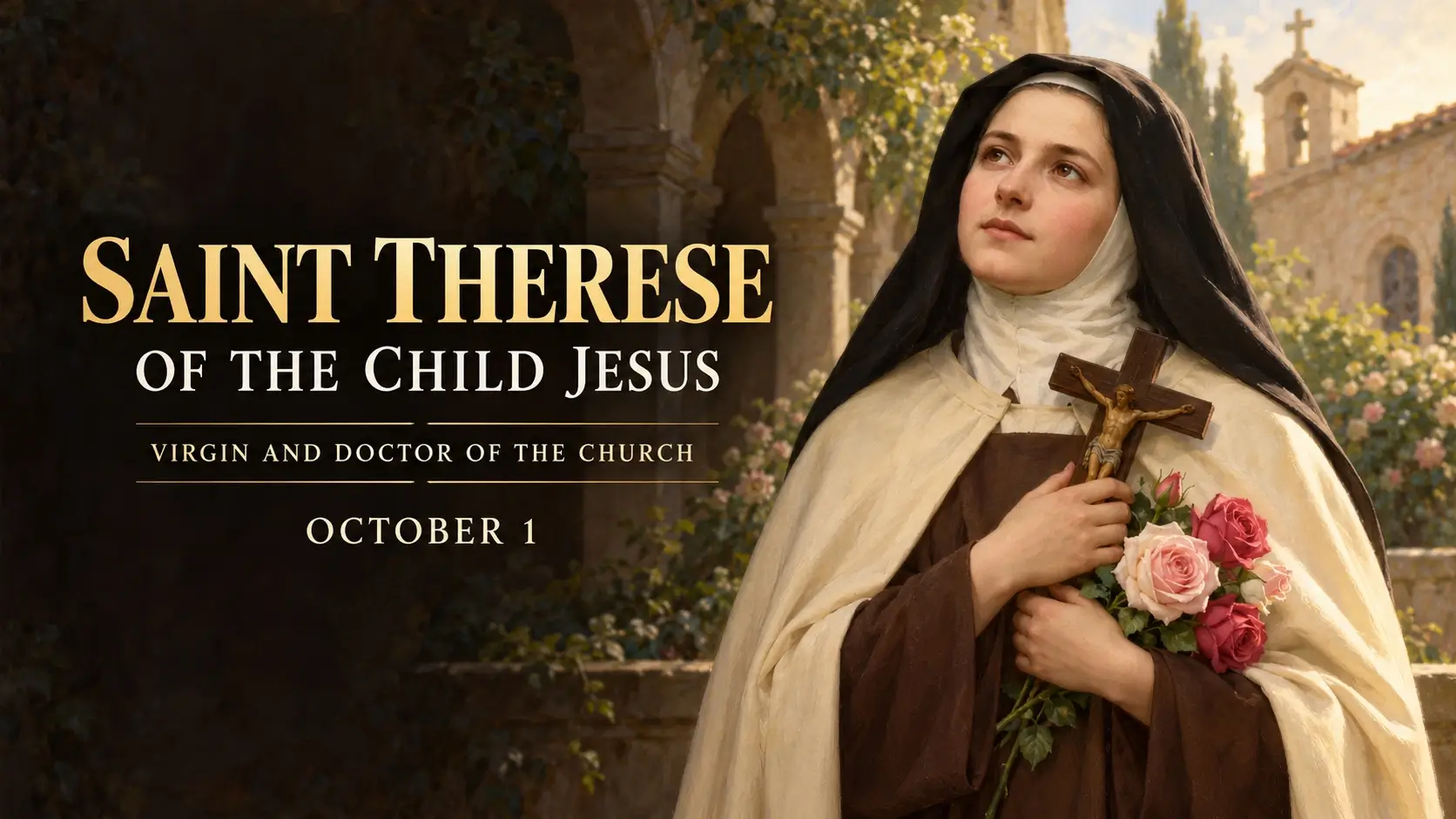
Saint Thérèse of Lisieux lived only twenty-four years, spent most of her religious life within a Carmelite monastery, and never traveled to a mission territory. Yet the Church honors her as a Doctor of the Church and a patroness of the missions.
Her influence did not come from public achievements or an extraordinary position. It came from a simple but demanding conviction: holiness is found by trusting completely in God’s mercy and doing ordinary things with great love.
On her memorial, Saint Thérèse invites us to stop measuring our spiritual life only by visible results. God can receive the smallest faithful act and make it fruitful far beyond what we see.
A Brief Life Hidden with Christ
Marie Françoise-Thérèse Martin was born in Alençon, France, on January 2, 1873. She was the youngest surviving daughter of Louis and Zélie Martin, who were later canonized together. After her mother’s death, the family moved to Lisieux.
Thérèse was sensitive, affectionate, and deeply attached to her family. Her childhood also included grief, illness, and periods of emotional struggle. At Christmas in 1886, she experienced a decisive interior conversion that gave her new courage and freedom from excessive self-concern.
She desired to enter the Carmelite monastery at Lisieux while still very young. After persistent appeals, including a request made to Pope Leo XIII during a pilgrimage to Rome, she entered Carmel at the age of fifteen.
Her life in the monastery was outwardly ordinary. She prayed, worked, lived in community, endured misunderstandings, and completed small duties that often went unnoticed. She died of tuberculosis on September 30, 1897.
After her death, her writings were published under the title Story of a Soul. Through them, the Church discovered the spiritual wisdom hidden within her brief and quiet life.
What Is the Little Way?
Thérèse knew that she could not perform the great deeds she admired in missionaries and martyrs. She was also honest about her weaknesses. Instead of becoming discouraged, she placed greater confidence in Jesus.
Her “little way” is the path of spiritual childhood. It means recognizing our dependence on God, trusting his merciful love, and offering him the small actions of daily life.
This is not childishness, passivity, or an excuse to avoid sacrifice. A child who trusts a loving parent still has to walk, obey, learn, and get up after falling. The little way requires humility because it accepts that we cannot save or perfect ourselves through willpower alone.
Pope Francis explained that this way is open to everyone, whatever their age or state of life. It begins with God’s grace rather than our achievements. We cooperate through faithfulness, but we do not pretend that holiness is something we manufacture.
Small Actions, Real Love
Thérèse practiced charity in the ordinary tensions of community life. She chose patience with people she found difficult. She served sisters who were sick or demanding. She resisted the desire to defend herself when misunderstood. She tried to make each duty an offering of love.
These actions may appear small, but they were not easy. The value of the act came from the love and surrender within it.
Most Christians will not be asked to do something publicly heroic. We are asked to answer the person who needs our attention, complete our work honestly, care for our families, forgive repeated offenses, pray when we feel distracted, and remain faithful when no one notices.
The little way gives these moments eternal importance. Nothing offered to Christ in love is wasted.
Trust Is Not the Absence of Darkness
Saint Thérèse is often associated with flowers, sweetness, and simplicity. Those images can hide the severity of her final trial.
During the last eighteen months of her life, while tuberculosis weakened her body, she endured a painful darkness of faith. Heaven no longer felt close or certain. She described herself as sharing the table of unbelievers and continued to make acts of faith even when she received no emotional consolation.
Her confidence in God was therefore not optimism based on pleasant feelings. It was a decision to trust Christ while suffering and unable to see clearly.
This makes her teaching especially helpful when prayer feels dry, plans fail, illness persists, or God seems silent. Faithfulness in darkness is not lesser faith. It can be a profound act of love.
“My Vocation Is Love”
Thérèse had many desires. She wanted to be a missionary, priest, martyr, apostle, and teacher. Reading Saint Paul’s teaching about the Church as the Body of Christ helped her understand that not every person has the same role. Reading his hymn to charity in 1 Corinthians 13 gave her the answer.
She discovered that love animates every vocation. In the heart of the Church, she would be love.
This insight explains why a cloistered nun became patroness of the missions. She supported missionaries through prayer, sacrifice, correspondence, and love for souls. Mission is not limited to travel or preaching. Every Christian can participate in Christ’s mission through prayer, witness, generosity, and faithful service.
The Rosary offers a practical way to live this missionary love. We can dedicate each decade to someone who needs grace: a family member, a person far from the Church, a missionary, someone who is sick, or a soul known only to God.
The Little Way and the Holy Rosary
Saint Thérèse loved the Blessed Virgin Mary, but she preferred a simple and Gospel-centered understanding of Mary. She saw Our Lady’s greatness in her humility, faith, poverty, and closeness to Jesus.
The Rosary follows this same ordinary path. Its repeated prayers are simple, but they carry us through the mysteries of Christ’s life. We do not need complicated words. We come with our limitations and allow Mary to lead us toward her Son.
When concentration is difficult, we can still offer the decade faithfully. When our prayer feels small, we can trust that God receives it. A Rosary prayed with weakness and perseverance can be a genuine act of the little way.
Living the Little Way Today
Saint Thérèse’s spirituality becomes practical when we stop waiting for ideal conditions.
Choose one small act of love that is already within reach:
- Complete an unnoticed duty without seeking praise.
- Listen patiently instead of preparing a quick reply.
- Pray one decade for a person who has hurt you.
- Accept a minor inconvenience without complaining.
- Encourage someone who feels forgotten.
- Return to prayer after distraction without discouragement.
- Entrust an unresolved worry to God’s mercy.
These actions are not impressive, but they train the heart to love. Repeated with grace, they shape a life.
Doctor of the Church
Saint John Paul II proclaimed Thérèse a Doctor of the Church in 1997. The title recognizes that her teaching offers reliable and important guidance for the whole Church.
Her doctrine is not complicated. God loves us first. His mercy is greater than our weakness. We should respond with confidence, surrender, and concrete charity. Holiness is possible in every vocation because every moment can become an offering of love.
This teaching corrects two common errors. The first is spiritual pride, which trusts in personal achievement. The second is discouragement, which assumes our weakness prevents us from becoming saints. Thérèse answers both with confidence in Jesus.
Prayer to Saint Thérèse
Saint Thérèse of the Child Jesus, faithful daughter of the Church, teach us your little way of trust and love.
Help us to accept our weakness without discouragement and to depend more completely on the mercy of Jesus. Show us how to offer our ordinary duties, hidden sacrifices, and quiet acts of charity for the good of others.
Pray for us when faith feels difficult and when God seems silent. Obtain for us perseverance in prayer, patience with those around us, and a heart ready to love without seeking recognition.
May our lives, however simple, help make Jesus known and loved. Saint Thérèse, Virgin and Doctor of the Church, pray for us. Amen.
Related Articles