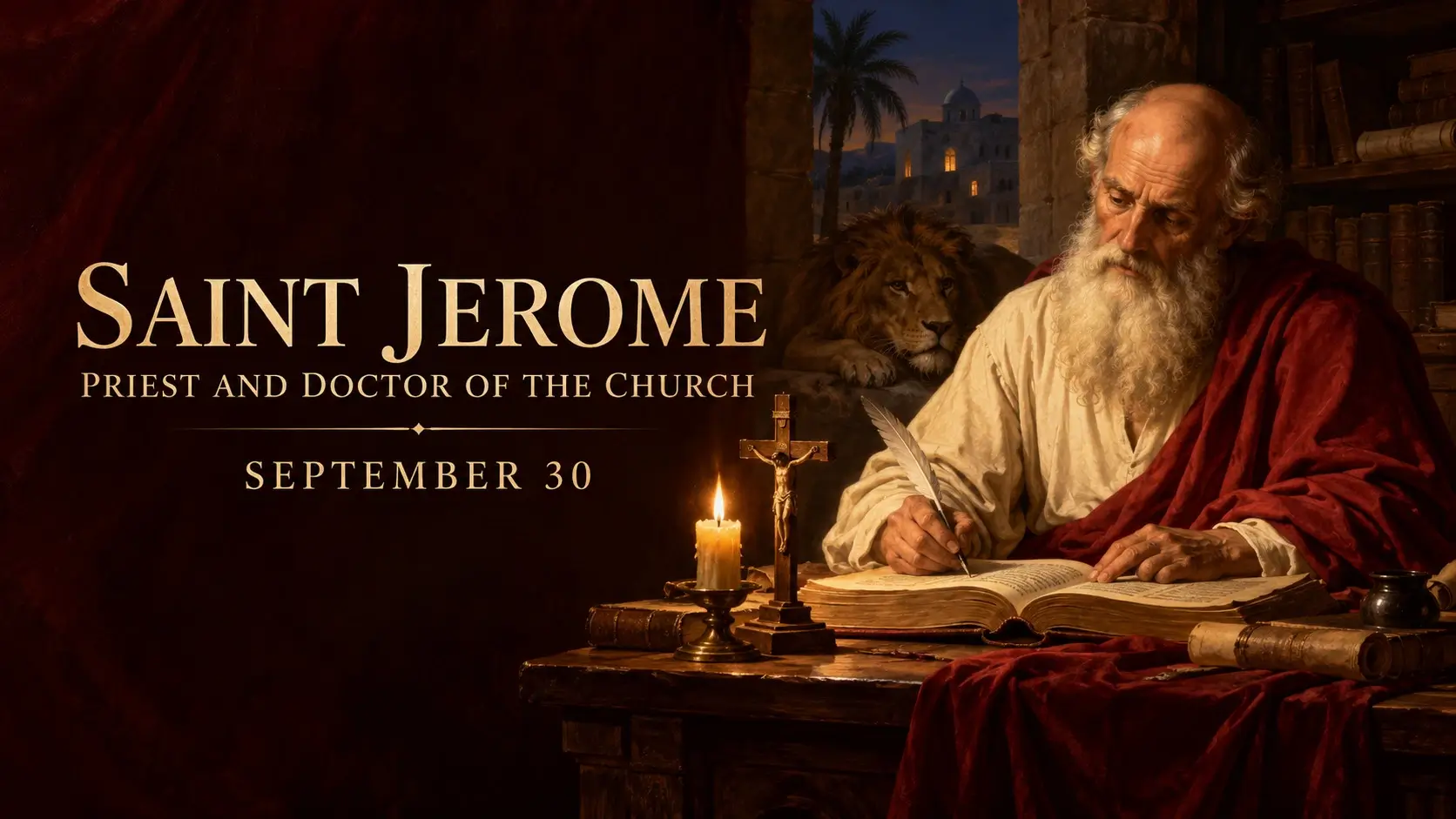
Saint Jerome is remembered as a priest, scholar, translator, and Doctor of the Church whose life was shaped by an intense love for the Word of God. His learning was immense, but his deepest purpose was not academic recognition. He wanted Christians to know Jesus Christ through the Scriptures and to allow God’s Word to reform their lives.
His memorial on September 30 invites us to ask a direct question: What place does Sacred Scripture hold in my daily life?
From Student to Servant of the Word
Jerome was born around the year 347 in Stridon, a town near the border of Dalmatia and Pannonia. As a young man, he went to Rome, where he received a strong classical education. He studied grammar, rhetoric, philosophy, and the great works of Latin literature. He also received Baptism and gradually began to understand that his intelligence and love of language were gifts meant to be placed at the service of Christ.
His conversion was not a single, effortless moment. Jerome wrestled with ambition, comfort, and his attachment to literary prestige. He later embraced an ascetic life of prayer, penance, study, and solitude. He was ordained a priest, traveled widely, and eventually settled in Bethlehem, near the place of the Lord’s birth.
There he spent the final decades of his life praying, teaching, welcoming pilgrims, guiding religious communities, writing commentaries, defending the faith, and laboring over biblical texts. He died in Bethlehem in 420.
A Great Work for the Church
Jerome knew Greek and learned Hebrew, an unusual achievement among Latin-speaking Christian scholars of his time. Drawing on the original languages and earlier translations, he revised the Latin text of the Gospels and translated much of the Old Testament. His work became central to the Latin Bible later known as the Vulgate.
Translation is more than replacing one word with another. It demands careful judgment, knowledge of history and grammar, attention to context, and humility before the meaning of the text. Jerome gave years of disciplined labor to this task so that Christians could hear God’s Word more clearly in the language they understood.
Pope Benedict XVI described this work as invaluable for the Latin Church and Western culture. Pope Francis later recalled Jerome as a man who placed the Bible at the center of his life. His scholarship mattered because it served the faith of the Church.
“Ignorance of Scripture Is Ignorance of Christ”
Jerome’s best-known teaching is simple and demanding: “Ignorance of Scripture is ignorance of Christ.” He did not mean that faith could be reduced to collecting biblical facts. He meant that the written Word leads us to the living Word, Jesus Christ.
We read Scripture not merely to finish a chapter, win an argument, or acquire information. We read so that Christ may speak to us, correct us, console us, and teach us how to love. The Bible belongs in the prayer of the Church, in the home, and in the ordinary decisions of Christian life.
This is why Jerome’s example remains so timely. Many words compete for our attention each day. News, messages, videos, and opinions can fill every quiet moment. Saint Jerome reminds us to make room for the one Word that reveals who we are, where we are going, and how God has acted to save us.
Zeal That Needed Charity
Jerome was courageous and brilliant, but he was not mild in every controversy. His letters could be sharp, and his disputes sometimes became personal. The Church does not honor him because every word he spoke was perfectly measured. She honors the grace of God at work in a real human life, with great gifts and real weaknesses.
That part of his story offers another lesson. Knowledge of Scripture should make us more humble, patient, and charitable. If biblical study only makes us eager to defeat others, something has gone wrong. The Word of God is meant to judge our hearts before we use it to judge anyone else.
Truth and charity must remain together. We should defend the faith clearly, but we should also remember that the person before us is made in the image of God. Saint Jerome’s whole life, including his struggles, calls us to place our intelligence, temperament, and speech under the discipline of Christ.
How to Read Scripture with Saint Jerome
You do not need Jerome’s command of ancient languages to begin. A faithful daily practice can start with ten quiet minutes.
- Ask for light. Begin with a simple prayer to the Holy Spirit. Ask for a listening heart, not merely a quick answer.
- Read a short passage slowly. A paragraph from one of the Gospels is enough. Read it twice and notice the words or actions that stand out.
- Listen in the Church. Use a reliable Catholic Bible and read passages within the whole faith handed on by the Church. Footnotes, a Catholic commentary, and the daily Mass readings can help.
- Speak honestly with God. Tell the Lord what consoles, challenges, or confuses you. Prayer grows through honest attention.
- Respond with one action. Let the passage shape something concrete: an apology, a work of mercy, a restrained word, a duty completed well, or a decision to trust God.
Consistency matters more than quantity. A few verses received with faith can bear more fruit than many pages read in haste.
Saint Jerome and the Holy Rosary
The Rosary is deeply scriptural. In each mystery, we return to the saving events proclaimed in the Gospels: the Annunciation, the birth of Christ, his public ministry, his Passion, and his Resurrection and glory. With Mary, we ponder the Word made flesh.
Saint Jerome can help us pray the Rosary with greater attention to Scripture. Before beginning a decade, read the corresponding Gospel passage. Pause briefly. Notice what Jesus says and does, how Mary responds, and what grace the mystery asks us to receive. Then pray the Hail Marys while holding that scene in the heart.
This simple practice unites biblical reading and Marian prayer. Mary never keeps our attention for herself. She leads us to her Son and teaches us to treasure his words.
A Simple Practice for September 30
Place a Bible in your prayer space today. Read a short Gospel passage slowly, perhaps the account of the Annunciation in Luke 1:26-38 or the call of the first disciples in Mark 1:16-20. Choose one sentence to carry through the day.
If daily Scripture reading has faded from your routine, begin again without discouragement. Set a realistic time and keep it. Five faithful minutes each day can open a path of lifelong friendship with Christ.
Prayer to Saint Jerome
Saint Jerome, faithful priest and devoted servant of Sacred Scripture, pray for us.
Help us to approach the Word of God with reverence, patience, and humility. Teach us to seek Jesus Christ on every page and to welcome his truth into our minds and hearts.
Pray that our study may lead to prayer, our prayer to conversion, and our conversion to works of charity. Guard us from pride, careless speech, and the desire to use truth against others. Obtain for us courage to defend the faith with clarity and love.
May the Holy Spirit give us a hunger for Scripture, and may the Blessed Virgin Mary teach us to keep the Word of God faithfully.
Saint Jerome, Priest and Doctor of the Church, pray for us. Amen.
Related Articles