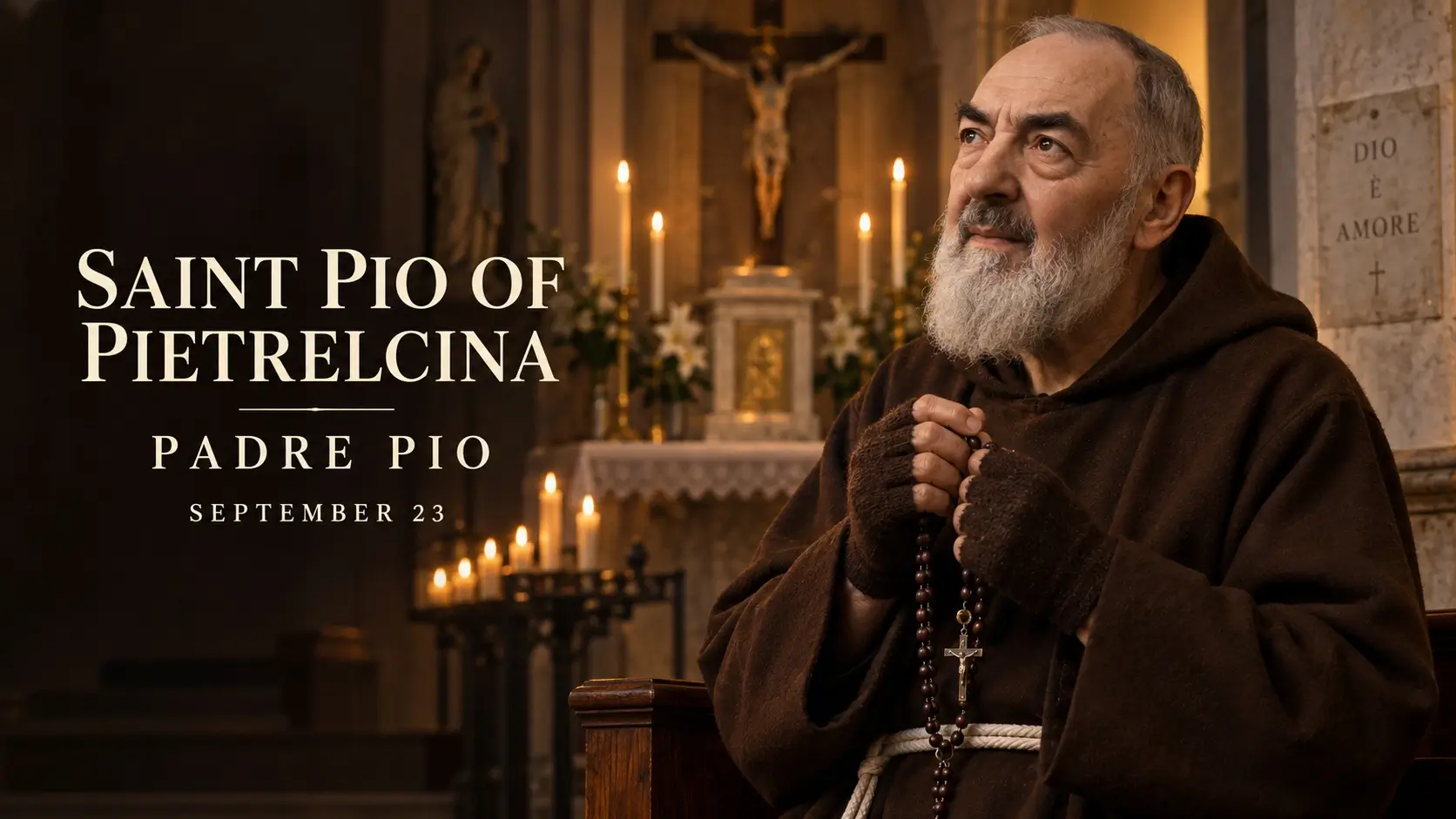
Many Catholics know Saint Pius of Pietrelcina simply as Padre Pio. His name is associated with remarkable spiritual gifts, the wounds of Christ, long hours in the confessional, and accounts of answered prayers. Yet the heart of his life was more demanding and more useful for our own discipleship: he remained close to Jesus through prayer, the Eucharist, suffering, and service.
The Church celebrates his memorial on September 23. His life reminds us that holiness is not built on extraordinary experiences. It grows through fidelity to Christ, sincere repentance, patient endurance, and practical love for those who suffer.
From Pietrelcina to the Capuchin life
Padre Pio was born Francesco Forgione on May 25, 1887, in Pietrelcina, a rural town in southern Italy. His family lived simply and practiced the Catholic faith with devotion.
From an early age, Francesco desired to give his life to God. He entered the Capuchin Franciscan order as a young man and received the religious name Pio. He was ordained a priest in 1910.
Poor health marked much of his early religious life. Eventually, he settled at the friary in San Giovanni Rotondo, where he would remain for decades. What began in a quiet and relatively unknown place became a ministry that drew people from many parts of the world.
They came seeking counsel, Confession, healing, and help in prayer. Padre Pio consistently directed their attention toward Christ.
A priest of the Eucharist
For Padre Pio, the celebration of Mass was not a routine responsibility. It was the center of his priestly life.
Those who attended his Masses often noticed the reverence and intensity with which he prayed. He understood the Eucharist as the sacrifice of Christ made present sacramentally. His devotion invited those around him to approach the altar with faith rather than distraction.
His example challenges us to examine how we participate in Mass. We may be physically present while our attention remains scattered among worries, plans, and notifications. Padre Pio reminds us that the Eucharist deserves preparation, silence, gratitude, and a heart willing to be changed.
Reverence does not require dramatic emotion. It begins with simple choices: arriving with enough time to pray, listening attentively to Scripture, receiving Holy Communion worthily, and remaining briefly in thanksgiving.
A minister of reconciliation
One of the defining works of Padre Pio’s ministry was hearing Confessions. He spent many hours each day helping people face sin honestly and receive God’s forgiveness.
He could be direct with penitents, especially when he sensed evasion or a lack of sincere repentance. His purpose was not humiliation. He wanted each person to understand the seriousness of sin and the greater reality of God’s mercy.
At Padre Pio’s canonization in 2002, Saint John Paul II described him as a generous dispenser of divine mercy, particularly through the Sacrament of Penance. The crowds that came to his confessional were seeking more than advice. They were seeking reconciliation with God.
His ministry corrects two common errors. The first is treating sin casually, as if our choices do not wound our relationship with God and others. The second is believing that our sins are too shameful to be forgiven.
Confession confronts both errors. It asks us to name our sins truthfully and then receive the mercy Christ gives through His Church.
Bearing the wounds of Christ
Padre Pio became known for bearing the stigmata, wounds corresponding to the Passion of Jesus. The Church examined these reported phenomena over many years.
For devotional purposes, it is important not to reduce his holiness to the wounds or to seek the sensational details surrounding them. Padre Pio did not preach himself. He pointed people toward the Crucified Lord.
Saint John Paul II taught that Padre Pio’s holiness cannot be understood apart from his constant reference to the Cross. His suffering became a place of union with Christ and intercession for others.
This does not mean that Christians should refuse medical care, remain in abusive situations, or treat pain as good in itself. Suffering is an evil we rightly seek to relieve. When suffering cannot be removed, however, it can be entrusted to Christ rather than allowed to destroy hope.
We can offer our unavoidable trials for someone who needs prayer, while still seeking proper treatment, protection, and support.
Prayer joined to charity
Padre Pio’s spirituality did not end with private devotion. He encouraged prayer groups and supported the creation of the Casa Sollievo della Sofferenza, the Home for the Relief of Suffering, a hospital in San Giovanni Rotondo.
This union of prayer and charity is essential. Prayer opens the heart to God, while charity makes that love visible in the needs of another person.
A devotion that never changes how we treat the sick, poor, lonely, or difficult people around us remains incomplete. At the same time, service without prayer can become exhausted, resentful, or dependent only on our own strength.
Padre Pio’s life holds the two together. He prayed intensely and worked to relieve suffering concretely.
His devotion to Mary and the Rosary
The Rosary had a central place in Padre Pio’s daily prayer. He encouraged the faithful to turn to the Blessed Virgin Mary and to persevere in prayer, especially during temptation, illness, and family difficulty.
The Rosary was not an escape from the demands of life. By contemplating Christ with Mary, Padre Pio found strength to serve people who arrived with painful stories, persistent needs, and complicated spiritual struggles.
His example encourages us to carry the Rosary not merely as a religious object but as a prayer we actually use. One decade prayed attentively is better than good intentions continually postponed.
Families can begin simply. Choose a consistent time, reduce distractions, and offer each decade for a real person or need. Perseverance matters more than creating a perfect routine.
“Pray, hope, and do not worry”
Padre Pio is often remembered through the counsel, “Pray, hope, and do not worry.” These words should not be interpreted as a command to ignore responsibilities or pretend that serious problems do not exist.
Christian hope is active. We pray, take the responsible action available to us, seek help when needed, and entrust what remains beyond our control to God.
Worry often repeats the same fearful possibilities without moving us toward wisdom or action. Prayer brings those fears into the presence of God. Hope then allows us to take the next faithful step without demanding to see the entire path.
For someone awaiting test results, looking for work, facing family conflict, or carrying financial pressure, this may mean praying honestly, asking for support, and completing today’s necessary task. Trust grows through such ordinary acts.
What Padre Pio teaches us today
Padre Pio’s life offers a practical pattern for Catholic discipleship:
- Place the Eucharist at the center of life.
- Return to Confession with sincerity.
- Pray the Rosary faithfully.
- Unite unavoidable suffering with the Cross of Christ.
- Turn prayer into concrete care for those who suffer.
- Trust God while carrying out present responsibilities.
We do not need Padre Pio’s extraordinary experiences to imitate his holiness. We need the same decision to belong to Christ in prayer, repentance, and charity.
Prayer to Saint Pius of Pietrelcina
Saint Pius of Pietrelcina, faithful priest and servant of God’s mercy, pray for us.
Help us approach Jesus in the Eucharist with reverence and return to the Sacrament of Confession with honest and contrite hearts.
Intercede for the sick, the grieving, those awaiting medical answers, and everyone carrying suffering known only to God. Obtain strength for caregivers and wisdom for those who serve the poor and vulnerable.
Teach us to pray without losing hope, to accept help without shame, and to serve others with patience.
May our devotion lead us closer to Christ, deepen our love for Mary, and bear fruit in works of mercy.
Saint Pius of Pietrelcina, pray for us. Amen.
A simple act for today
Pray one decade of the Rosary for someone who is sick or discouraged. Then make your prayer concrete by sending a message, offering practical help, or arranging the Confession you have been postponing.
Padre Pio’s witness is clear: prayer and charity belong together.
Sources
Related Articles