
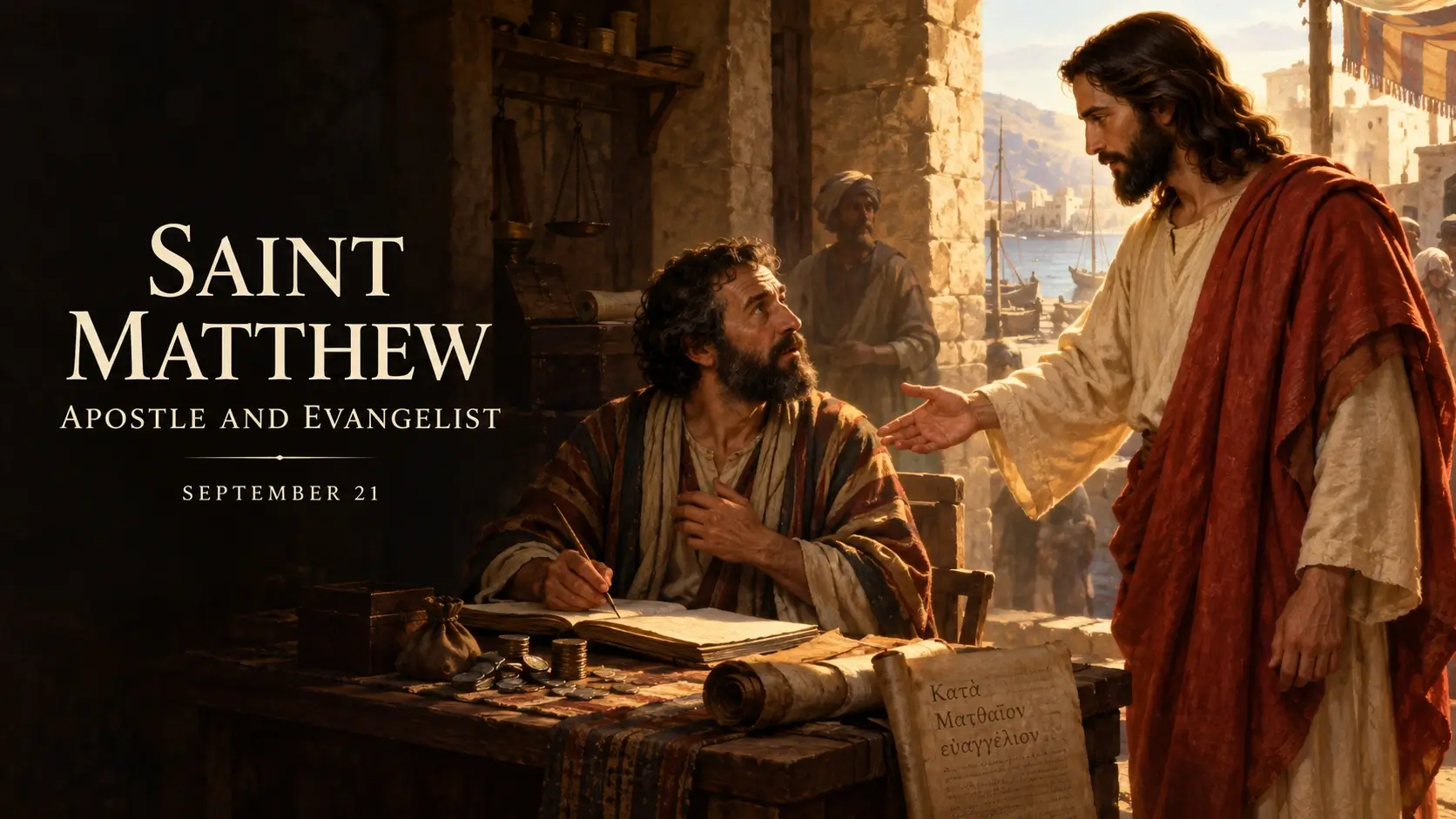
The call of Saint Matthew begins with a short command and an immediate response.
Jesus sees Matthew sitting at the customs post and says, “Follow me.” Matthew gets up and follows Him. There is no long explanation in the Gospel, no record of conditions being negotiated, and no attempt to defend the life he is leaving behind.
This brief encounter reveals the mercy of Christ and the possibility of conversion. Jesus sees more than Matthew’s occupation, reputation, and past decisions. He sees a man who can become a disciple, an apostle, and a witness to the Gospel.
On September 21, the Church celebrates the Feast of Saint Matthew, Apostle and Evangelist. His story invites us to hear Christ’s call within the ordinary circumstances of our own lives and to respond without allowing the past to decide our future.
Matthew at the customs post
Matthew worked as a tax collector. Under Roman rule, tax collectors were widely distrusted and often regarded as collaborators and public sinners. Their work also created opportunities for dishonesty and personal enrichment.
Yet this is where Jesus meets Matthew. Christ does not wait for him to repair his reputation or prove that he deserves another beginning. He approaches Matthew at the place where his old life is still visible.
The Gospel does not suggest that the customs post was good for Matthew simply because Jesus found him there. Instead, it shows that no place is beyond the reach of grace. Christ can enter the parts of life we would rather hide and call us toward something new.
Matthew’s response is decisive. He rises and follows Jesus. Conversion requires more than recognizing that Christ is near. It asks us to stand up, leave what keeps us from Him, and begin walking in a different direction.
Mercy at the table
After Matthew follows Jesus, the scene moves to a meal. Tax collectors and others labeled as sinners gather at the table with the Lord and His disciples. The Pharisees question why Jesus would associate with such people.
Jesus answers that those who are well do not need a physician, but the sick do. He then declares that He came to call sinners.
This does not mean that sin is unimportant. A physician approaches the sick because healing is needed. Jesus welcomes sinners because He desires their conversion and restoration. His mercy does not leave us trapped in the habits that wound us. It calls us into a changed life.
The table also challenges the way we view other people. We may find it easy to define someone by a mistake, a reputation, or a difficult chapter in their life. Jesus sees what grace can still accomplish.
If Christ had treated Matthew only as society treated him, Matthew would have remained at the customs post. Mercy made room for a different future.
A calling within ordinary life
Matthew was not praying in the Temple when Jesus called him. He was working.
This detail matters because many people expect God’s call to arrive only during extraordinary spiritual moments. Christ certainly speaks through prayer, the sacraments, and Scripture. He can also interrupt an ordinary day with an invitation to act differently.
The call may be to forgive someone, return to Confession, end a dishonest practice, serve the parish, care for a family member, or finally make time for daily prayer. It may require leaving something behind, even when that something has become familiar or profitable.
Matthew teaches us that discernment should not become a way of indefinitely postponing obedience. Once the direction is clear, faith must become action.
From collecting accounts to proclaiming the Gospel
The tax collector who once recorded debts became an apostle who announced God’s mercy.
Catholic tradition honors Matthew as both an Apostle and an Evangelist. The Gospel bearing his name presents Jesus as the fulfillment of God’s promises and emphasizes His teaching, including the Sermon on the Mount and the command to make disciples of all nations.
Matthew’s transformation shows what Christ can do with a surrendered life. God does not merely erase the past. He can redirect our abilities toward service.
The discipline Matthew once used in his work could now serve the proclamation of the Gospel. His familiarity with records, language, and public dealings became part of a new mission. Grace did not destroy the person Matthew was. It reordered his life around Christ.
This gives hope to anyone who believes that years have been wasted or that previous choices have made them useless to God. Repentance is real, consequences may remain, and restitution may be necessary. Still, Christ can bring genuine good from a life placed in His hands.
“Follow me” is also addressed to us
The feast of Saint Matthew is not only a remembrance of something that happened long ago. The words of Jesus remain personal: “Follow me.”
Following Christ begins again each day. We follow Him when we choose honesty over convenience, patience over anger, generosity over self-protection, and prayer over constant distraction.
We also follow Him by welcoming people who are sincerely trying to return to God. A parish should never make repentance harder through gossip, suspicion, or permanent labels. Christian communities must protect the vulnerable and take wrongdoing seriously, but they must also believe in conversion.
Matthew’s place among the Apostles is evidence that the Church is built from people called and changed by mercy.
Saint Matthew and the Rosary
The call of Matthew is not one of the traditional mysteries of the Rosary, yet his response helps us understand how the Rosary should shape our lives.
In every mystery, Mary directs our attention to Jesus. We contemplate His life so that we may follow Him more faithfully. Prayer is not meant to leave us sitting where we were. It should make us more ready to respond when Christ asks something of us.
As we pray today, we can ask for the courage to leave behind whatever keeps us at a distance from Jesus. We can also pray for people who believe they are unworthy of returning to Him.
Prayer to Saint Matthew
Saint Matthew, Jesus called you from the customs post and you rose to follow Him.
Pray for us when we are hesitant to change, attached to old habits, or ashamed of our past. Help us trust the mercy of Christ and respond when He calls.
Intercede for those working in finance, government, accounting, and public service. May they carry out their responsibilities with honesty, justice, and concern for the common good.
Teach us to welcome those seeking a new beginning and to recognize what God’s grace can accomplish in every life.
May our prayer lead to action, our repentance bear good fruit, and our daily work become a place where we encounter and serve Jesus.
Saint Matthew, Apostle and Evangelist, pray for us. Amen.
A simple act for today
Read Matthew 9:9–13 slowly. Ask Christ to show you the customs post from which He is calling you to rise.
Then take one concrete step. Make the call, offer the apology, schedule Confession, begin the prayer, or correct the practice you know must change.
Christ’s invitation is merciful, but it is not vague: “Follow me.”
Sources
Related Articles